
About this story
On 17 August 1970 the Soviet Union launched Venera 7 from Baikonur toward Venus, aiming to land a reinforced probe and return even a brief surface signal. Built under Georgy Babakin at Lavochkin, the mission faced extreme heat and pressure. On 15 December 1970 it entered the atmosphere, landed, and sent a faint transmission that confirmed a robotic spacecraft could speak from Venus.
Venera 7 began its Venus mission after launch from Baikonur on 17 August 1970.
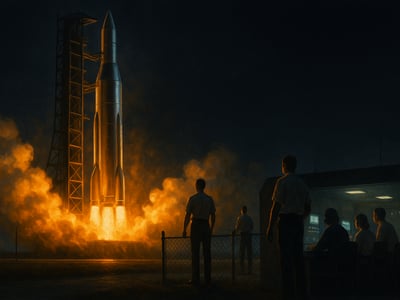
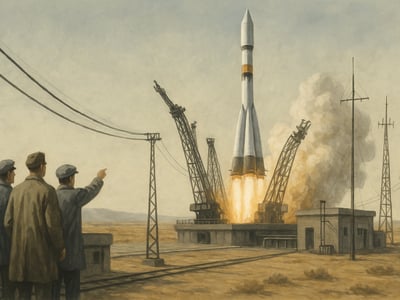
On August 17, 1970, the Soviet Union launched Venera 7 from Baikonur Cosmodrome in the Kazakh SSR, sending a heavily reinforced spacecraft toward Venus. The launch was one step in the broader Venera program, but it carried a particularly demanding goal. Engineers were not simply trying to reach another planet. They were trying to send a lander into an atmosphere dense and hot enough to destroy ordinary spacecraft, and to keep it functioning long enough to return even a brief signal from the surface.
Launch toward a hostile world
By 1970, Venus had already become one of the most difficult targets in planetary exploration. Earlier Soviet attempts in the 1960s had shown how hard the problem was. Reaching the planet was only the first challenge. A probe then had to survive entry into a thick atmosphere, descend under intense pressure, endure extreme heat, and continue operating after touchdown. Any one of those stages could end a mission. A failure might mean silence, with no way to repair the spacecraft and little immediate evidence of what had gone wrong.
Venera 7 was built in that context. The spacecraft was developed by the Lavochkin design bureau under chief designer Georgy Babakin, whose team had to work within severe technical limits while planning for conditions on Venus that were still being refined through observation and earlier missions. The central idea behind the mission was straightforward but difficult to realize: make the lander strong enough to withstand Venus long enough to send data home. That meant accepting trade-offs in weight, systems, and mission design in favor of survival.
Designing a lander to survive Venus
The mission architecture reflected that choice. Instead of aiming for a long and complex surface operation, Venera 7 was designed around the possibility that only a narrow window might exist between arrival and failure. In practical terms, success did not require hours of activity or a large stream of information. It required proof that a spacecraft could descend to the surface of Venus and still communicate with Earth afterward.
After launch, the spacecraft began its interplanetary cruise. For months, its success depended on systems operating far from Earth with no possibility of intervention. This quiet middle phase of a planetary mission often receives less attention than launch or landing, but it is where many missions are won or lost. Guidance, communications, power, and thermal control all had to continue working as planned while Venera 7 crossed the space between Earth and Venus.
Cruise, descent, and a faint surface signal
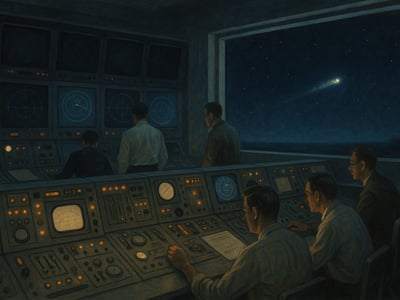
All of that preparation led to the decisive day: December 15, 1970. Venera 7 entered the Venusian atmosphere and began its descent. Atmospheric entry at Venus was itself a test of engineering judgment. The probe had to absorb extraordinary stress, then continue descending through conditions that became harsher as it approached the ground. Even if it survived the fall, the landing impact and the immediate environment on the surface posed one final threat.
The result was not a smooth or dramatic flood of data. Instead, the signal received on Earth after landing was weak and brief. By the standards of later planetary missions, it was limited. But in the context of 1970, it was historic. That faint transmission was later interpreted as data sent from the surface of Venus itself. In other words, the mission had done the one thing it most needed to do: it had shown that a robotic spacecraft could reach Venus's surface and send a signal back.
A fragile first in planetary exploration
That outcome mattered because it came so close to failure at multiple points. The launch could have failed. The spacecraft could have been lost during cruise. The descent system could have broken down in the atmosphere. The landing could have destroyed the probe outright. Or the lander might have survived physically but been unable to communicate. Venera 7 succeeded in a narrow and fragile way, but sometimes that is how a genuine first happens in exploration. A short, imperfect result can still redraw the boundary of what is possible.
The mission also stood within a larger Soviet scientific effort during the period when the Academy of Sciences was led by Mstislav Keldysh. The Venera program was not a single isolated attempt but a continuing campaign to understand a nearby world that had proved far more hostile than many early planetary models assumed. Each mission added experience, and each failure forced revisions. Venera 7 represented the value of that cumulative work: lessons from earlier losses were turned into a design focused on endurance under extreme conditions.
Why it still matters
Venera 7 remains important because it established a new threshold in planetary exploration. Before it, landing on another planet and returning data from the surface remained unproven. After it, the concept had been demonstrated, even if only briefly. That changed how engineers and scientists could think about robotic exploration of harsh worlds.
The mission also showed that success in space exploration is not always measured by quantity alone. Venera 7 did not return a long stream of readings, but the signal it sent was enough to confirm that the mission architecture had worked. In a place as unforgiving as Venus, a marginal outcome could still be a major technical achievement.
Its example shaped later Venus exploration as well. The mission revealed both the possibilities and the narrow margins involved in operating on the planet's surface. Later probes benefited from the knowledge that survival there was achievable, but only with careful design and a clear understanding of the environment. In that sense, Venera 7 was both a first success and a reminder of how exacting planetary exploration can be.
The story of its launch on August 17, 1970, is therefore larger than a single departure from Baikonur. It marks the beginning of a mission built around a difficult idea: that even on one of the harshest worlds in the Solar System, a spacecraft might survive just long enough to speak.
Timeline
- Venera 7 launch from Baikonur
- Venera 7 Venus entry and landing
- Post-landing signal received from Venus
What you uncovered
Built for Bare Survival
You didn't just… complete a space-history puzzle; you traced the start of a mission built around surviving Venus just long enough to return even a faint signal from the surface.
What made this launch significant was not only its destination, but the logic behind the spacecraft itself. Venera 7 was engineered for a very narrow goal: endure an environment so hostile that even a short transmission would count as success. That approach shows how exploration often advances not through perfect results, but through systems designed to extract meaning from extreme constraints.
Venera 7 reached the surface of Venus on 15 December 1970, and the weak signal received afterward was later interpreted as limited data sent from the planet's surface.
FAQ
When was Venera 7 launched toward Venus?
Venera 7 was launched on 17 August 1970 by the Soviet Union from Baikonur Cosmodrome toward Venus.
Who developed Venera 7?
The spacecraft was developed by the Lavochkin design bureau under chief designer Georgy Babakin.
When did Venera 7 reach Venus?
Venera 7 entered the Venusian atmosphere and reached the planet's surface on 15 December 1970.
What made Venera 7 historically significant?
After landing, Venera 7 sent back a weak signal that was received on Earth and later interpreted as limited data from the surface of Venus. It was part of the Soviet Venera program and marked a breakthrough in transmitting data from another planet's surface.