

About this story
Amnesty decision proclaimed in Slovakia on 7 July 1998 under powers exercised by Vladimír Mečiar.
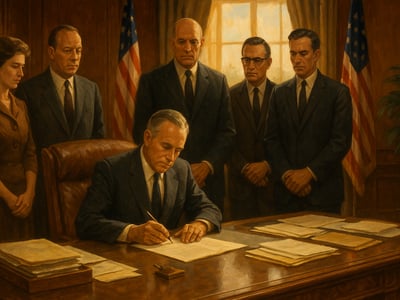
On 7 July 1998, Slovakia proclaimed an amnesty decision issued by Prime Minister Vladimír Mečiar while he was exercising certain presidential powers. The step became one of the most disputed legal acts of post-independence Slovakia because it concerned politically charged events already at the center of public conflict: the 1995 abduction of Michal Kováč Jr. and the troubled 1997 referendum process. Although the exact legal scope belongs to the text of the decision itself, the act was widely understood as extending protection in matters linked to those cases.
To understand why that date mattered, it helps to look at the atmosphere in Slovakia during the second half of the 1990s. The country was still shaping its institutions after independence, and relations between major constitutional offices were tense. Political rivalry was not only a matter of speeches or parliamentary votes. It also affected how state institutions functioned, how public authority was used, and how much trust citizens placed in official procedures.
One of the most serious episodes came on 31 August 1995, when Michal Kováč Jr., the son of President Michal Kováč, was abducted and taken to Hainburg an der Donau in Austria. The case quickly became more than a criminal matter. Because of suspicions and allegations surrounding possible involvement by state-linked actors, it developed into a major political crisis. It raised difficult questions about whether investigators would be able to work independently and whether responsibility, if established, could reach beyond ordinary criminal networks.
Another institutional conflict followed in 1997. On 23 May of that year, a referendum was held in Slovakia amid disputes over the wording and handling of a question concerning direct presidential election. The referendum became controversial not only for its political context but also for what it suggested about the management of democratic procedures in a polarized environment. By then, the country was already experiencing sharp disagreements over the balance of power among the government, the presidency, and other state bodies.
A further constitutional complication arrived on 2 March 1998, when President Michal Kováč’s term ended without a successor being elected. Under that situation, some presidential powers were exercised temporarily by other constitutional officials, including Prime Minister Vladimír Mečiar. This transfer of authority was formally grounded in the constitutional framework, but it also created an unusual concentration of influence at a politically sensitive moment. Powers designed for continuity of the state were now being used in the middle of unresolved and controversial cases.
An amnesty decision associated with what later became known collectively as the Mečiar amnesties was issued on 23 May 1998. Then came the decision proclaimed on 7 July 1998, widely described as broadening or clarifying coverage in ways that affected the 1995 abduction case and acts connected with the 1997 referendum. In practice, this mattered because amnesty is not simply symbolic. It can stop or prevent criminal proceedings, affect the collection and use of evidence, and narrow the path toward judicial review.
That is why the second decision drew such attention. Supporters of amnesty powers can argue that they are legal instruments available within a constitutional system. Yet this particular use of those powers immediately touched a more difficult issue: what happens when an executive act intersects with cases in which the state itself, or people close to political power, may be under scrutiny? In such a situation, the question is no longer only whether an act is formally issued under proper authority. It is also whether that act closes off the ordinary mechanisms through which facts could be established.
The July 1998 proclamation sharpened a conflict that would remain alive for years. On one side stood the principle that constitutional powers, once validly exercised, produce legal consequences. On the other stood a public demand that serious allegations connected to the abuse of power should not be sealed off before courts and investigators can fully test them. For many observers in Slovakia, the issue became a symbol of the gap that can open between formal legality and the broader expectation of accountability.
The cases linked to the amnesties did not fade into obscurity. Instead, they became reference points in legal argument, political memory, and public debate. The name “Mečiar amnesties” itself came to represent more than one document. It referred to a larger controversy about how temporary constitutional authority had been used, and about whether later institutions could respond to acts that had already interrupted the usual path of criminal justice.
Why it still matters
The events of 7 July 1998 still matter because they show how a decision made during a temporary constitutional arrangement can shape public life for decades. Slovakia’s debate over the amnesties was not only about one prime minister or one presidency. It became a test of how a democratic state handles the tension between executive discretion and legal accountability.
The case is often cited in discussions about whether pardon and amnesty powers need clearer limits, especially when they touch politically sensitive investigations. Such powers exist in many constitutional systems, but the Slovak example showed how powerful they can be when used at the wrong moment or in the wrong context. Once an amnesty blocks proceedings, the consequences can be long-lasting, even if public controversy continues.
It also remains important because the amnesties became part of a longer institutional struggle over whether later bodies could revisit executive acts that had interrupted accountability efforts. That question reached beyond the immediate personalities involved. It concerned the resilience of constitutional order itself: whether democratic institutions can correct decisions that are legally issued yet widely seen as obstructing justice.
In that sense, the second amnesty decision proclaimed on 7 July 1998 stands as a lasting reference point in modern Slovak history. It marks a moment when law, politics, and trust in institutions collided in a particularly visible way, and when the use of temporary constitutional power left effects far beyond the day it was announced.
Timeline
- Michal Kováč Jr. abduction
- Slovak referendum
- Presidential powers exercised by Vladimír Mečiar
- Amnesty decision issued
- Amnesty decision proclaimed
What you uncovered
Temporary Power, Lasting Effects
You didn't just… complete a puzzle; you traced how a temporary shift in constitutional authority could influence whether sensitive cases moved toward accountability or were stopped.
One reason this episode still resonates is that it shows how procedural authority can matter as much as political intent. A temporary transfer of presidential powers created a lawful mechanism whose effects could outlast the moment that produced it. That tension helps explain why the case became a reference point in debates about limits on amnesty and clemency powers when they touch politically sensitive investigations.
From 2 March 1998, Vladimír Mečiar exercised certain presidential powers after President Michal Kováč's term ended without a successor being elected.
FAQ
What happened on 7 July 1998 in Slovakia?
On 7 July 1998, an amnesty decision was proclaimed in Slovakia. It is widely described as extending coverage to acts linked to the 1997 referendum and the Michal Kováč Jr. abduction case.
Who issued the 1998 amnesty decision?
Vladimír Mečiar issued it while exercising certain presidential powers in Slovakia. He began doing so on 2 March 1998, after President Michal Kováč's term ended without a successor being elected.
What cases was the amnesty connected to?
It was associated with the broader Mečiar amnesties and with events linked to the 1997 referendum and the 1995 abduction of Michal Kováč Jr. The precise legal scope should be verified in the primary text.
Why is this amnesty still controversial?
Because it affected whether controversial cases could continue toward investigation or prosecution. It remains a major example of how temporary constitutional powers can influence criminal justice and public trust.