
About this story
On 20 August 1848 railway traffic began on the Marchegg–Bratislava line, giving Bratislava its first operating connection to the steam-rail system spreading across the Habsburg Monarchy. By joining the Northern Railway network at Marchegg toward Vienna, the city entered a wider transport web that reshaped trade, travel, and regional geography.
Start of traffic on the Marchegg–Bratislava railway line, 20 August 1848
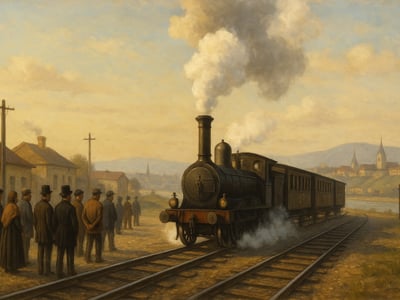
On 20 August 1848, railway traffic began on the Marchegg–Bratislava line, giving Bratislava its first operating connection to the steam-rail system that was spreading across the Habsburg Monarchy. The new route linked the city with Marchegg, where it joined the Northern Railway network oriented toward Vienna. What opened that day was not simply a local stretch of track. It was Bratislava's entry point into a much larger transport system that was beginning to reorder movement, trade, and the practical geography of Central Europe.
Bratislava joins the steam-rail age
By the middle of the 19th century, railways had become one of the defining technologies of the age. Rivers and roads still mattered, but they no longer set the only rhythm of travel and freight. In the Habsburg lands, as elsewhere in Europe, the expanding rail map gradually altered which towns were easy to reach, which markets were worth serving, and which places gained new strategic importance. For a city like Bratislava, long connected to surrounding regions by the Danube and by overland routes, a railway link promised something different: regular, faster, and more predictable connection to the main corridors of the monarchy.
That promise depended on completing a line across administrative and investment boundaries and then bringing it into operation at a moment that was far from calm. The year 1848 was marked by political upheaval across the Habsburg world and beyond. In such a setting, large infrastructure projects could face delays, financial uncertainty, or shifting official priorities. The opening of the Marchegg–Bratislava line therefore reflected a practical commitment by railway backers and public authorities to continue extending the network despite instability. Had the project stalled, Bratislava would have remained outside the fast-growing web of steam transport that was beginning to connect major urban centers.
Why Marchegg mattered as a junction
The importance of Marchegg lay in its position as a junction point rather than as an endpoint in itself. Once Bratislava was connected there, the city gained access to the wider Northern Railway system associated with Vienna. This mattered because early railways worked as networks, not isolated inventions. A single short line could be transformative if it joined a city to routes already carrying passengers, goods, and information over longer distances. In that sense, the beginning of traffic on the line marked the moment when Bratislava ceased to be merely near the railway age and actually became part of it.
For travelers, the new connection changed expectations. Journeys that had depended heavily on road conditions, seasonal constraints, or slower modes of movement could increasingly be planned around timetables. For merchants and suppliers, rail service offered new possibilities in the movement of goods. Even when immediate changes were modest, the direction was clear: once a city entered a railway network, it became easier to imagine wider commercial ties, more regular exchange, and a different scale of regional interaction.
Opening a line amid the upheavals of 1848
The line also mattered in relation to the larger transport axis that would link Vienna and Budapest more closely over time. Bratislava stood between important political and economic centers, and rail infrastructure heightened the practical significance of that position. A city connected by steam rail could function more effectively within a multi-centered monarchy in which communication and circulation increasingly depended on modern transport. The Marchegg line therefore reduced Bratislava's relative isolation not by replacing older routes overnight, but by adding the city to a new framework of mobility whose importance would keep growing.
As with many railway openings, the consequences unfolded over years rather than in a single dramatic instant. Tracks alone did not transform urban life immediately. But they created conditions in which change could accumulate. Better access could influence trade patterns, encourage related construction, alter where goods were handled, and gradually reshape how residents and officials understood the city's place within the region. In 19th-century Europe, railway access often became part of a broader process of urban modernization, and Bratislava's new connection fit that pattern.
Networks, markets, and a city’s new position
The opening is also notable because it brought steam-rail service to the city. That fact had symbolic weight as well as practical value. Steam railways represented speed, engineering, schedule, and system. Their arrival signaled participation in a technological order that was becoming central to public life and state administration. To be connected by rail was to be drawn into a new kind of spatial logic, one in which distance was measured not only in kilometers but in travel time and network access.
Why it still matters
The start of railway traffic on the Marchegg–Bratislava line remains important because it shows how infrastructure can change a city's role without changing its location. Bratislava did not move, but its position within the Habsburg Monarchy became different once it was linked to a functioning rail network. That is a useful reminder that transport systems do more than carry passengers and freight. They reorganize relationships between places.
The event also offers a clear example of how 19th-century railways integrated cities into larger economic and administrative systems. A connection to Marchegg meant access to Vienna-oriented circulation and, through that, to broader patterns of exchange. In historical terms, such links helped shape which cities expanded their commercial reach and which became more tightly tied to state and regional structures.
Finally, the line's opening illustrates an early form of cross-regional network building within a complex monarchy. Railway development required coordination, investment, and confidence that a local segment would matter because it belonged to something larger. On 20 August 1848, Bratislava gained more than a train service. It gained an operational place in a network that would help define the modern history of movement, commerce, and urban development in the region.
Timeline
- Development of the Northern Railway in the Habsburg Monarchy
- Growth of rail links between Vienna and Budapest
- Railway traffic begins on the Marchegg–Bratislava line
- Creation of the Hungarian Central Railway network
What you uncovered
A City Enters the Network
You didn't just… complete a puzzle; you traced the moment Bratislava became part of a much larger rail system.
An opening date like this marks more than the start of service on a single line. It shows when a city became connected to a wider technological and administrative network that could redirect trade, travel, and daily rhythms. Railways did not simply shorten journeys; they changed how urban places were positioned within larger systems.
The new line connected Bratislava to Marchegg, where it joined the Northern Railway network oriented toward Vienna.
FAQ
When did railway traffic begin on the Marchegg–Bratislava line?
Railway traffic began on 20 August 1848. That date marks the opening of the Marchegg–Bratislava line.
What did the opening of the Marchegg–Bratislava line connect?
It connected Bratislava with Marchegg. At Marchegg, the line joined the Northern Railway network associated with Vienna.
Was this Bratislava’s first rail connection?
The opening is described as Bratislava’s direct rail link into the wider Habsburg railway system. It also marked the arrival of steam-rail service in Bratislava.
Why is the 1848 railway opening in Bratislava important?
It reduced Bratislava’s transport isolation within the Habsburg Monarchy. The new rail connection also created conditions for later commercial and urban change.