
About this story
On 19 August 1942 Allied forces launched Operation Jubilee, a one-day raid on German-held Dieppe on the French Channel coast. About 6,100 troops, mostly Canadian, aimed to strike fast, gather intelligence, and withdraw. Timing broke down on the beaches under intense fire; by nightfall evacuation under pressure left heavy losses and a costly lesson for later amphibious planning.
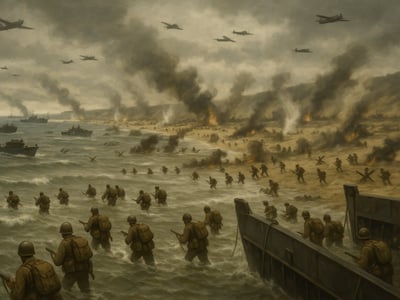
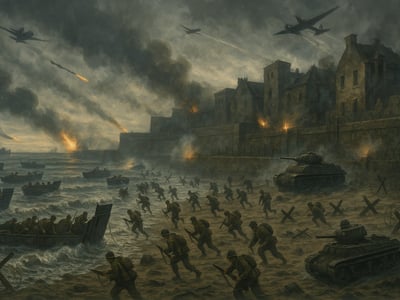
Operation Jubilee at Dieppe, where Allied forces withdrew on 19 August 1942 after heavy losses.
On 19 August 1942, Allied forces carried out Operation Jubilee, a raid against the German-held port of Dieppe on the French Channel coast. The force numbered about 6,100 personnel, including nearly 5,000 Canadians, supported by ships and aircraft. It was planned as a fast strike: land before dawn, hit selected objectives, gather intelligence, damage defenses and facilities, and withdraw before German forces could fully react. Instead, by the end of the same day, the attackers had pulled back after heavy losses, leaving many dead, wounded, and captured.
Planning a fast strike on a defended port
The raid grew out of a period when the Western Allies were under pressure to find ways of taking the fight back to occupied Europe. Combined Operations, overseen by Lord Louis Mountbatten, had been developing methods for amphibious attacks against defended coasts. An earlier plan, Operation Rutter, had been cancelled in July 1942, but the idea of a Dieppe raid returned in revised form as Operation Jubilee. In broad terms, the operation was meant to test whether a heavily defended port could be struck directly and whether troops, armor, naval support, and air cover could be coordinated in a short, concentrated assault.
That design depended on speed and timing. Troops were assigned to land on flanking beaches as well as at Dieppe itself. On the eastern flank, near Berneval-le-Grand, and on the western side at Green Beach near Pourville-sur-Mer, the attackers were supposed to suppress batteries and secure approaches. At the same time, assaults at Blue Beach at Puys and on the main Red and White Beaches at Dieppe were intended to open the way for the central force. The largest contingent came from the 2nd Canadian Infantry Division under Major-General John Hamilton Roberts. Naval arrangements were closely tied to the timing of the landings, while air support was intended to shield the force and strike targets around the area.
Before the main assault reached shore, however, the operation had already begun to lose the narrow advantage on which it depended. Fighting during the approach and at some of the flank landings disrupted the schedule and communications. In a raid that relied on several moving parts arriving in sequence, even limited delay mattered. Units that were meant to support one another became less synchronized, and German defenders had more warning than the planners had hoped.
From cancelled Rutter to Operation Jubilee
At Blue Beach at Puys, the situation became especially difficult. Troops landing there faced steep obstacles and concentrated fire from prepared positions. Similar problems appeared elsewhere: narrow beachheads, exposed shingle, limited exits, and strong defensive ground overlooking the shore. The geography around Dieppe favored defenders who could fire onto the beaches and the approaches from the headlands and built-up positions.
The central landing at Dieppe faced the most severe test. Canadian troops coming ashore on the Red and White Beaches met intense fire almost immediately. The beach itself was covered in large shingle, which slowed movement, made men vulnerable in the open, and complicated the handling of equipment. Behind the beach stood a sea wall and defended exits that had to be crossed quickly if the raid was to move inland. Instead, many of the troops were pinned down before they could gain momentum.
Beaches under fire and stalled armor
Churchill tanks of the Calgary Regiment were landed on the main beach, making the raid one of the notable early attempts to use armor in an amphibious assault. Some tanks got ashore, but getting inland was another matter. The beach surface, the obstacles, and the blocked exits sharply limited what they could do. Tanks could provide fire on the waterfront, but they could not solve the underlying problem: the attack was not moving off the beach fast enough. A plan built around rapid penetration and short occupation was turning into a struggle just to survive under sustained fire.
As the morning wore on, the main question changed. Instead of whether the port could be hit and key objectives seized, commanders increasingly had to consider how many troops could still be withdrawn. Communication problems, local confusion, and the difficulty of seeing the whole battlefield from offshore made adaptation hard. Orders had to be made under pressure while units on the beaches faced fire from multiple directions.
Evacuation and a costly day's lessons
Naval forces moved repeatedly into danger to evacuate survivors. The withdrawal later on 19 August 1942 was itself a major operation, carried out while fighting continued and while many men were still trapped near the shore. Some parties on the flanks managed to re-embark more successfully than the central force, but overall the result was severe. By the end of the day, the raid had failed to secure the port and had cost the attackers heavily in killed, wounded, and prisoners.
For Canada, Dieppe became one of the most painful single-day episodes of the war. Because Canadian troops formed the largest part of the landing force, the losses were deeply felt in units, families, and national memory. The event also remained controversial. Historians and participants have long differed over the balance between its intended military value and its human cost, as well as over how far later Allied successes were shaped by lessons drawn from Dieppe.
Why it still matters
Dieppe is still studied because it exposed, in a compressed and costly form, the practical difficulties of attacking a defended coastline. The raid showed how intelligence, beach conditions, direct fire, armored mobility, communications, and command coordination could all determine whether a landing moved forward or stalled immediately. It also demonstrated the risks of trying to seize a port frontally when defenders held the high ground, the exits, and the approaches.
For later Allied planning, the raid became part of a wider body of experience about amphibious warfare. Military institutions have examined it not as a simple template but as a case study in what happens when a tightly timed plan begins to break down at the first point of contact. The interaction between sea, land, and air forces at Dieppe, and the problems created when those elements could not support one another as intended, remained highly relevant as the Allies prepared larger landings in Europe.
Dieppe also matters because its documentary record is unusually rich. War diaries, planning files, naval records, photographs, oral histories, and later analysis continue to shape archival research and public remembrance in Canada, Britain, and beyond. The raid is remembered not only for what happened on a single August day in 1942, but also for the enduring questions it raises about planning, responsibility, and the cost of learning in wartime.
Timeline
- Combined Operations planning for coastal raids
- Operation Rutter cancelled
- Operation Jubilee begins at Dieppe
- Dieppe Raid evacuation under fire
What you uncovered
When Timing Fell Apart
You didn't just… complete a puzzle; you traced how a raid built around speed and coordination could unravel once troops met prepared defenses and lost time, contact, and freedom of movement.
Operation Jubilee is often remembered not only for its losses but for how quickly a plan dependent on exact timing could lose coherence. Once the first delays disrupted communications and movement, each part of the operation became harder to support from the others. That is why the raid remains a useful case study in combined operations: it shows that intelligence, beach conditions, armor, and command links are not separate factors, but parts of the same system under pressure.
Churchill tanks from the Calgary Regiment reached the main beach at Dieppe, but the terrain and obstacles limited their ability to move inland.
FAQ
What was Operation Jubilee at Dieppe?
Operation Jubilee was the Allied raid on the German-held port of Dieppe on 19 August 1942. It was launched against Dieppe on the French Channel coast and ended the same day after heavy losses.
Who took part in the Dieppe Raid?
The raid involved about 6,100 Allied personnel, including nearly 5,000 Canadians. The 2nd Canadian Infantry Division supplied the largest contingent, under Major-General John Hamilton Roberts.
Why did the Dieppe Raid end in heavy casualties?
German defenses covered the beaches, headlands, and port approaches, leaving attacking troops exposed on shingle beaches under direct fire. By the end of 19 August 1942, the attackers had withdrawn after suffering many killed, wounded, and captured.
What happened to the Churchill tanks at Dieppe?
Churchill tanks of the Calgary Regiment were landed on the main Dieppe beach during the raid. The operation’s beach conditions and strong defenses made it difficult for the armor to move inland.
What did the Dieppe Raid mean for later Allied landings?
The raid became an important lesson for later Allied landings in Europe, especially in planning and coordination. It is still studied as a case in amphibious warfare and command coordination.