
About this story
On 22 August 1911 the Louvre in Paris found Leonardo da Vinci’s Mona Lisa missing from the Salon Carré. What first seemed like a temporary removal soon proved to be theft — and the disappearance became an international sensation lasting more than two years.
The Mona Lisa, discovered missing from the Louvre in Paris on 22 August 1911.
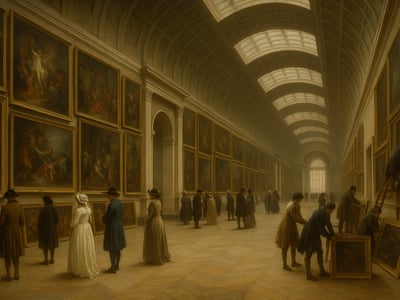
On 22 August 1911, visitors and staff at the Louvre in Paris confronted an absence that would become one of the most famous losses in museum history. Leonardo da Vinci’s *Mona Lisa*, usually displayed in the Salon Carré, was found missing. What had seemed at first like a temporary removal for photography or maintenance soon became something far more serious: the painting had been taken out of the museum.
An empty space in the Salon Carré
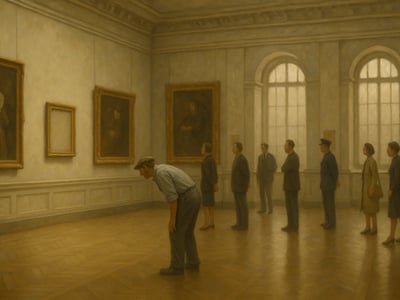
The discovery is closely associated with the painter Louis Béroud, who arrived at the Salon Carré expecting to see the work in its usual place. Instead, he found the space empty. At first, this did not automatically mean theft. In a large museum, paintings could be moved by staff for practical reasons, and the Louvre’s routines did not immediately point to a crime. But as checks continued, it became clear that the panel was not being photographed, cleaned, or reframed. It was gone.
That uncertainty in the first moments helps explain why the theft was not stopped earlier. The *Mona Lisa* was a relatively small panel painting in an institution that managed vast collections, frequent movement of objects, and work by many employees and contractors. The Louvre was also closed on Mondays, a detail that mattered to later reconstructions of the theft. By the time the absence was fully confirmed on Tuesday, investigators had to work backward, asking not only who had taken the painting, but when it had actually left the building.
Officials closed the Louvre for a week while the disappearance was investigated. The closure itself signaled the seriousness of the event. Police examined the gallery spaces, questioned employees, and tried to reconstruct the route by which the painting might have been removed. Attention focused on the practical problem at the center of the case: how could a work by Leonardo da Vinci have been taken from one of Europe’s best-known museums without immediate detection?
Investigation and the Louvre’s closure
The answer, as it emerged later, depended less on force than on familiarity. Vincenzo Peruggia, an Italian glazier and former Louvre employee, was eventually identified as the man who had taken the painting. According to the established account of the case, he used his knowledge of museum routines to remove the panel and leave the building with it. The theft did not require an elaborate break-in from outside; it appears to have relied on access, timing, and the ability to pass through a working museum without attracting notice.
For more than two years, however, the public did not know that. In Paris, the disappearance quickly became a major news story. Newspapers reported each development, and the missing painting became a subject of intense curiosity. The blank space on the wall was itself transformed into an object of attention. People came to the Louvre not to see the *Mona Lisa*, but to see where it had been. That reaction revealed something important about modern museum culture in the early twentieth century: an artwork’s public life could be reshaped not only by scholarship or display, but by the mechanics of publicity.
Press, sensation, and international attention
The investigation produced speculation, false leads, and wide interest. Because the painting was so recognizable in reproduction, its disappearance was easy to narrate and easy to circulate through the press. Illustrated newspapers and other forms of mass media helped turn the theft into an international story. The crime was not simply a matter for police files or museum administrators. It became part of public conversation across borders.
Meanwhile, the painting remained hidden. Peruggia kept the *Mona Lisa* concealed for more than two years. The case was broken only when he tried to return or sell the work in Florence in December 1913. On 10 December 1913, the art dealer Alfredo Geri received a letter from a man offering to bring Leonardo’s painting to Florence. That letter moved the story from rumor and long uncertainty toward verification.
Geri did not act alone. The offer led to a meeting in Florence, where the painting could be examined. On 12 December 1913, Giovanni Poggi, director of the Uffizi, inspected the recovered panel. His examination helped confirm that the work was indeed the missing *Mona Lisa*. After that confirmation, Peruggia was arrested.
Florence, exposure, and return
The recovery brought the long episode to a close, but it also changed the meaning of the theft. The *Mona Lisa* was no longer just a Renaissance portrait in a major museum collection. It had become the center of a modern media event, discussed in relation to crime, national ownership, museum procedure, and celebrity. The painting was eventually returned to France, and the Louvre regained the work that had been missing since August 1911.
It is important to be careful about motives in recounting the case. Peruggia later gave explanations for his actions, but historians have treated some of the larger myths around those claims with caution. What can be stated firmly is simpler: a former Louvre employee removed the painting, hid it, and was discovered after attempting to place it in Florence. That sequence is enough to explain why the case has remained so durable in public memory.
Why it still matters
The theft of the *Mona Lisa* remains a reference point in the history of museum security because it exposed how vulnerable even major institutions could be when routines, staff access, and assumptions went untested. The case is often recalled not because it involved the most technically complex theft, but because it revealed how ordinary procedures could create opportunity.
It also matters as an episode in the history of mass media. Press coverage did more than report the disappearance: it amplified it. Reproductions, headlines, and international reporting helped focus public attention on a single object in a way that earlier generations could not have done so quickly. The case shows how an artwork’s fame can be shaped by circulation, narrative, and repeated public exposure.
Finally, the story illustrates how display, loss, and recovery affect the status of cultural objects. A painting hanging in a gallery belongs to one kind of public world; a painting that vanishes, is searched for, and then reappears belongs to another. The *Mona Lisa*’s place in global culture was not created by the theft alone, but the events set in motion in August 1911 undeniably altered its public history. The empty space in the Salon Carré became, for a time, almost as meaningful as the portrait itself.
Timeline
- Mona Lisa reported missing from the Louvre
- Offer to return the Mona Lisa sent in Florence
- Recovered painting examined in Florence
What you uncovered
Fame Through Absence
You didn't just… piece together a famous art theft; you retraced the moment a missing painting became a public event far beyond the Louvre.
The theft mattered not only because a work was taken, but because newspapers, reproductions, and cross-border reporting kept its absence in circulation. For many people, the Mona Lisa became newly recognizable through the story of it being missing rather than through a prior museum visit. The case shows how publicity, recovery, and institutional response can change the public status of an artwork as much as the object itself.
The Louvre closed for a week after the disappearance was discovered while officials investigated how the painting had been removed.
FAQ
What happened at the Louvre on 22 August 1911?
On 22 August 1911, painter Louis Béroud reported that Leonardo da Vinci's Mona Lisa was missing after arriving in the Salon Carré at the Louvre in Paris. Officials then confirmed that the painting had been removed from the museum.
Who stole the Mona Lisa from the Louvre?
The thief was identified as Vincenzo Peruggia, an Italian glazier and former Louvre employee. He was later linked to the theft after trying to sell the painting in Florence in December 1913.
How long was the Mona Lisa missing?
The Mona Lisa was missing for more than two years. It was taken in 1911 and reappeared in connection with events in Florence in December 1913.
When was the Mona Lisa recovered in Florence?
The painting was examined in Florence on 12 December 1913 by Giovanni Poggi, director of the Uffizi. That inspection took place before Peruggia was arrested.
Why did the Louvre close after the theft?
The Louvre closed for a week after the disappearance was discovered while officials investigated the removal of the painting. The closure was part of the response to the theft.