
About this story
On 21 August 1968 Czechoslovakia woke to a Warsaw Pact invasion that had begun overnight without the consent of its leadership. Troops from the Soviet Union, Poland, Hungary, and Bulgaria seized transport routes, communications hubs, and political sites across the Czech lands and Slovakia, interrupting the Prague Spring reform movement within hours.
Warsaw Pact forces occupy sites in Czechoslovakia, including Slovak cities, on 21 August 1968
On 21 August 1968, Czechoslovakia woke to the reality that the Prague Spring reform movement had been interrupted by military force. During the night of 20–21 August, troops from the Soviet Union, Poland, Hungary, and Bulgaria crossed the country’s borders without the consent of the Czechoslovak leadership. By morning, key transport routes, communications hubs, and political sites were under the control of the invading armies in both the Czech lands and Slovakia.
An overnight intervention across the republic
The invasion was the climax of months of tension inside the Eastern Bloc. Earlier in 1968, the leadership around Alexander Dubček had introduced a reform program that loosened censorship, widened public discussion, and promised what became known as “socialism with a human face.” These changes did not remove the Communist Party from power, but they did suggest that a communist state might follow a less rigid political path. For leaders in Moscow and some allied capitals, that possibility raised fears that Czechoslovakia could weaken bloc discipline and encourage similar demands elsewhere.
Pressure had been building for weeks. Soviet and allied representatives warned the Czechoslovak leadership that reforms were moving too far and too fast. Meetings between party leaders became increasingly tense, including the gathering that produced the Bratislava Declaration on 3 August 1968. On paper, that declaration affirmed socialist unity. In practice, it did not remove the growing distrust between the reforming Czechoslovak leadership and those who were considering direct intervention.
When the invasion began, speed was essential to its planners. In the early hours of 21 August, Soviet forces secured Prague’s Ruzyně Airport, allowing additional aircraft, troops, and equipment to arrive quickly. Similar logic shaped operations across the country. Roads, broadcast facilities, administrative centers, and other strategic points were taken before the state could organize any coordinated response. In Slovak territory as well as in Prague and other Czech cities, the immediate effect was the same: the country’s political leadership still existed, but its practical freedom of action was disappearing by the hour.
From reform pressure to armed control
That created the central human dilemma of the day. Dubček, President Ludvík Svoboda, Prime Minister Oldřich Černík, and other leaders had to decide whether any call for active resistance might lead to large-scale civilian casualties. Czechoslovakia had its own state institutions, but it could not realistically meet the invasion with force. Tanks and troops were already in control of crucial positions, and the possibility of bloodshed was immediate. In this setting, restraint was not a sign that the intervention had been accepted; it reflected the imbalance between an unprepared state and a coordinated multinational military action.
Publicly, one of the most important early responses came from the Presidium of the Communist Party of Czechoslovakia. On 21 August it issued a statement declaring that the intervention had taken place without the knowledge of the state’s constitutional organs. That wording mattered. It rejected any claim that the entry of foreign troops had been legally invited by the Czechoslovak authorities. At the same time, it showed how quickly the crisis had moved beyond normal political procedure. A state that had been debating reform only hours earlier was now forced to assert, under occupation conditions, that it had not consented to the presence of foreign armies.
Leaders under occupation and public response
Events then moved even further out of Czechoslovak hands. Dubček, Černík, and other leading figures were detained and later taken to Moscow. Their removal shifted the crisis from a domestic political struggle to an imposed international settlement. The question was no longer simply how far reform could go inside Czechoslovakia. It had become whether the country’s leaders would be allowed to act independently at all.
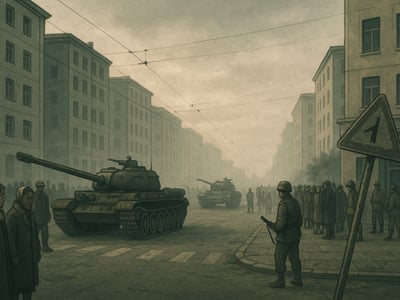
For ordinary people, the invasion was experienced locally and immediately. Troops in city streets, military vehicles at strategic intersections, and uncertainty around radio and official communication made the scale of the intervention unmistakable. In Slovak urban centers including Bratislava and Košice, as elsewhere in the republic, the presence of foreign forces turned a political dispute among party leaders into a visible fact of daily life. Many civilians responded through protests, public discussion, symbolic acts of non-cooperation, and efforts to preserve reliable information as confusion spread.
From invasion day toward imposed settlement
The intervention also revealed divisions within the socialist camp. Romania did not participate in the invasion, and Albania condemned the action before withdrawing from the Warsaw Pact structure shortly afterward. That did not change the outcome on the ground in Czechoslovakia, but it showed that the operation was not supported uniformly across all communist states. Even within a system built on alliance discipline, there were limits to consensus.
In the days that followed, negotiations in Moscow produced terms that marked the end of the Prague Spring as an independent reform experiment. The longer process later known as “normalization” would reverse many of the year’s changes and restore tighter political control. What had begun in 1968 as an attempt to reform socialism from within was now constrained by the demonstrated willingness of allied powers to use military force.
Why it still matters
The invasion of 21 August 1968 remains a key reference point for understanding how power operated inside the Eastern Bloc. It showed that alliance membership did not only provide security; it could also be used to enforce political conformity. The case of Czechoslovakia became central to later discussions about sovereignty, party rule, and the narrow limits within which reform could take place in communist states.
Its memory also remains especially important in the Czech Republic and Slovakia. Archives, public commemorations, and personal testimony continue to shape how 1968 is understood, not only as a dramatic single day but as a turning point that affected political life for decades. The events of that August morning are still studied because they reveal how quickly reform, state authority, and public hope can be overtaken when military power is used to settle a political dispute.
Seen from that perspective, the invasion was not only an episode in Cold War diplomacy. It was also a moment when decisions made at the top of an alliance were felt in streets, homes, and public institutions across an entire country, including Slovakia, within a matter of hours.
Timeline
- Bratislava Declaration
- Night border crossings begin
- Warsaw Pact invasion reaches Czechoslovakia
- Detention of Czechoslovak leaders
- Moscow Protocol negotiations
What you uncovered
When Pressure Became Control
You didn't just…complete a scene from August 1968; you traced the moment when reform was overtaken by armed intervention across both Prague and Slovak territory.
One of the lasting meanings of 21 August 1968 is how quickly pressure inside an alliance system could become direct control on the ground. What had been argued through party meetings and warnings was enforced within hours through airports, roads, communications, and the detention of leaders. That shift helps explain why the invasion remains central to later debates about sovereignty, reform, and the real limits of political independence within the Eastern Bloc.
On 21 August 1968, the Presidium of the Communist Party of Czechoslovakia stated that the intervention had taken place without the knowledge of the state's constitutional organs.
FAQ
What happened on 21 August 1968 in Czechoslovakia?
During the night of 20–21 August 1968, forces from the Soviet Union, Poland, Hungary, and Bulgaria entered Czechoslovakia without the consent of the Czechoslovak leadership. By 21 August, they had occupied key transport, communications, and political sites across the country, including in Slovak urban centers.
Which countries took part in the invasion of Czechoslovakia?
The invasion involved forces from the Soviet Union, Poland, Hungary, and Bulgaria. Romania did not participate, and Albania condemned the action before later withdrawing from the Warsaw Pact structure.
Why did Warsaw Pact troops enter Czechoslovakia in 1968?
The intervention was meant to halt the Prague Spring reform process. The neutral factual record says the invasion began as Warsaw Pact forces crossed into Czechoslovakia to stop the reforms underway there.
What happened to Dubček and other Czechoslovak leaders?
On 21 August 1968, Alexander Dubček, Oldřich Černík, and other Czechoslovak leaders were detained and later transported to Moscow. The Presidium also stated that the intervention had taken place without the knowledge of the state's constitutional organs.