
About this story
On 12 September 1940 four teenagers near Montignac entered a cave and found painted chambers that became Lascaux. Henri Breuil soon classed the images as Upper Paleolithic art. After the war the site opened to crowds, then closed in 1963 when visitor traffic threatened the paintings. The find joined discovery, scholarship, and a lasting lesson in heritage conservation.
Lascaux near Montignac, discovered in 1940 and identified as Upper Paleolithic cave art.
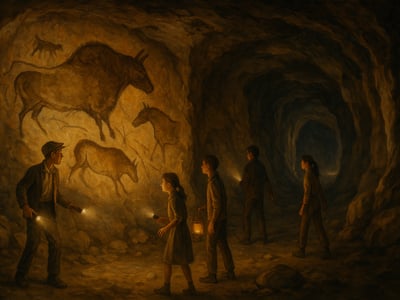
On September 12, 1940, four teenagers near Montignac in the Dordogne region of southwestern France entered a cave and found images that would become some of the most famous works of prehistoric art in the world. Marcel Ravidat, Jacques Marsal, Georges Agnel, and Simon Coencas did not set out that day with a plan to change archaeology. They were exploring locally, in a country already living through the disruptions of wartime, when they came upon an opening that invited a choice: leave it alone, or go down and see where it led.
A shaft near Montignac
That choice was the turning point. A cave opening by itself was not yet a major discovery. It had to be entered, navigated, and understood. Underground, in low light and uncertain conditions, the teenagers faced immediate physical risks. The shaft could have led nowhere useful, or to passages too difficult or dangerous to follow. Even if they found something unusual, there was no guarantee they would recognize its importance.
Instead, they continued. Inside, they encountered decorated chambers covered with painted and drawn figures, along with engravings. The images included many animals, and among the best known spaces later recorded there was the Hall of the Bulls. What the boys had entered was not simply a cave with scattered marks on the wall. It was a major decorated site from the Upper Paleolithic, containing a dense and complex body of imagery.
Hall of the Bulls and recognition
The discovery mattered not only because the images existed, but because the find did not remain a private story. Many important sites are vulnerable in the period immediately after discovery, when they can still be dismissed, misunderstood, or damaged before proper study begins. In Lascaux's case, the next challenge was recognition. The cave had to move from local knowledge to scholarly examination without losing the evidence that made it significant.
Among the early specialists associated with that examination was Henri Breuil, one of the leading prehistorians of his time. He was among those who helped identify and classify the paintings as Upper Paleolithic art. That scholarly work gave the discovery a framework. It connected the cave to broader research on prehistoric societies, artistic techniques, and symbolic expression. Without that step, Lascaux might have remained an extraordinary anecdote rather than a documented archaeological landmark.
From private find to public site
What made Lascaux especially striking was the scale and quality of its decoration. The cave contained hundreds of figures, created through painting, drawing, and engraving. The animal forms, often rendered with a strong sense of movement, became central to later public understanding of prehistoric art. For many people in the twentieth century, Lascaux offered one of the clearest visual challenges to older assumptions that early humans had left behind only crude or purely utilitarian traces. Here was evidence of planning, image-making, and sustained use of symbolic forms deep in prehistory.
As attention to the site grew, Lascaux became far more than a specialist's subject. After World War II, it was opened to the public and developed into a major visitor destination. Large numbers of people came to see the cave for themselves. This broadened awareness of prehistoric art, but it also created a new problem. The same popularity that made Lascaux internationally famous began to threaten the conditions that had preserved it.
Closing the cave to save it
Caves are delicate environments. Temperature, humidity, air composition, and microscopic life can all affect wall surfaces and pigments. Heavy visitor traffic altered that balance. By the early 1960s, concern over deterioration had become serious enough that French authorities closed Lascaux to the public in 1963. The closure marked a significant moment in heritage management: access and preservation could no longer be treated as compatible by default. Protecting the site required limiting direct contact with it.
That decision disappointed many visitors, but it also showed how the meaning of discovery had changed. Finding the cave in 1940 had been only the first stage. Keeping it intact for future study became the longer and more difficult task. Lascaux's history therefore includes both revelation and restraint: first the excitement of entering a hidden chamber, then the realization that public admiration itself could become a source of damage.
Why it still matters
Lascaux remains a reference point in the study of prehistoric art. Researchers continue to use its documentation when discussing Upper Paleolithic imagery, dating questions, and the interpretation of symbolic forms. Even where scholars debate details of meaning or chronology, the cave stands as one of the key comparative sites for understanding how ancient image-making functioned in human societies.
Its conservation history has also had a lasting influence. The problems caused by visitor traffic helped shape modern thinking about fragile archaeological environments. Museums, heritage institutions, and site managers have had to confront a central question that Lascaux made impossible to ignore: how can a place be shared with the public without destroying the conditions that make it valuable?
Part of the answer has come through documentation and replication. Because the original cave could not remain open in the same way, archives, studies, and replicas became essential tools for public presentation. This approach has allowed Lascaux to remain widely known while reducing pressure on the original walls. In that sense, the cave has influenced not only archaeology, but also the broader practice of how cultural heritage is interpreted and presented.
The discovery near Montignac still endures because it joined several histories at once: a local exploration by four teenagers, the scholarly identification of a major Paleolithic site, and a later global debate about preservation. Lascaux is remembered not just for what was painted there long ago, but for what its modern history revealed about knowledge, responsibility, and the care of irreplaceable evidence from the human past.
Timeline
- Four teenagers enter the cave near Montignac
- Henri Breuil inspects the paintings as Upper Paleolithic art
- Lascaux opens to the public after the war
- Authorities close the original cave to visitors
What you uncovered
Discovery at the Edge of Loss
You didn't just… reconstruct a famous cave discovery; you followed the brief moment when a hidden find still depended on people choosing to recognize and protect it.
Lascaux matters not only because the paintings survived for millennia, but because modern discovery created a new kind of vulnerability. Once a fragile site becomes known, its future depends on reporting, expert attention, and limits on access as much as on the original act of finding it. That is why Lascaux became important not just for prehistoric art, but for the modern practice of conservation.
One of Lascaux’s best-known decorated spaces is the Hall of the Bulls, a principal painted chamber recorded in the cave.
FAQ
What happened at Lascaux on 12 September 1940?
On 12 September 1940, four teenagers discovered the cave at Lascaux near Montignac in Dordogne, France. The cave contained decorated chambers with painted, drawn, and engraved figures identified as Upper Paleolithic cave art.
Who discovered Lascaux cave?
The cave was discovered by Marcel Ravidat, Jacques Marsal, Georges Agnel, and Simon Coencas. Henri Breuil was later among the early specialists who examined the site.
How was Lascaux cave found?
The teenagers entered a cave near Montignac and explored it in low-light underground conditions. Their decision to go farther inside led them to the decorated chambers now known as Lascaux.
Why is the Hall of the Bulls important at Lascaux?
The Hall of the Bulls is one of the principal painted chambers recorded at Lascaux. It is part of the cave’s decorated interior that made the site famous as an example of prehistoric art.
Why was Lascaux closed to the public in 1963?
French authorities closed Lascaux to the public in 1963 because visitor traffic was damaging the cave environment and the paintings. The cave had been opened to visitors after World War II.