
About this story
On 7 September 1940 the Luftwaffe launched large raids on London’s docks and East End, a turning point widely identified as the start of the Blitz. After weeks aimed at RAF airfields, German leaders shifted pressure onto the capital’s port, transport, and densely lived districts. Night attacks then continued, making the city itself a sustained target of the air war.
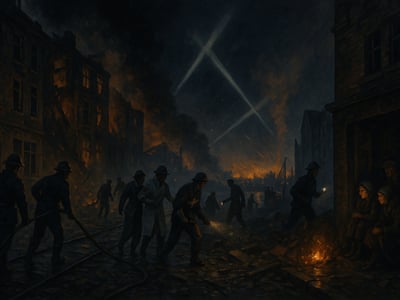
London docks and East End districts under attack on 7 September 1940.
On 7 September 1940, German Luftwaffe forces launched major raids on London in an attack widely identified by many historical institutions as the beginning of the sustained bombing campaign known as the Blitz against the British capital. Definitions can vary, because London had already experienced earlier bombing and the wider air war was already under way, but that Saturday marked a clear turning point: after weeks in which the Battle of Britain had focused heavily on RAF airfields and related targets, the center of pressure shifted toward the city itself.
From airfields to the capital
The first large attacks that day fell on the Port of London and the East End. These were not marginal districts. The docks were a vital part of the capital's economic life, linking shipping, warehousing, transport, labor, and nearby housing. In such an environment, damage rarely stayed confined to a single target. A bomb aimed at dock facilities could also destroy homes, sever roads, interrupt rail connections, and set off fires that spread across tightly packed neighborhoods. The geography of London's working riverfront meant that military, industrial, and civilian spaces stood close together.
This made the attack both strategic and deeply human in its consequences. German leaders, including Adolf Hitler and Hermann Göring, were making a high-risk decision. By concentrating on London, they were betting that pressure on docks, infrastructure, and civilian life would produce faster results than continuing the earlier campaign against RAF-related targets. The gamble was not only about physical destruction. It was also about whether striking the capital could disrupt government, weaken morale, and force Britain into a more favorable position for Germany.
Docks, the East End, and a city at work
That outcome was far from guaranteed. The shift to London meant trading one kind of pressure for another. The earlier air campaign had aimed more directly at Britain's fighter defenses. Turning bombers against the capital could inflict severe damage, but it also gave Britain an opportunity to preserve and continue using key elements of its air defense system. In military terms, this remains one of the most discussed decisions of the Battle of Britain: whether the attack on London represented a logical broadening of pressure or a costly diversion from the attempt to reduce RAF strength.
For Londoners, however, the strategic debate was inseparable from immediate experience. The raids of 7 September brought war directly into densely populated districts where many families lived close to their workplaces and close to the river-based infrastructure that supplied the city. Fires, collapsing buildings, blocked streets, and interrupted services quickly became part of daily reality. Civil defense workers, firefighters, medical personnel, transport staff, and local authorities had to respond at once, often under the threat of further attack.
Nights of fire and civil defence
The events of that day were not isolated. The bombing of London continued over successive nights in September 1940, becoming a sustained campaign rather than a single dramatic strike. Many major reference institutions describe what followed as 57 consecutive nights of bombing of London, though the exact wording and scope of that claim can vary by source. What is not in doubt is the persistence of the attacks. Repeated night raids placed enormous strain on emergency services and on civilians trying to sleep, work, travel, and maintain some routine under blackout conditions and recurring danger.
Prime Minister Winston Churchill quickly became associated with public visits to bomb-damaged areas during the Blitz. Such appearances mattered symbolically, but they also reflected a basic fact of the moment: the bombing of London was no longer a distant military episode. It had become a visible test of how the British state and the city's population would function under sustained air attack. Shelters, rescue systems, fire response, and local organization all became part of the war effort in a very direct sense.
A gamble in the Battle of Britain
The term "Blitz" itself, derived from the German word used in "Blitzkrieg," later became central to British wartime memory. But memory can simplify events that were more complex on the ground. Not every source defines the campaign's opening in exactly the same way, and historians often note the importance of earlier bombing incidents and the broader phases of the air war in 1940. Even so, 7 September remains widely recognized because it marks the start of bombing on a scale and with a continuity that transformed London's place in the war.
Why it still matters
The Blitz remains one of the clearest historical examples of strategic bombing directed at a major city. It is still studied to understand how air power can be used not only against military installations, but also against transport networks, port facilities, industrial areas, and the civilian environments around them. The attack on London showed how closely those categories could overlap in a large urban center.
It also shaped the organization of civilian protection. Britain's use of shelters, blackouts, emergency coordination, and urban rescue measures became part of a larger wartime model for defending cities from air attack. Later governments and military planners looked closely at these experiences when considering civil defense in other conflicts.
Just as importantly, the Blitz continues to matter because it raises enduring questions about the relationship between strategy and civilian exposure. The attacks on London's docks and East End were intended to disrupt supply and pressure the British war effort, but they also demonstrated how quickly infrastructure bombing could become mass urban suffering. For that reason, 7 September 1940 is remembered not only as a date in the Battle of Britain, but as a moment when modern war reached deeply into the everyday life of a capital city.
Timeline
- Luftwaffe intensifies attacks on RAF airfields
- Daylight raids hit London docks and the East End
- Battle of Britain Day: large daylight fighting over London
- Last major raid of the London Blitz
What you uncovered
A Shift in the Air War
You didn't just… complete a puzzle; you traced the moment when air attacks on Britain shifted toward a direct assault on London and its civilians.
The move against London was not only about destruction in one city; it tested whether striking docks, transport links, and residential districts could achieve what attacks on RAF targets had not. That helps explain why the Blitz remains important in the history of strategic bombing: it exposed how closely military aims, urban infrastructure, and civilian life could be bound together in modern war. It also pushed governments to think more systematically about shelters, emergency services, and blackout measures as part of national defense.
On 7 September 1940, some of the main targets in the first major raids were the Port of London and districts in the East End.
FAQ
What happened in London on 7 September 1940?
On 7 September 1940, the German Luftwaffe launched major daylight and evening raids against London. The attacks struck the Port of London and East End districts.
Why is 7 September 1940 linked to the Blitz?
Many major historical institutions identify that date as the beginning of the sustained mass bombing campaign against London commonly called the Blitz. Definitions vary, because earlier bombing of London and related phases of the air war can affect how the start date is described.
Why did Germany shift from RAF targets to London?
German leaders shifted major attacks toward London after an earlier phase of the Battle of Britain focused on RAF targets. The aim was to damage docks, infrastructure, and morale in the capital.
How long did the bombing of London continue after that date?
Many reference institutions describe the bombing of London as continuing for 57 consecutive nights after 7 September 1940. The exact wording and geographic scope can vary by source.
How did the Blitz fit into the wider Battle of Britain?
The sustained bombing of London was part of the wider Battle of Britain in 1940 between Nazi Germany and the United Kingdom. It marked a major shift in the air war from attacks on airfields to attacks on the capital.