
About this story
On 21 September 1937 George Allen & Unwin published J.R.R. Tolkien's The Hobbit in London, with the author's own illustrations. Ten-year-old Rayner Unwin had recommended the manuscript in a reader's report. Houghton Mifflin issued a United States edition in 1938. The book later opened demand for a longer legend.
The Hobbit entered print in London on 21 September 1937 as a George Allen & Unwin title.
On 21 September 1937, George Allen & Unwin published J.R.R. Tolkien's *The Hobbit* in London, issuing a book that would grow far beyond its original place in the children's market. The first British edition introduced readers to Bilbo Baggins, a comfort-loving hobbit drawn into an unexpected journey, and it did so in a form that already carried the marks of its author: Tolkien's own illustrations accompanied the text. What seems obvious in hindsight—that readers would embrace this invented world—was much less certain before the book reached print.
A manuscript that did not fit
Tolkien was not primarily known as a novelist when the manuscript came before the publisher. He was an Oxford academic, trained in language and literature, with deep interests in philology, myth, and old stories. That background helped shape the tone and texture of *The Hobbit*, but it did not automatically make the book easy to market. In the 1930s, publishers still had to judge whether an unusual manuscript could find enough readers to justify printing costs, advertising, and distribution. A fantasy tale set in a fully imagined secondary world did not fit neatly into the most familiar commercial categories.
That uncertainty formed the central practical problem of the book's path to publication. The manuscript that reached Allen & Unwin had charm, humor, and a strong narrative voice, but it also asked readers to accept a setting populated by dwarves, goblins, dragons, and a very particular kind of hero. Bilbo was not a knight, explorer, or conventional adventurer. He was cautious, domestic, and often reluctant. For a publisher, that could look either refreshingly original or commercially difficult.
A child's reader's report
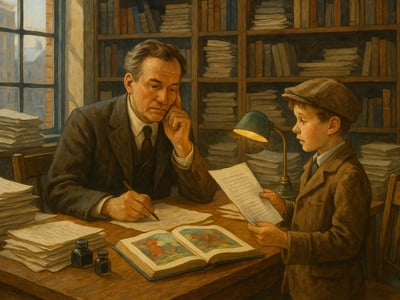
One of the most often repeated details in the story of the book's publication is the role of Rayner Unwin, the ten-year-old son of Stanley Unwin. Asked to read the manuscript and report on it, Rayner recommended it. His reader's report has endured in publishing history partly because it captures a moment when a commercial decision was informed by the response of an actual child reader rather than by market formulas alone. That recommendation did not publish the book by itself, but it gave Stanley Unwin encouraging evidence that the manuscript could connect with its intended audience.
Stanley Unwin still had to decide whether that promise justified the risk. Publishing is often remembered through the books that succeeded, but at the moment of decision the outcome is rarely guaranteed. Backing *The Hobbit* meant committing company resources to a title that was distinctive and somewhat hard to classify. If readers had ignored it, the book might have remained a curious one-off. Instead, Allen & Unwin chose to publish it, and that decision placed Tolkien into the trade market at exactly the moment when his fiction could begin to find a broader audience.
Publication in London
The 1937 edition appeared with illustrations by Tolkien, reinforcing that this was not just a text but a carefully imagined world. Those visual elements mattered. They helped establish a sense of place and authorial identity, linking the story's geography and mood to Tolkien's own artistic interpretation. The book was issued as a children's title, yet it was also readable by adults in a way that helped extend its life beyond a single age category. That flexibility would prove important to its long-term reach.
Early reception helped confirm that the gamble had been worthwhile. The book found readers quickly enough to justify continued attention, and its circulation did not remain confined to Britain. By 1938, Houghton Mifflin had published a United States edition, extending the novel beyond the British market. That expansion matters because international reach can change the destiny of a book. A title that succeeds in one national market may become durable; a title that moves across markets gains stronger chances of remaining in print, entering libraries and classrooms, and developing a larger cultural afterlife.
From one book to a longer legend
The success of *The Hobbit* also had consequences for Tolkien's own career as a fiction writer. Its publication and reception created demand for further work, and that demand eventually contributed to the long path leading toward *The Lord of the Rings*. In that sense, the 1937 publication date marks more than the release of a single children's novel. It marks the opening of a publishing relationship and a readership large enough to sustain a much more expansive fictional project.
It is useful, though, not to read this history too neatly backward from later fame. In 1937, nobody could assume that *The Hobbit* would help define modern fantasy for generations of readers. What existed then was a manuscript, a publisher, a favorable reader's report, and a business decision made under uncertainty. Publisher archives, catalog records, and bibliographic documentation can verify key edition details, but the larger significance only became visible over time as the book stayed in circulation and moved into new contexts.
Why it still matters
The publication of *The Hobbit* still matters because it shows how literary categories are often shaped by ordinary publishing decisions rather than by abstract theory alone. A house willing to print an unconventional manuscript can help create space for kinds of storytelling that later seem established and familiar. In this case, a book that did not fit comfortably into standard formulas became one of the reference points for modern fantasy.
It also matters because the book sits at an intersection of worlds that are often treated separately: children's literature, university scholarship, and commercial publishing. Tolkien's academic background informed the language, names, and historical depth of his fiction, but the book only became culturally influential because a trade publisher brought it to market and readers responded. That chain—scholarship, manuscript, editorial judgment, publication, readership—remains central to how literature enters public life.
Finally, the 1937 edition continues to matter as an example of how a single publication can support a long future of reprints, translations, adaptations, and study. Once a book establishes itself in print, it can travel far beyond its first season. *The Hobbit* moved from a London publication into international circulation and, over time, into a much wider cultural sphere. Its first publication remains a useful point of reference not only for Tolkien readers, but for anyone interested in how books survive, expand, and reshape the markets that once hesitated over them.
The event commemorated on 21 September 1937 is therefore both specific and far-reaching: the publication of a particular edition, in a particular city, by a particular publisher. Yet from that concrete beginning came one of the most enduring works in twentieth-century literature, carried forward by the combination of authorial invention, editorial judgment, and readers willing to follow an unfamiliar road.
Timeline
- Rayner Unwin reader report recommending the manuscript
- First British edition published in London
- Houghton Mifflin United States edition published
What you uncovered
When a Genre Finds a Market
You didn't just… complete a literary puzzle; you traced the moment an unconventional manuscript became a published book with a much wider future.
The publication of The Hobbit shows that literary genres are not shaped by authors alone, but also by the judgments publishers make about what readers might accept. A manuscript that did not fit neatly into established categories still moved forward because someone inside the publishing process treated its difference as worth backing. That kind of decision can do more than launch a single title: it can help define a durable market for similar books.
Before publication, Rayner Unwin, the publisher's ten-year-old son, wrote a reader's report recommending The Hobbit.
FAQ
When was The Hobbit first published?
The Hobbit was first published on 21 September 1937. That date is commonly cited for George Allen & Unwin’s first British edition in London.
Who published the first edition of The Hobbit?
George Allen & Unwin published the first edition of The Hobbit. The book appeared in London as a British edition in 1937.
Was The Hobbit first published in Britain or the United States?
It was first published in Britain. The first British edition appeared on 21 September 1937 in London, and a United States edition followed in 1938.
Did J.R.R. Tolkien illustrate the original edition of The Hobbit?
Yes. The first edition of The Hobbit was issued in 1937 with illustrations by J.R.R. Tolkien.
What role did Rayner Unwin play in publication?
Rayner Unwin, then ten years old, wrote a reader’s report recommending the manuscript before publication. His report was part of the publisher’s decision-making process.