
About this story
On 26 September 1957 West Side Story opened at the Winter Garden Theatre on Broadway. Jerome Robbins, Leonard Bernstein, Stephen Sondheim, and Arthur Laurents recast Romeo and Juliet amid New York gang conflict, with dance as drama. The original run lasted 732 performances until 27 June 1959; a film followed in 1961.
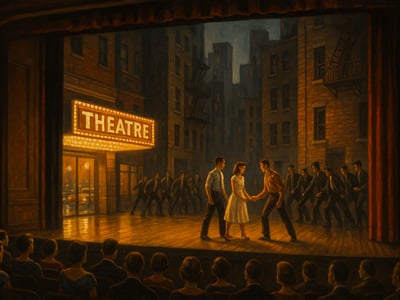
West Side Story at its 1957 Broadway opening at the Winter Garden Theatre.
On 26 September 1957, *West Side Story* opened at the Winter Garden Theatre on Broadway in New York City. The new musical arrived with well-known creative names behind it—Jerome Robbins as director and choreographer, Leonard Bernstein as composer, Stephen Sondheim as lyricist, and Arthur Laurents as book writer—but its significance did not rest on reputation alone. It asked a Broadway audience to accept something less familiar: a tragic love story set in contemporary New York, shaped by street-gang conflict, ethnic tension, and a theatrical language in which dance was not an interlude but part of the drama itself.
A tragic Romeo and Juliet in New York
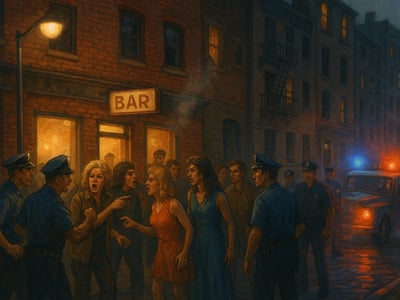
That combination carried real risk in the commercial theater of the late 1950s. Broadway certainly knew romance, spectacle, and musical sophistication, but *West Side Story* did not offer the reassuring structure of a light comedy or a neatly resolved sentimental ending. Its creators built the show around a modern echo of *Romeo and Juliet*, placing young lovers inside a violent social environment defined by rivalry between gangs. Instead of softening that premise, the production emphasized it through movement, rhythm, and dramatic tension.
The setting mattered. By choosing a recognizable New York environment rather than a distant or purely stylized world, the musical placed contemporary urban life on a Broadway stage in a direct way. It used the city not simply as backdrop but as pressure: neighborhoods, territory, migration, and belonging all shaped the conflict. In 1957, that gave the show a different tone from many of its peers. It looked outward to present-day social strain while still working within the formal demands of a major musical production.
Dance as the drama
Jerome Robbins was central to that effect. His direction and choreography treated dance as a primary storytelling tool. Movement established rivalry, coded allegiance, and drove emotional shifts long before characters explained themselves in words. The gangs were defined not just by costume or dialogue but by physical vocabulary. That integration helped make the show feel unusually unified. Music, lyrics, staging, and movement were not arranged as separate attractions; they were built to carry one dramatic line.
Bernstein's score contributed to that impression of intensity and modernity. It brought a musical language that could move from lyricism to sharp rhythmic attack, supporting both romance and conflict. Sondheim's lyrics and Laurents's book worked within the same structure, shaping scenes that were meant to progress through a close relationship between speech, song, and choreography. For Broadway audiences in 1957, this was a notable demonstration of how fully a musical could organize its elements around dramatic purpose.
Opening night at the Winter Garden
Opening-night audiences also met the principal characters through the original cast. Carol Lawrence played Maria, Larry Kert played Tony, and Chita Rivera played Anita. Their performances introduced the emotional core of the musical: young love crossing lines that the surrounding world insists must remain fixed. Anita, in particular, stood at an important dramatic intersection, tied both to affection and to the pressures of the community conflict around her. The cast had to carry material that demanded singing, acting, and movement at a high level, because the production depended on all three being inseparable.
Part of what made the opening noteworthy was the extent to which the show refused to retreat from its own form. A tragic ending was not the conventional commercial promise of Broadway musicals, and a story centered on violence among urban youth was hardly the safest possible subject. Yet the production did not frame those elements as isolated moments of realism inside an otherwise familiar formula. They were structural. The musical's emotional effect depended on the audience accepting that a Broadway musical could move toward loss rather than easy release.
A long run and a wider afterlife
That did not mean the work existed outside entertainment culture; it opened in one of the most visible theatrical systems in the United States and had to function there. The significance of 26 September 1957 lies partly in that test. A mainstream Broadway production was betting that formal ambition and difficult subject matter could still find an audience. The result was not an immediate one-night curiosity but a sustained run. The original Broadway production continued for 732 performances before closing on 27 June 1959, a factual measure that the experiment had achieved substantial public reach.
Its success did not erase the complexity of its subject matter. The musical dealt with ethnic conflict and with portrayals of Puerto Rican identity shaped by the assumptions and cultural frameworks of its time. Those issues have remained part of the work's history and later discussion. But at the moment of its opening, what stood out most clearly was the degree to which the show expanded what a Broadway musical could attempt in tone, structure, and dramatic seriousness.
Why it still matters
The opening of *West Side Story* remains important because it marks a durable change in the expectations placed on musical theater. The production became a benchmark for how choreography, music, lyrics, and narrative could operate as one system rather than as separate features. That model influenced later stage works that treated movement as essential dramatic language rather than decorative accompaniment.
It also stands as evidence that Broadway's commercial framework could support a darker contemporary story without abandoning scale or musical richness. The show demonstrated that a major musical could engage conflict, loss, and social tension while still reaching a broad audience. That point has mattered to theater history ever since, because it widened the range of subjects and endings that later creators could imagine bringing to the mainstream stage.
The work's influence spread far beyond its first run. Revivals, recordings, and especially the 1961 film adaptation helped carry its music, characters, and visual ideas into international culture. Across stage and screen, it became one of the central reference points for 20th-century American musical theater.
Its history also continues to matter because it remains part of ongoing discussion about representation, ethnicity, migration, and urban conflict in popular culture. Those debates belong to a longer story than opening night alone, but they help explain why the 1957 premiere is still studied. It was not just the debut of a successful musical. It was the arrival of a work that changed artistic practice while continuing to invite scrutiny about how American culture presents social conflict on stage.
Timeline
- West Side Story opens at the Winter Garden Theatre
- Original Broadway run closes after 732 performances
- West Side Story film opens
What you uncovered
Broadway Tests a New Form
You didn't just… finish a puzzle; you traced the moment when Broadway tested whether a commercial musical could carry a tragic contemporary story without retreating to safer conventions.
The significance of this opening lies less in simple success than in what it proved about the Broadway system. West Side Story showed that dance, music, and plot could operate as one dramatic engine rather than as separate attractions, even in a work built around conflict and loss. That helped expand the range of subjects and structures that later musicals could attempt on major stages. It also helps explain why the show remains part of larger conversations about representation and urban identity, not only theatrical craft.
The original Broadway production of West Side Story ran for 732 performances before closing on 27 June 1959.
FAQ
When did West Side Story open on Broadway?
West Side Story opened on 26 September 1957. The opening took place at the Winter Garden Theatre on Broadway in New York City.
Where was the original Broadway production staged?
The original production was staged at the Winter Garden Theatre in New York City. It opened on Broadway in Manhattan.
Who created the original 1957 Broadway production?
Jerome Robbins directed and choreographed the production. Leonard Bernstein wrote the score, Stephen Sondheim wrote the lyrics, and Arthur Laurents wrote the book.
Who played Maria, Tony, and Anita in the opening cast?
Carol Lawrence played Maria, Larry Kert played Tony, and Chita Rivera played Anita in the opening-night cast.
How long did the original Broadway run last?
The original Broadway production ran for 732 performances. It closed on 27 June 1959.