
About this story
On 2 October 1869 Mohandas Karamchand Gandhi was born in Porbandar, a princely state in Kathiawar on the western coast of India, under British paramountcy. His father, Karamchand Gandhi, held senior administrative office; his mother was Putlibai. The later honorific Mahatma was not part of his birth name. The date fixes the start of a life later tied to anti-colonial politics and nonviolent resistance.
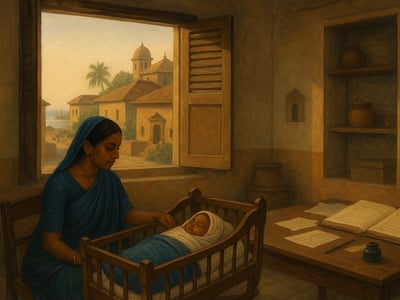
Mohandas Karamchand Gandhi at the date of his birth in Porbandar, 2 October 1869.
On 2 October 1869, Mohandas Karamchand Gandhi was born in Porbandar, a coastal town in the Kathiawar region of western India, in what is now the state of Gujarat. The date is straightforward and well established. What gives it historical weight is not anything dramatic that happened that day, but the fact that this birth marked the beginning of a life that would later become closely associated with anti-colonial politics and nonviolent resistance. At the time, however, Gandhi was simply a child born into a family connected to the administration of a small princely state under British paramountcy.
A birth in a princely state
That setting matters. Porbandar in 1869 was not part of British India in the same way as directly governed provinces. It was a princely state, one of many polities in the subcontinent that retained local rulers and internal administrative structures while operating within a wider imperial order dominated by Britain. This arrangement shaped political life across much of the region. Local courts, officials, and customs remained important, but so did the broader framework of colonial power.
Gandhi's father, Karamchand Gandhi, held senior administrative office in Porbandar State. This placed the family near the practical workings of government rather than at its ceremonial edge. The household would have been familiar with questions of duty, rank, negotiation, and the routines of public administration. Such details should not be overstated into a prediction of Gandhi's future, but they do help explain the social world into which he was born. His mother, Putlibai Gandhi, is also part of the securely documented birth record and family background. Later biographical writing often points to the religious and moral atmosphere of the home, but the most careful starting point is simply that Gandhi was born into a family with both administrative standing and a defined place in local society.
A name before the title
Even his name is worth stating carefully. The given name recorded at birth was Mohandas Karamchand Gandhi. The honorific "Mahatma," by which he later became widely known, was not part of his birth name. Remembering that distinction helps keep the date in proportion. On 2 October 1869, there was no public symbol yet, no national leader, and no global figure. There was only an infant whose later reputation would gradually transform the meaning attached to his birth.
The broader regional context adds another layer. Kathiawar in the late nineteenth century was a patchwork of princely states, commercial towns, religious communities, and local political traditions. Ports along the western coast connected the region to trade networks across the Arabian Sea, while inland political authority was divided among many rulers and estates. British paramountcy did not erase these local structures; instead, it sat above them, limiting sovereignty while relying on existing institutions. A child born into an administrative family in such a setting would have entered a world shaped by both regional particularity and imperial hierarchy.
From Porbandar toward a wider world
That combination of local and imperial structures would later matter greatly in Gandhi's life, though not immediately. His early years remained rooted in western India before later phases took him to London for legal study and then to South Africa, where much of his political development took shape. Those later chapters are often so prominent that they can overshadow the importance of the beginning. Yet birth dates are historical anchors precisely because they place major lives back into ordinary circumstances. Gandhi's story started not on a mass platform or at the head of a movement, but in a princely-state environment where family position, regional culture, and imperial politics quietly overlapped.
There is also a useful discipline in treating this date with restraint. Birth anniversaries can tempt historians and writers to read the future backward, as if later achievements were already visible from the cradle. In Gandhi's case, that temptation is especially strong because his adult public image became so large. But the birth event itself supports a narrower, firmer account: a child named Mohandas Karamchand Gandhi was born in Porbandar on 2 October 1869; his father served in senior administration; his mother was Putlibai; and the family lived within the social and political world of a princely state under British paramountcy.
Why a birth date still anchors a life
That narrower account is not trivial. It identifies the exact place where one influential modern biography begins. It also connects that biography to the layered realities of nineteenth-century western India: coastal trade, local statecraft, family networks, and the unequal structure of empire. In that sense, the birth date is less a complete story than a precise point of departure.
Why it still matters
This date still matters because it fixes the beginning of a life that later became central to the history of British India, anti-colonial mobilization, and debates about political method. Gandhi's later campaigns would be studied not only as episodes in Indian history but also as examples of mass politics built around nonviolent action, civil resistance, and disciplined public protest. Whatever judgments people make about his ideas or legacy, his influence on twentieth-century political thought is difficult to separate from the biography that begins in Porbandar in 1869.
The birth date also helps connect scales of history that are often kept apart. It links a local princely-state society in Kathiawar to imperial governance and then, through Gandhi's later life, to movements and arguments that crossed borders. Historians often look for such points of connection: moments where a single documented fact opens onto larger systems. Gandhi's birth is one of those moments. It belongs to family history, regional history, colonial history, and eventually global political history all at once.
For that reason, 2 October 1869 is remembered not because the day itself was publicly momentous, but because it marks the documented beginning of a life whose later course would be felt far beyond Porbandar. The value of the date lies in that combination of certainty and perspective: a clear fact, firmly placed, from which a much larger historical story would later unfold.
Timeline
- Mohandas Karamchand Gandhi is born in Porbandar
- Gandhi leaves India to study law in London
- Political development takes shape in South Africa
- Gandhi returns to India
What you uncovered
A Life Shaped by Setting
You didn't just… complete a date puzzle; you traced the starting point of a life that would later connect local governance, empire, and mass politics.
This birth date matters not only because of who Gandhi became, but because it places him within a specific social and political setting in western India. Being born in a princely state under British paramountcy meant growing up near overlapping layers of local authority and imperial power. That context helps explain why his later political life is often read not simply as personal conviction, but as a response to systems of rule that were already present at the beginning.
The name recorded at birth was Mohandas Karamchand Gandhi; the honorific "Mahatma" was adopted later and was not part of his birth name.
FAQ
When was Mohandas Karamchand Gandhi born?
Mohandas Karamchand Gandhi was born on 2 October 1869 in Porbandar, in the Kathiawar region of western India.
Where was Gandhi born?
He was born in Porbandar, a coastal town in Kathiawar, in present-day Gujarat, India.
What was Gandhi's birth name?
The given name recorded at birth was Mohandas Karamchand Gandhi. The honorific "Mahatma" was not part of his birth name.
What was Porbandar's status in 1869?
At the time of Gandhi's birth, Porbandar was a princely state under British paramountcy in western India.