
About this story
On 10 November 1969, Sesame Street premiered on public television stations in the United States. Joan Ganz Cooney and Lloyd Morrisett had founded the Children’s Television Workshop in 1968 so preschool teaching could hold a child’s attention. The first season ran to 130 hour-long episodes. Public Broadcasting Service distribution followed in 1970, and the workshop took the name Sesame Workshop in 2000.
Sesame Street began airing on U.S. public television on November 10, 1969.
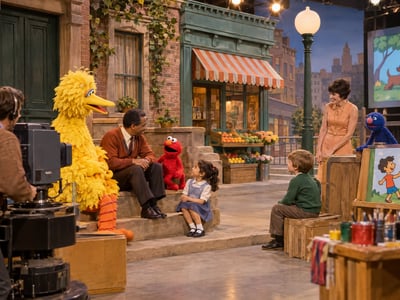
On November 10, 1969, Sesame Street premiered on public television stations across the United States. Its approximately hour-long opening episode introduced preschool viewers to a neighborhood setting within a program that combined live action, puppetry, animation, and filmed segments. Produced in New York City by the Children’s Television Workshop, the series brought an educational proposal onto the screen: television could be designed around young children’s learning while drawing on the techniques that made the medium entertaining.
A lesson that had to hold attention
That proposal came with a practical difficulty. A television program could offer letters, numbers, and other preschool material, but it could not assume that children would keep watching. Nor could its makers assume that a child who enjoyed a puppet or a song had learned the intended lesson. The production needed to make instruction engaging without treating engagement as proof of educational success.
The organization behind the program had been established the previous year. In 1968, Joan Ganz Cooney and Lloyd Morrisett co-founded the Children’s Television Workshop to develop educational television for children. Cooney and her collaborators brought together people whose work was usually judged by different standards: educators concerned with curriculum, researchers concerned with evidence, and television professionals concerned with what worked on screen.
A neighborhood instead of a classroom
Their collaboration shaped the program’s central production challenge. Educational objectives had to become material that performers could present and young viewers could follow. A segment needed more than a worthwhile subject; it also needed a form suited to television. Jim Henson’s puppetry was part of that effort, alongside human performers, animation, and filmed sequences. The different formats offered different ways to introduce and revisit preschool concepts.
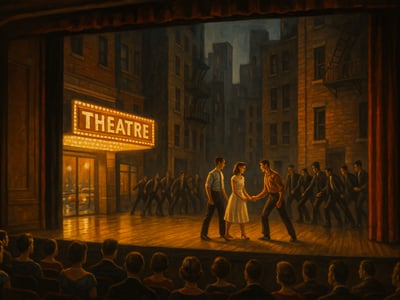
The neighborhood setting gave those varied elements a shared home. Rather than presenting the entire broadcast as a classroom lesson, Sesame Street could move between scenes with people and puppets and shorter pieces with their own visual styles. Familiar surroundings and recurring performers provided continuity, while changes in format gave the program ways to renew attention. The result was not one uninterrupted teaching method, but a television hour assembled from several approaches.
The people on the screen, and public television
The people who inhabited that screen world mattered to its identity. Matt Robinson was the original performer of Gordon. Caroll Spinney originated the performance roles of Big Bird and Oscar the Grouch. Along with the broader cast and production team, they helped give the educational project recognizable voices and personalities. Those performances were part of the program’s construction, not simply decoration added to instructional material.
The premiere also belongs to a specific moment in American broadcasting history. Sesame Street began through National Educational Television and affiliated public television stations. Although the program later became closely associated with PBS, PBS broadcasting did not begin until 1970. Describing the first broadcast simply as a PBS premiere would therefore blur the sequence of events. The series arrived through the public-television arrangements already operating when it was ready to air.
A season of 130 episodes
The commitment extended well beyond an opening episode. The first season comprised 130 approximately hour-long programs. That scale required a continuing supply of scripts, performances, animation, filmed material, and educational planning. An approach that looked promising in an individual segment had to remain workable across a sustained production schedule. The challenge was organizational as well as creative: different specialists had to keep contributing to the same series.
Broadcasting those episodes did not, by itself, answer the question that had motivated the project. Making a program available was one achievement; holding attention was another. Evidence of learning required separate investigation. Research and evaluation therefore mattered not only as preparation for the launch, but as ways to examine what the educational effort was accomplishing. The premiere marked the beginning of a public test, rather than a final demonstration that the underlying idea had succeeded.
Why it still matters
Sesame Street’s early history offers a lasting example of collaboration between curriculum specialists, researchers, and creative teams. Their responsibilities overlapped without becoming identical. A producer’s judgment about a compelling scene could inform the work, while educational questions still required their own evidence. That distinction remains important whenever entertainment is presented as a vehicle for learning.
The program’s later international adaptations extended the project beyond the export of an American television series. Locally selected languages, characters, and educational priorities allowed adaptations to address different audiences. The transferable idea was not that every child needed precisely the same screen neighborhood, but that educational aims could be developed for particular linguistic and cultural settings.
Its public-television debut also provides a historical reference point for access to preschool educational media outside classrooms. A broadcast could bring material into homes, but availability, attention, and demonstrated learning remained separate measures. The significance of the opening day lies in the attempt to address all three through a sustained television project. A neighborhood appeared on screen; behind it stood an organization working to discover what that screen could teach.
Timeline
- Children's Television Workshop founded
- Sesame Street premiere
- PBS broadcasting begins
- Sesame Workshop name adopted
What you uncovered
The Work Behind Play
You didn't just… complete a puzzle; you revisited Sesame Street’s first step in bringing a research-informed preschool program into homes.
The workshop model treated curriculum, entertainment, and evaluation as connected tasks rather than separate stages. Holding a child’s attention was a production goal, but it could not substitute for evidence of learning. That distinction remains useful when assessing educational media: access, engagement, and learning each require their own measures.
Sesame Street’s first season comprised 130 approximately hour-long episodes produced by the Children’s Television Workshop.
FAQ
When did Sesame Street first air on television?
Sesame Street first aired on November 10, 1969, on National Educational Television and affiliated public television stations in the United States.
How long was Sesame Street’s first episode?
The premiere was an approximately one-hour episode. It introduced the program’s neighborhood setting.
Who created the Children’s Television Workshop?
Joan Ganz Cooney and Lloyd Morrisett co-founded the Children’s Television Workshop in 1968. It was created to develop educational television for children.
How many episodes were in Sesame Street’s first season?
The 1969–1970 season comprised 130 approximately hour-long episodes. They were produced by the Children’s Television Workshop.