

About this story
On 3 October 1942 the German A-4 rocket completed its first successful flight from the Peenemünde Army Research Center on the Baltic coast. Earlier test attempts had failed. Walter Dornberger directed the army program and Wernher von Braun led technical development. The vehicle later went to war as the V-2 and was used against cities including London and Antwerp.
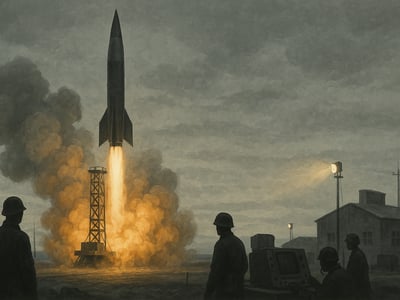
A-4 rocket test at Peenemünde on 3 October 1942, later associated with the V-2
On October 3, 1942, a large liquid-fueled rocket rose from the Peenemünde Army Research Center on Germany’s Baltic coast and completed the first successful flight of the vehicle known as the A-4. Later widely identified by its wartime designation, V-2, the rocket had already consumed years of work, repeated failures, and substantial military backing. The launch became a turning point in the history of rocketry, but it cannot be separated from the fact that it emerged within Nazi Germany and was developed as a weapon.
A rocket beyond artillery
Peenemünde had been built as a site where the German Army could test ideas that went beyond conventional artillery. The A-4 program aimed to produce a long-range ballistic missile powered by liquid fuel, a far more demanding machine than the smaller rockets that had come before it. Such a project required several complex systems to work together at once: a reliable engine, stable fuel delivery, guidance that could keep the vehicle on course, and an airframe strong enough to survive acceleration and flight stresses.
Those demands help explain why success did not come quickly. Before the October 1942 flight, A-4 test attempts had exposed serious weaknesses. Engineers and military officials confronted engine trouble, guidance problems, and structural failures. A rocket of this scale could lose control, break apart, or fail to maintain powered flight long enough to prove the design. Each failed test showed that the machine was not just a larger version of earlier rockets, but something that pushed against the limits of available materials, manufacturing, and control systems.
Failure before the October flight
Even so, work continued under wartime conditions. Walter Dornberger, who directed the Army Ordnance rocket program associated with Peenemünde, remained a central military figure in sustaining the effort. Wernher von Braun, serving as technical director of the development program, was among the leading engineers trying to turn theory and bench testing into a working vehicle. Their project depended on state resources, military priorities, and a research environment shaped by the coercive structures of the Nazi regime.
When the A-4 launched on October 3, the test was meant to answer a basic question: could a full-scale rocket of this kind actually fly as designed? According to NASA historical summaries, the answer was yes. The rocket reached about 275,000 feet, or roughly 52 miles, and traveled about 116 miles. Those figures mattered because they showed that the A-4 could achieve sustained powered flight, reach very high altitude, and follow a long ballistic path. What earlier attempts had failed to demonstrate, this launch established in practice.
The successful launch at Peenemünde
To later generations, the flight came to symbolize a threshold moment. The A-4 brought together propulsion, guidance, and range in a way that pointed toward the future of large rocket systems. It showed that a state-backed program could organize research, testing, and industrial production around a missile that was neither aircraft nor conventional shell. In that sense, the launch stood at a crossroads between older ideas of artillery and newer forms of long-range rocketry.
But the October test did not remain an isolated experiment. The vehicle was later deployed in war under the name V-2. It was used against cities including London and Antwerp. That later service is essential to the meaning of the 1942 launch. A technical milestone at Peenemünde became part of the operational history of a weapon used by Nazi Germany, and any account that focuses only on engineering misses that connection.
From test vehicle to the V-2
The event is therefore difficult to classify in simple terms. It was undeniably important in the development of modern rocketry. At the same time, it formed part of a military program of an authoritarian regime engaged in aggressive war and broader criminal policies. The launch can be studied as a breakthrough in engineering only if its political and military setting remains visible.
Why it still matters
The October 1942 A-4 flight still matters because it marked a practical demonstration of technologies that would shape later missile and rocket programs. Large liquid-fueled engines, long-range guidance, and integrated systems testing became central features of postwar rocketry. The test history at Peenemünde showed that modern weapons research would increasingly depend on institutions capable of coordinating design, trial, failure analysis, and production at scale.
Its influence also extended beyond Germany’s defeat in 1945. Personnel, methods, and technical knowledge associated with the A-4 program fed into later rocket development in multiple countries, especially the United States and the Soviet Union. In that sense, the launch occupies an uneasy place in history: it forms part of the lineage of later space launch systems while also belonging to the history of wartime missile violence.
That tension is precisely why the event continues to be discussed. The first successful A-4 flight was not simply the beginning of one story. It sat at the intersection of military ambition, scientific and engineering problem-solving, and the coercive power of the Nazi state. Remembering it accurately means holding those elements together rather than isolating the technical achievement from the purposes it served.
Timeline
- An earlier A-4 test launch fails
- First successful A-4 flight at Peenemünde
- V-2 attacks begin against London
What you uncovered
From Missile Test to Model
You didn't just… complete a puzzle; you traced a moment when a wartime weapons test also became part of the technical lineage later used in state-run rocketry.
The October 1942 flight matters not only because it succeeded after earlier failures, but because it showed that a large rocket could be treated as a system of propulsion, guidance, structure, and range management rather than as an oversized shell. That shift helped move rocketry away from older artillery logic and toward the kind of coordinated engineering later used in national missile and space programs. But the continuity is inseparable from its setting: the knowledge came through a Nazi military project, so its place in spaceflight history cannot be separated from the coercive and violent system that produced it.
The rocket launched on 1942-10-03 was designated the A-4 at the time; the name V-2 was applied later.
FAQ
What happened at Peenemünde on October 3, 1942?
On 1942-10-03, an A-4 test vehicle was launched at the Peenemünde Army Research Center on Usedom Island. It was the first successful launch of that rocket design.
What was the A-4 rocket later called?
The vehicle tested on 1942-10-03 was the A-4. The designation “V-2” was applied later, after the wartime development phase.
How high and how far did the test flight go?
NASA historical summaries state that the flight reached about 275,000 feet, or roughly 52 miles, in altitude. It also covered about 116 miles.
Who led the A-4 program at Peenemünde?
Walter Dornberger directed the Army Ordnance rocket program associated with the A-4 tests at Peenemünde. Wernher von Braun served as the technical director of the rocket development effort.