
About this story
On 1 October 1949 Mao Zedong proclaimed the People’s Republic of China at Tiananmen in Beijing. The Chinese People’s Political Consultative Conference had opened in Beiping on 21 September. On 27 September delegates renamed the city Beijing and adopted the Common Program. Zhou Enlai was presented as premier while Nationalist forces were still falling back toward Taiwan.
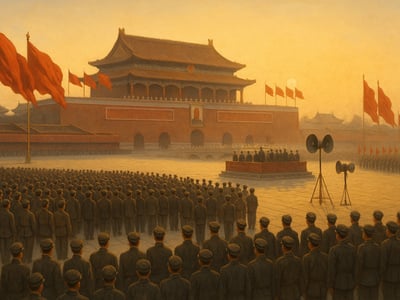
Tiananmen in Beijing, where Mao proclaimed the People's Republic of China in 1949.
On October 1, 1949, Mao Zedong stood at Tiananmen in Beijing and proclaimed the establishment of the People's Republic of China. The ceremony is often remembered as a single dramatic founding moment, but it came at the end of a rapid political and military transition. By that autumn, the Chinese Communist Party had gained control over most of mainland China during the Chinese Civil War, while the Nationalist government led by Chiang Kai-shek was retreating and the shape of a new state was being defined in public view.
After the civil war’s turn
The proclamation mattered because battlefield success alone did not automatically create a functioning government. After years of war, the Communist leadership faced a practical problem as much as a symbolic one: how to turn territorial control into a capital city, a governing framework, a leadership structure, and institutions able to claim authority across a vast country. The announcement in Beijing was therefore both a public declaration and the visible outcome of decisions taken in the preceding days.
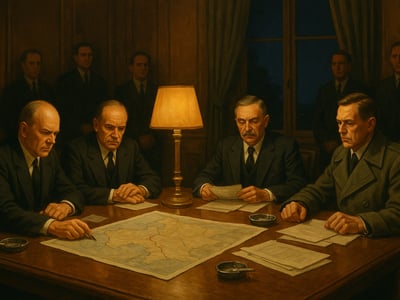
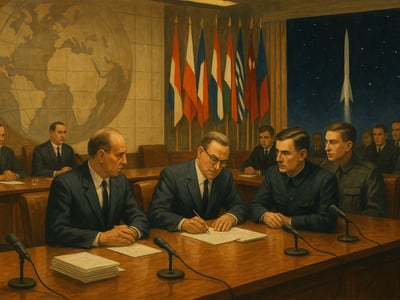
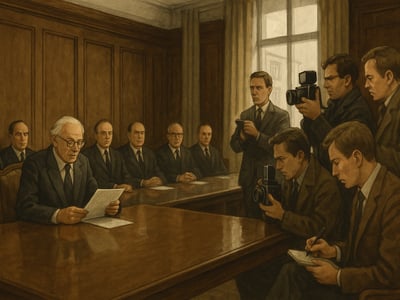
Those preparations had begun formally on September 21, 1949, when the Chinese People's Political Consultative Conference opened in Beiping. The gathering brought together representatives assembled to establish the framework of the new government. This was an important step in showing that the emerging regime was not presenting itself only as a military command. It was also constructing organs of state, a provisional governing basis, and a national center from which orders could be issued.
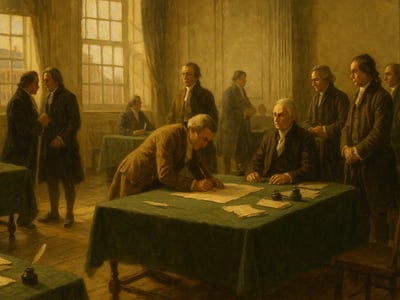
Several of the conference's most consequential decisions came on September 27. On that day, delegates adopted the name Beijing for the city, replacing Beiping. The change was more than administrative. It signaled that the city was no longer to be understood simply as a northern urban center but as the capital of a new political order. On the same day, the conference selected the Common Program as the provisional governing document of the new state. That gave the new authorities a formal framework before a permanent constitution existed, helping define how the government would present its authority at home and abroad.
A conference in Beiping
Seen in sequence, these steps show that October 1 was carefully staged rather than improvised. The leadership chose to proclaim the new state publicly while military operations were still continuing elsewhere and while the Nationalist government still existed. That carried risk. A declaration made too early could have appeared premature if the new rulers proved unable to secure administrative control or establish political stability. It could also have weakened their position internationally at a moment when foreign governments had not yet settled how they would respond.
Even so, the Communist leadership judged that a decisive public act was necessary. Beijing offered a powerful setting for such an announcement. By choosing Tiananmen as the site of the ceremony, the new government linked itself to a recognizable political center and displayed its claim to rule from the capital. In revolutionary movements, symbols matter, but in this case symbolism was tied directly to administration. The ceremony did not stand apart from the work of government formation; it announced that this work was already underway.
Beijing and a public proclamation
At Tiananmen on October 1, Mao declared the Central People's Government of the People's Republic of China. The new authorities also publicly presented leading state appointments, including Zhou Enlai in a leading executive role as premier of the Government Administration Council. This, too, was significant. A founding proclamation could attract attention, but a named leadership lineup suggested continuity of command and an intention to govern through identifiable offices rather than through victory alone.
The wider civil war context gave the moment its urgency. During 1949, Nationalist control on the mainland had collapsed across large areas, and the government of the Republic of China was retreating to Taiwan. Yet the conflict had not simply vanished on October 1. The proclamation therefore marked a threshold rather than an endpoint. It announced a new central authority on the mainland, but later military, constitutional, and diplomatic developments would still shape how that authority operated and how it was recognized abroad.
A state announced while fighting continued
Foreign recognition remained unresolved in the immediate aftermath. Governments had to decide whether, when, and on what basis to recognize the new regime. Those decisions mattered not only for diplomacy with China itself but also for the broader alignment of the early Cold War. The emergence of a Communist government ruling the Chinese mainland affected strategic calculations across East Asia and beyond, influencing alliance patterns, representation questions, and the international balance of power.
The event is sometimes reduced to a single image of Mao addressing a crowd, but that image can obscure the administrative logic behind it. The days before October 1 reveal a sequence: a conference convened, a capital's name confirmed, a provisional governing document adopted, and a top leadership structure presented. The proclamation gave public form to that sequence. It told domestic and foreign audiences that a new state was claiming not only victory but organization.
Why it still matters
The proclamation of the People's Republic of China still matters because it illustrates how revolutionary movements become states. Military success on its own does not settle questions of governance, law, or political legitimacy. In late September and early October 1949, the Communist leadership moved through a series of legal, symbolic, and administrative steps that transformed control on the ground into a central government that could speak in the name of a state.
It also remains a reference point in debates over the representation of China and the unresolved political split across the Taiwan Strait. The events of 1949 did not end all rival claims at once; instead, they established a new mainland government while the Republic of China government continued elsewhere. For that reason, the proclamation is central to understanding later disputes over recognition, sovereignty, and diplomatic status, even though those disputes developed over time rather than being settled in a single ceremony.
Finally, the event helps explain why 1949 reshaped East Asia in the early Cold War. The founding of a new government on the mainland altered international calculations, affected bilateral recognition decisions, and changed the geopolitical map. The announcement at Tiananmen was therefore not only a national founding ceremony. It was also one of the moments through which a civil war outcome became an international fact with lasting consequences.
Timeline
- Chinese People’s Political Consultative Conference opens in Beiping
- Beiping is renamed Beijing
- Delegates adopt the Common Program
- Mao proclaims the People’s Republic of China
What you uncovered
From Ceremony to State Power
You didn't just… complete a date puzzle; you traced the moment when a wartime victory was presented as an organized government with institutions, offices, and a public claim to rule.
The proclamation at Tiananmen was not only a symbolic announcement but the visible endpoint of decisions already taken in late September. Naming Beijing as the capital and adopting a provisional governing framework helped turn military control into administrative authority. That sequence matters because states are not established by ceremony alone: they depend on rules, offices, and recognition, even when conflict has not fully ended.
On 27 September 1949, the Chinese People's Political Consultative Conference adopted the Common Program as the new state's provisional governing document.
FAQ
What happened in Beijing on 1 October 1949?
On 1 October 1949, Mao Zedong announced the Central People's Government of the People's Republic of China at Tiananmen in Beijing. The proclamation marked the public founding of the new state.
Who proclaimed the founding of the People's Republic of China?
Mao Zedong made the proclamation at Tiananmen in Beijing. It was the public announcement of the new government.
What had the Chinese People's Political Consultative Conference decided before the proclamation?
The Chinese People's Political Consultative Conference opened on 21 September 1949 in Beiping. On 27 September 1949, it adopted the Common Program as the provisional governing document and chose Beijing as the city's name.
What role did Zhou Enlai have in the new government?
On 1 October 1949, the new Central People's Government publicly announced Zhou Enlai in a leading executive role as premier of the Government Administration Council. This was part of the first public presentation of the new leadership.