
About this story
On 9 October 1874 representatives of 22 countries signed the Treaty of Bern, creating the General Postal Union. Heinrich von Stephan of the German Empire pushed the move beyond a web of bilateral mail agreements. The treaty entered into force on 1 July 1875. At the Paris Congress the union was renamed the Universal Postal Union on 1 June 1878, the name by which the system became widely known.
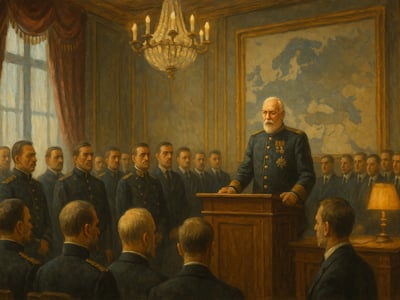
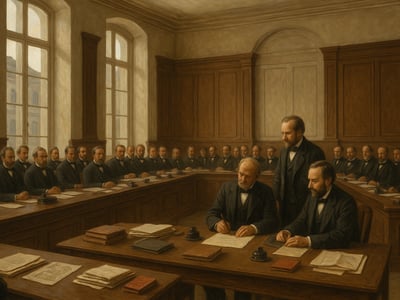
Treaty of Bern delegates in Bern, where 22 countries formed the General Postal Union in 1874.
On 9 October 1874, representatives of 22 countries signed the Treaty of Bern in Bern, Switzerland, creating the General Postal Union. The agreement addressed a practical problem that had grown more obvious as trade, government, and private correspondence crossed more borders in the nineteenth century: sending a letter abroad was not simply a matter of carrying it from one place to another. It often meant passing through a maze of separate national systems, each governed by its own rates, procedures, and transit rules.
A patchwork of bilateral mail
Before that treaty, international mail usually depended on bilateral agreements. One country negotiated terms with another, then with another again, producing a patchwork that could be difficult to manage. A letter moving across several frontiers might involve different calculations of payment, different rules for transit, and different administrative expectations from one segment of the journey to the next. For postal officials, this created complexity. For governments, it created inefficiency. For ordinary correspondents and businesses, it added uncertainty to something that was becoming increasingly important in modern life.
The Bern agreement did not invent the postal service, and it did not make geography disappear. What it did was create a common framework for international mail exchange among the member states that joined it. Instead of relying mainly on a web of separate bilateral arrangements, the signatories accepted a multilateral structure with shared rules. That shift was administrative, but it was also consequential. A system that had been fragmented became more coherent.
One of the principal advocates associated with the plan was Heinrich von Stephan of the German Empire, a major figure in nineteenth-century postal reform. His name is often linked to the effort to move beyond the older bilateral model toward a wider postal union. The significance of that effort lay in its recognition that communication infrastructure was not only about vehicles, routes, or sorting offices. It was also about agreements: who accepted whose mail, under what terms, at what rates, and with what obligations when mail crossed territory controlled by another state.
Stephan’s case for a wider union
Bern was an appropriate setting for such a meeting. By gathering delegates in a neutral and well-connected European city, the conference gave participating governments a place to negotiate technical arrangements that had broad practical consequences. The people signing the treaty were not producing a dramatic declaration in the style of a peace settlement or constitutional charter. They were doing something quieter and more routine: standardizing an everyday system that touched commerce, diplomacy, administration, and personal life.
That quietness can make the event look modest at first glance. Yet the obstacle it addressed was real. Every country had reasons to preserve its own methods and pricing structures. Postal administrations had their own habits, legal rules, and financial concerns. A multilateral framework required states to accept common procedures rather than insist on separate arrangements for every relationship. Agreement was not automatic. It depended on a shared judgment that the gains from coordination would outweigh the comfort of keeping older, more particular systems.
From a signature to a working system
The Treaty of Bern therefore marked a change in the way international communication could be governed. It treated the exchange of mail not as a series of isolated bargains, but as a common problem requiring common rules. In practical terms, that meant fewer barriers in the handling of cross-border correspondence. In institutional terms, it meant creating an intergovernmental framework durable enough to continue beyond the conference itself.
The treaty entered into force on 1 July 1875, giving the new arrangement legal and operational effect. That date matters because it marks the transition from signed agreement to functioning system. The union was not merely a conference outcome on paper; it became a working framework for the participating states. Then, in 1878, at the Paris Congress, the General Postal Union was renamed the Universal Postal Union, the title by which it became widely known.
A new name in Paris
The new name reflected more than branding. It suggested a broader ambition and a more expansive view of the network being built. A postal union could begin with a limited number of states, but its logic pointed outward. The easier it became for separate national postal systems to operate under shared rules, the more plausible a wider and more inclusive international exchange became.
In that sense, the Treaty of Bern belongs to the history of standardization as much as to the history of communication. It showed that a network grows not only through physical expansion, but also through compatible procedures. Tracks, ships, roads, and mailbags mattered, but so did decisions about rates, transit, and administration. Without such agreements, even an extensive physical network could remain divided by institutional friction.
Why it still matters
The Treaty of Bern remains useful as an example of how international systems often become effective. They do not depend on invention alone. They also depend on rules that allow separate jurisdictions to work together predictably. The postal problem of the nineteenth century was specific to letters and parcels, but the underlying lesson is broader: shared standards can reduce friction across borders.
It also highlights the importance of ordinary infrastructure. Postal arrangements may seem less visible than railways, telegraphs, or ports, yet they were essential to commerce, administration, and personal communication. A reliable cross-border mail system required not just transport, but coordination among states that had different institutions and interests. The Bern treaty showed that such coordination could be organized and maintained.
Finally, the General Postal Union, later the Universal Postal Union, stands as an early example of a durable international organization built around routine exchange rather than crisis management. Its purpose was practical and continuous. By helping make national systems interoperable, the agreement contributed to a more connected world in a way that was technical, procedural, and lasting. That is why a treaty about mail signed in Bern in 1874 still deserves attention.
Timeline
- Treaty of Bern creates the General Postal Union
- Treaty enters into force
- Paris Congress renames it the Universal Postal Union
What you uncovered
When Networks Learn to Connect
You didn't just complete a puzzle; you traced the moment when countries began treating cross-border mail as a shared system rather than a set of separate bargains.
What made international post truly global was not simply faster transport or better sorting, but agreement on common rules that let different national networks work together. The Treaty of Bern shows how infrastructure often depends on standards that are administrative rather than mechanical. When rates, transit, and procedures become coordinated, everyday communication can scale across borders with much less friction.
The Treaty of Bern entered into force on 1 July 1875, and in 1878 the General Postal Union was renamed the Universal Postal Union.
FAQ
What happened on 9 October 1874 in Bern?
On 9 October 1874, representatives of 22 countries signed the Treaty of Bern in Bern, Switzerland. The treaty created the General Postal Union for international mail exchange.
What was the Treaty of Bern of 1874?
It was an agreement that set up a common framework for handling international mail among member states. It replaced reliance on multiple bilateral postal arrangements with shared rules.
Why was the General Postal Union created?
It was created to make cross-border mail easier to manage by using common rates, procedures, and transit rules. The aim was to reduce the fragmentation caused by separate bilateral agreements.
Who was Heinrich von Stephan?
Heinrich von Stephan of the German Empire was a principal advocate of the postal union plan associated with the 1874 agreement. He is linked to the broader effort to reform international postal cooperation.
When did the treaty enter into force and what changed later?
The Treaty of Bern entered into force on 1 July 1875. In 1878, at the Paris Congress, the General Postal Union was renamed the Universal Postal Union.