
About this story
On 19 October 1989, the Court of Appeal in London quashed the murder convictions of the Guildford Four: Gerry Conlon, Paul Hill, Paddy Armstrong, and Carole Richardson. They had spent about 15 years in prison after convictions in October 1975 for the 1974 Guildford pub bombings. The ruling turned on disputed confessions and police records.
Guildford Four case at the Court of Appeal in London, 19 October 1989
On 19 October 1989, the Court of Appeal in London quashed the murder convictions of the four people known as the Guildford Four, bringing to an end about 15 years in prison for Gerry Conlon, Paul Hill, Paddy Armstrong, and Carole Richardson. The ruling concerned one of the most closely watched criminal cases in Britain, rooted in the 1974 bombings of two pubs in Guildford, Surrey, during a period of heightened tension linked to the conflict in Northern Ireland.
Two pubs, and a case built on confessions
The original crime had taken place on 5 October 1974, when bombs exploded at the Horse and Groom and the Seven Stars in Guildford. Five people were killed and dozens were injured. The attacks caused immediate shock and public anger, and the investigation unfolded under intense pressure to identify and convict those responsible.
In October 1975, Conlon, Hill, Armstrong, and Richardson were convicted in connection with the bombings. The prosecution case rested heavily on confessions said to have been made during police questioning. From the beginning, however, those confessions were disputed. Over time, the reliability of the statements became the central issue in the case.
That question mattered because confession evidence can be powerful in court. A jury may treat an apparent admission of guilt as especially persuasive, even when later arguments suggest the circumstances of the questioning were flawed. In the Guildford Four case, the confessions were not simply one part of the prosecution story; they were at the core of it. Once their reliability came under sustained challenge, the safety of the convictions themselves came into doubt.
When an admission becomes the whole case
The years between conviction and the 1989 ruling were marked by continuing efforts to reopen the case. Defence teams and campaigners kept pressing questions about how the statements had been obtained and how the original evidence had been presented. As scrutiny increased in the 1980s, attention also turned to police records and documentation connected to the investigation. The case did not collapse because of a single dramatic new fact appearing all at once. Rather, it was weakened by renewed examination of the evidence already used to secure conviction and by documentary material that raised serious concerns about whether the record before the court had been reliable.
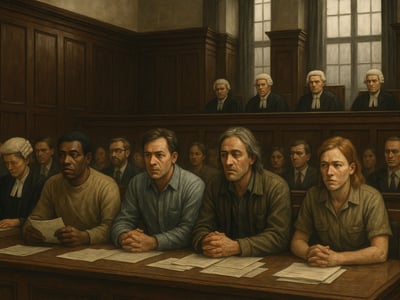
When the appeal came before the Court of Appeal in 1989, it was heard by judges led by the Lord Chief Justice, Lord Lane. The court had to decide whether convictions secured in the charged atmosphere of the mid-1970s could still stand after sustained challenges to the confession evidence and after review of police documentation linked to the original case. This was not a narrow procedural question. The answer would determine whether four people remained imprisoned for murders they said they had not committed.
A record reopened in the 1980s
The court concluded that the convictions could not safely stand. On 19 October 1989, the Court of Appeal quashed them. After the judgment, the four appellants were released. The decision did not undo the bombings, lessen the loss suffered by those killed and injured, or resolve every wider question raised by the investigation. But it did mark a decisive judicial acknowledgment that the earlier verdicts were unsound.
The ruling quickly became significant beyond the lives of the four individuals involved. It highlighted how difficult it can be to correct a conviction once a case has passed through trial, public attention, and years of imprisonment. It also showed the importance of appellate review in cases where evidence that seemed compelling at first is later found to be unreliable or incomplete.
The court decides the verdicts cannot stand
The Guildford Four case was not considered in isolation. In Britain, it came to be discussed alongside other miscarriage-of-justice cases that raised concerns about investigative methods, record-keeping, disclosure, and the treatment of confession evidence. In that broader setting, the 1989 judgment became part of a larger reassessment of how criminal cases should be tested, documented, and reviewed.
The case also carried a particular public weight because it sat within the fraught political and social context of the 1970s and 1980s. Violence associated with the Northern Ireland conflict had created fear, anger, and pressure for swift action. Those conditions did not determine every outcome, but they formed the backdrop against which police, prosecutors, courts, and the public understood such cases. Looking back, the Guildford Four appeal is often studied not only for what happened in one courtroom, but also for what it reveals about decision-making under pressure.
Why it still matters
The quashing of the Guildford Four convictions remains an important reference point in legal and historical discussions because it focuses attention on two enduring issues: the reliability of confessions and the handling of official records. Criminal justice systems depend on procedures that test evidence carefully, especially when liberty depends on statements made in custody. The case is regularly cited in discussions of how courts should approach disputed admissions and what safeguards are needed when police interviews become central to a prosecution.
It also matters because of what it showed about disclosure and documentation. Appeals often turn not on abstract principles alone, but on whether records were accurate, complete, and properly examined. In that sense, the Guildford Four case helped sharpen scrutiny of investigative practices and the duties owed by authorities in presenting evidence.
More broadly, the judgment affected public trust. Miscarriages of justice do not only concern the wrongly convicted; they also affect confidence in the institutions meant to establish facts fairly. For that reason, the events of 19 October 1989 continue to be remembered as part of a wider British reckoning with wrongful conviction, appellate oversight, and the standards required for a criminal verdict to be considered safe.
Timeline
- Guildford pub bombings
- Guildford Four convicted
- Case referred back to the Court of Appeal
- Court of Appeal quashes the convictions
What you uncovered
When Records Change a Verdict
You didn't just piece together a court ruling; you retraced a moment when years of imprisonment were reversed through renewed scrutiny of evidence and records.
What made this case so significant was not a single dramatic breakthrough, but the way the appeal forced attention onto how confessions were obtained, interpreted, and supported by documentation. That matters because justice systems often depend as much on procedure and record-keeping as on witness accounts or courtroom argument. The case remains important partly because it showed how errors can endure when those systems are not tested closely.
The 19 October 1989 judgment quashing the convictions was delivered in the Court of Appeal by Lord Chief Justice Lord Lane.
FAQ
What happened on 19 October 1989 in the Guildford Four case?
On 19 October 1989, the Court of Appeal in London quashed the murder convictions of the Guildford Four. They were released after about 15 years in prison.
Who were the Guildford Four?
The Guildford Four were Gerry Conlon, Paul Hill, Paddy Armstrong, and Carole Richardson. They had been convicted in October 1975 in connection with the Guildford pub bombings.
Why were the convictions quashed in 1989?
The appeals were based on renewed examination of confession evidence and police records from the original case. The court concluded the convictions could not stand.
What happened in the Guildford pub bombings of 1974?
On 5 October 1974, bombs exploded at the Horse and Groom and the Seven Stars in Guildford, Surrey. Five people were killed and dozens were injured.