

About this story
On 20 October 1973, Queen Elizabeth II opened the Sydney Opera House at Bennelong Point, after a project that began with Jørn Utzon’s 1957 competition win, started on site in 1959, and continued without him after his 1966 resignation. The ceremony made a disputed building a working landmark on Sydney Harbour.
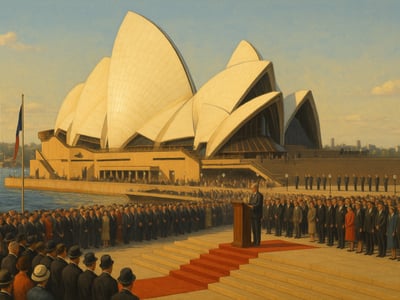
Sydney Opera House at Bennelong Point during its formal opening in Sydney in 1973.
On 20 October 1973, Queen Elizabeth II formally opened the Sydney Opera House at Bennelong Point in Sydney, placing one of the most ambitious public building projects in Australia into regular use. Set against Sydney Harbour, the ceremony presented the building as a completed national landmark. Yet the moment also carried the weight of a long and contested history: years of construction, engineering challenges, political argument, rising costs, and the notable absence of the architect whose design had first captured international attention.
A competition winner, not yet a building
By the time the Opera House opened, its silhouette was already widely recognizable. The sweeping roof forms, often compared to sails, shells, or sections of an orange, had transformed Bennelong Point into a site known far beyond Australia. But that visual clarity hid a more complicated story. The building that audiences were about to enter had taken shape through a process that was neither straightforward nor harmonious.
The story began with an international design competition. On 29 January 1957, the New South Wales government announced Danish architect Jørn Utzon as the winner. His proposal stood out for its boldness. Rather than offering a conventional monument, Utzon imagined a sculptural complex that would sit dramatically on the harbour edge. The design promised not only a home for performance, but also a new image for the city.
Construction at Bennelong Point began in 1959. From the beginning, the project pushed beyond familiar limits. The site itself was prominent, and expectations were high, but the form of the building created unusual technical problems. The great roof shells that gave the Opera House its identity were not easy to translate from drawing to construction. Engineers and builders had to work through methods that were still being developed as the project advanced. What looked effortless in outline required years of calculation, testing, and adaptation.
Shells, delays, and a rising bill
As work continued, time and cost became increasingly sensitive issues. Public projects are often judged not only by what they become, but by how efficiently they are delivered. The Opera House began attracting criticism for delays and for escalating expense. By the time of the opening in 1973, the project was widely reported as having cost about A$102 million, far above early expectations. This gap between original hopes and eventual reality helped turn the building into a subject of public debate long before the first formal ceremony was held there.
The sharpest break came in 1966, when Jørn Utzon resigned after disputes over payments and control of the work. His departure changed the meaning of the project. A building that had been closely identified with a single architectural vision now had to be completed without its original designer. That created a lasting question that has followed the Opera House ever since: how should credit be understood when a landmark depends both on an initial concept and on the many later decisions required to finish it?
Utzon leaves; the interiors still have to work
After Utzon's resignation, Peter Hall was appointed to lead completion of the interiors. His role was difficult and highly consequential. The exterior form already defined the building in the public imagination, but the internal spaces still had to be resolved for practical performance use. Completing the Opera House meant more than finishing surfaces; it required translating a powerful image into rooms, stages, halls, circulation routes, and technical systems that could function day after day. The result was a building shaped by both continuity and change.
This is part of what made the 1973 opening so significant. Ceremonies of state often simplify history. They compress years of argument and revision into a single public image of arrival. At the Opera House opening, the emphasis fell on celebration, pageantry, and national presentation. With Queen Elizabeth II presiding, the event signaled confidence and permanence. It introduced the complex to audiences not as an unfinished controversy, but as a cultural institution ready to serve the public.
An opening that turned a dispute into a place
That choice carried a risk. The project could easily have been remembered, at that exact moment, less as a triumph of architecture than as a cautionary story about conflict, authorship, and government management. Instead, the opening helped stabilize a new public meaning for the building. However divided its making had been, the Opera House was now a fact of civic life: a multi-venue performing arts complex on Sydney Harbour, visible, operational, and impossible to ignore.
The absence of Utzon from the completed project remained part of the story, and interpretations of authorship did not disappear. Nor did the debates over what had been lost or altered between the competition design and the finished interiors. But openings have a way of shifting perspective. Once people begin using a building—attending concerts, approaching it by ferry, seeing it in photographs, treating it as a meeting point or symbol—the building enters a different phase of history. It becomes not just a project, but a place.
Why it still matters
The opening of the Sydney Opera House still matters because it offers a clear example of how major public works are shaped by more than artistic ambition alone. The project remains a reference point in discussions of procurement, budgeting, and design governance. It is often cited when people ask how governments should manage landmark buildings whose cultural value may be obvious even when schedules and costs prove difficult to control.
It also continues to matter as a case study in the relationship between architectural vision and engineering constraint. The Opera House is admired for its daring form, but its history shows that bold design does not move directly from sketch to stone. It passes through negotiation, mathematics, materials, revised plans, and institutional decision-making. That process is part of the building's meaning, not separate from it.
Finally, the Opera House demonstrates how a cultural venue can become inseparable from urban identity. Its continued use links performance, tourism, and the global image of Sydney. Many buildings host events; fewer come to represent a city itself. The formal opening on 20 October 1973 marked the moment when that transformation became public. What had been a controversial construction site became, unmistakably, a lived landmark.
Timeline
- Utzon named winner of the design competition
- Construction begins at Bennelong Point
- Jørn Utzon resigns
- Queen Elizabeth II opens the Sydney Opera House
What you uncovered
More Than a Landmark
You didn't just complete a picture of the Sydney Opera House—you traced the public debut of a building shaped by design ambition, engineering revision, and political dispute.
The 1973 opening did more than present a new arts venue; it helped fix a complicated project into a confident public symbol. That matters because major civic buildings are often remembered through their finished image, even when their creation depended on compromise, revised authority, and difficult technical adaptation. The Opera House still serves as a useful case for thinking about how cultural prestige, public spending, and design governance become tied together.
Jørn Utzon, whose design won the international competition in 1957, resigned from the project in 1966 before the building was completed.
FAQ
When was the Sydney Opera House officially opened?
The Sydney Opera House was formally opened on 20 October 1973. Queen Elizabeth II performed the opening ceremony in Sydney.
Who opened the Sydney Opera House in 1973?
Queen Elizabeth II officially opened the Sydney Opera House. The ceremony took place in Sydney on 20 October 1973.
Where is the Sydney Opera House located?
It is located at Bennelong Point in Sydney, New South Wales, Australia. The building sits on Sydney Harbour.
How long did it take to build the Sydney Opera House?
Construction began in 1959 and the building was formally opened in 1973. That means the project took about 14 years from start to opening.
How much did the Sydney Opera House cost by 1973?
By the time it opened in 1973, the project was widely reported as having cost about A$102 million. That figure reflects the total reported cost at completion.