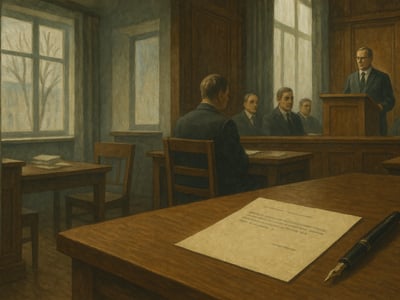

About this story
On 23 October 1958, the Swedish Academy awarded Boris Pasternak the Nobel Prize in Literature for his poetry and for the Russian epic tradition, at a moment when Doctor Zhivago had been published in Milan but not in the Soviet Union. Six days later he declined the prize under official pressure.
Boris Pasternak after the 1958 Nobel Prize in Literature announcement
On October 23, 1958, the Swedish Academy announced that Boris Pasternak had been awarded the Nobel Prize in Literature, honoring a writer already widely respected for his poetry but now internationally associated with a novel that had not been published in his own country. The announcement came from Stockholm. Pasternak, meanwhile, was living in Peredelkino near Moscow, where the news quickly became more than a literary distinction. Within days, the prize stood at the center of a conflict involving art, publication, state authority, and the international visibility of Soviet culture during the Cold War.
A citation wider than one novel
The Academy's citation praised Pasternak "for his important achievement both in contemporary lyrical poetry and in the field of the great Russian epic tradition." That wording mattered. Outside the Soviet Union, Pasternak was often discussed mainly through *Doctor Zhivago*. The citation, however, placed him in a broader literary frame, linking his verse and prose to a longer Russian tradition. It recognized not a single controversy, but a body of work.
Still, by 1958, *Doctor Zhivago* could not be separated from the circumstances of its publication. The novel had first appeared in 1957 through Giangiacomo Feltrinelli Editore in Milan after it had not been published in the Soviet Union. That route to readers abroad changed Pasternak's situation at home. A writer whose reputation had been built over decades as a poet and translator was now attached to a book circulating internationally without official Soviet publication. When the Nobel announcement followed, the meaning of the award was interpreted through that background.
Pasternak was not an obscure figure suddenly elevated by one event. By the middle of the 20th century, he had long been known in Russian literary life. He had published poetry that drew attention for its distinctive language and imagery, and he had also worked as a translator, a role that carried particular importance in Soviet literary culture. His standing, however, did not guarantee freedom from official pressure. The Soviet literary system depended on institutions, permissions, and ideological boundaries, and a writer's reputation could be complicated by changing political expectations.
A book that left the country first
That tension sharpened around *Doctor Zhivago*. The novel's path to publication outside the Soviet Union made it into more than a literary work. It became part of a wider argument over who controlled circulation, legitimacy, and interpretation. For foreign publishers and readers, the book represented access to a major Russian novel unavailable in the Soviet domestic press. For Soviet officials and institutions, foreign publication without domestic approval could be treated as a challenge to cultural authority. Those competing views were already present before the Nobel Prize was announced.
The prize therefore arrived in an atmosphere where literature was not treated as separate from politics. In Stockholm, the award could be presented in the language of literary merit. In the Soviet Union, it could also be read through questions of loyalty, prestige, and international rivalry. That did not make the prize unreal as a literary honor; rather, it meant that its consequences were shaped by more than literary judgment alone.
Pressure after the announcement
After the announcement, official Soviet opposition intensified. Press reaction and institutional pressure narrowed Pasternak's room to maneuver. The central human problem was immediate and personal: accepting the prize would bring one kind of recognition and one kind of risk, while refusing it would protect little of his dignity and confirm the pressure under which he was living. The question was not simply whether he wanted the award, but what acceptance might cost him in practical terms inside the Soviet Union.
This is what makes the episode so stark. An international prize is often imagined as the culmination of a career, a moment of unambiguous honor. For Pasternak, it became the opposite: a test of how much a writer could safely receive from abroad while remaining at home. His decision was not made in the abstract. It unfolded under circumstances in which his standing, safety, and ability to remain in the country could be affected.
A telegram that did not erase the prize
On October 29, 1958, six days after the original announcement, Pasternak sent a telegram to the Nobel Committee declining the prize. The speed of the reversal showed how quickly the situation had hardened. The refusal did not erase the award itself: the Swedish Academy had made its decision, and the reasons given in the citation remained. But the public outcome was now inseparable from coercive pressure surrounding the author.
Pasternak's case also revealed a wider contradiction in Cold War cultural life. States sought prestige through literature, music, science, and the arts, yet the same fields could become difficult to manage when recognition came on terms they did not control. The Nobel Prize was not created as an instrument of Soviet policy or anti-Soviet policy; nevertheless, in this case, it entered an international contest over meaning. That is one reason the event has endured as more than a Nobel footnote.
Why it still matters
The 1958 award remains important because it shows how literary recognition can become entangled with censorship and international politics even when the stated grounds are artistic. Pasternak was honored for his achievements as a writer, but the public life of the prize was shaped by where *Doctor Zhivago* had been published and by the political setting in which he lived. The case is therefore often used to illustrate how cultural institutions do not operate in isolation from state power.
It also remains a reference point for the role of publication across borders. A manuscript that could not appear in one country found readers in another, and that altered the author's status in both places. Translation, foreign publishing, and international awards did not merely spread literature; they changed the conditions under which literature was discussed and judged. During the Cold War, those channels could carry artistic work, political meaning, or both at once.
The story did not end in 1958. In 1989, Pasternak's son Yevgeny Pasternak received the Nobel medal and diploma in Stockholm on his father's behalf. That later ceremony did not remove the circumstances of the original refusal, but it marked a change in the public treatment of Pasternak's legacy. What had once been a moment of acute pressure could then be acknowledged in a more official and less punitive way.
Seen across those three dates—1957, when *Doctor Zhivago* was published in Milan; October 23, 1958, when the Nobel Prize was announced; and 1989, when the medal and diploma were finally received by his family—the episode traces a longer history of how literature moves, survives, and is remembered. Pasternak's Nobel Prize remains significant not because it produced a simple victory or defeat, but because it showed how a writer's work could cross borders more easily than the political system around him could accept.
Timeline
- Doctor Zhivago published in Milan
- Nobel Prize in Literature announced
- Pasternak declines the prize
- Pasternak’s son receives the medal in Stockholm
What you uncovered
When Recognition Becomes Pressure
You didn't just complete a puzzle—you traced the moment when a literary award collided with the political constraints surrounding Boris Pasternak at home.
Pasternak's Nobel Prize is often remembered as a literary distinction, but it also showed how hard it was to separate cultural recognition from state power during the Cold War. Once a book circulated across borders, it could alter not only an author's readership but also his political vulnerability. The episode remains a useful example of how prizes, publication networks, and international attention can change the meaning of literature beyond the page.
The Swedish Academy's 1958 citation praised Pasternak for "his important achievement both in contemporary lyrical poetry and in the field of the great Russian epic tradition."
FAQ
When was Boris Pasternak awarded the Nobel Prize in Literature?
On 23 October 1958, the Swedish Academy announced that Boris Pasternak had been awarded the Nobel Prize in Literature. The announcement was made in Stockholm.
Why did the Swedish Academy honor Boris Pasternak?
The Academy cited his important achievement in contemporary lyrical poetry and in the great Russian epic tradition. The award recognized his literary work as a whole.
What role did Doctor Zhivago play in the controversy?
Doctor Zhivago had first been published in 1957 in Milan after it had not been published in the Soviet Union. Its foreign publication became part of the controversy around Pasternak's Nobel award.
Why did Boris Pasternak decline the Nobel Prize?
On 29 October 1958, Pasternak sent a telegram to the Nobel Committee declining the prize after mounting pressure in the Soviet Union. The award had brought international prestige but also increased pressure at home.
When did Pasternak's family receive his Nobel medal and diploma?
In 1989, Pasternak's son Yevgeny Pasternak received the Nobel medal and diploma in Stockholm on his father's behalf.