

About this story
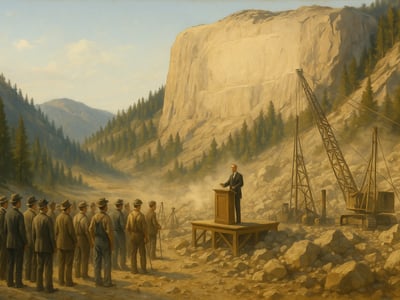
Cleveland Agreement concluded by Czech and Slovak delegates in Cleveland, Ohio, in 1915.
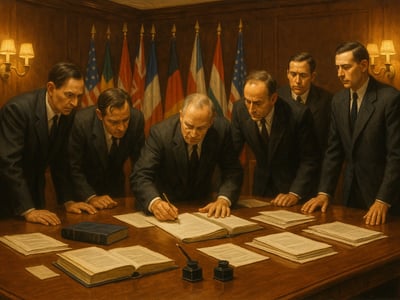
On October 23, 1915, delegates meeting at Bohemian National Hall in Cleveland, Ohio, concluded what became known as the Cleveland Agreement. The document was brief, but the question behind it was not. Czech and Slovak representatives in the United States were trying to define how they could pursue a shared political future during the First World War while also addressing a specific Slovak demand: that any common arrangement should include autonomy.
The agreement emerged from meetings held on October 22 and 23 between two émigré organizations, the Slovak League of America and the Czech National Association. Both groups were part of a wider wartime effort among expatriate communities to influence the future of Central Europe. The war had unsettled the old political order, and for many activists abroad, it also opened a rare chance to argue for a new one.
That did not mean unity came automatically. Czechs and Slovaks shared some political aims, especially opposition to the Habsburg framework that then governed their lands, but they did not approach the problem from identical positions. A common political declaration had to do more than express goodwill. It needed wording that each side could present to its own supporters as a meaningful and defensible step.
Cleveland was therefore not just a ceremonial gathering. It was a working meeting shaped by negotiation. The central issue was how to describe a future common state project without treating Slovak concerns as secondary or undefined. General declarations of cooperation were easier to draft than constitutional principles. The more specific the language became, the more clearly delegates had to confront the tension between unity and self-government.
Published texts of the Cleveland Agreement are commonly noted for doing both things at once. They supported a common political arrangement of Czechs and Slovaks, and they also included a provision for Slovak autonomy within that framework. That combination helps explain why the agreement has continued to attract attention in later historical discussion. It was not simply an appeal for solidarity. It was an attempt to put into writing a formula that balanced joint action with differentiated status.
The setting mattered too. Cleveland in the early twentieth century was home to active immigrant communities, voluntary associations, newspapers, and halls where political and cultural life overlapped. In that environment, Czech and Slovak organizations could meet, debate, and issue public statements with an audience already invested in events across the Atlantic. The agreement was signed in the United States, but it addressed the future of lands in Europe. That transatlantic character was one of its defining features.
The timing also gave the meeting significance. In late 1915, the future shape of postwar Europe was far from settled. No independent Czechoslovak state yet existed. Programs, alliances, and public declarations all had to be built before final outcomes were known. A written agreement between Czech and Slovak émigré bodies gave their cooperation a more concrete basis than informal sympathy alone. It offered a platform that could be cited in further organizing and diplomacy.
The choice to write down the autonomy language was especially important. It meant the delegates did not postpone the issue in the name of wartime unity. Instead, they accepted language that linked the two questions directly: cooperation on one side, Slovak self-government on the other. That did not resolve every future dispute, nor did it provide a finished constitutional design. But it did create a public record of how at least these organizations, at this moment, understood the relationship.
This is part of why the Cleveland Agreement is often discussed alongside later documents, especially the Pittsburgh Agreement of May 31, 1918. Historians frequently compare the two when examining promises, expectations, and interpretations of Slovak self-government in the movement that led to Czechoslovakia. The Cleveland text did not settle the later constitutional reality, but it established an early reference point that could not easily be ignored.
Its value in 1915 was practical as well as symbolic. A common declaration helped Czech-Slovak cooperation in the United States appear more organized at a crucial wartime moment. For émigré politics, that mattered. Diaspora organizations were not simply preserving identity abroad; they were trying to shape policy, influence opinion, and strengthen the legitimacy of a future state project. The Cleveland Agreement gave those efforts a clearer public expression.
At the same time, the document should not be read as if everyone involved understood its long-term meaning in exactly the same way. Agreements of this kind often work because they permit a degree of shared purpose without eliminating every difference in interpretation. The delegates found wording that both sides could endorse, but later generations would ask what those words had promised, how binding they were, and how they should be measured against later developments.
Why it still matters
The Cleveland Agreement still matters because it shows that the road to Czechoslovakia was shaped not only in ministries and battle zones, but also in immigrant meeting halls far from Europe. Exile and diaspora organizations played a real role in formulating political programs before 1918. Their statements helped define aims, build cooperation, and present those aims to broader audiences.
It also matters because the autonomy clause became part of a much longer conversation. Later debates about Czech-Slovak relations, constitutional arrangements, and the meaning of earlier political commitments often returned to texts like Cleveland. For historians, the agreement is valuable not because it offers a simple answer, but because it documents an early effort to reconcile two principles that would remain difficult to balance: common statehood and Slovak self-government.
Finally, the agreement is a reminder that diaspora networks can have political weight across borders. The delegates who met in Cleveland were operating outside the territory whose future they discussed, yet their cooperation contributed to a wider movement with consequences in Europe. In that sense, the Cleveland Agreement is both a local event in an American city and a chapter in the international history of state formation.
Timeline
- Cleveland meeting opens
- Cleveland Agreement concluded
- Pittsburgh Agreement signed
What you uncovered
Unity and Autonomy
You didn't just complete a puzzle; you traced how Czech and Slovak émigré groups turned a difficult constitutional question into a shared political statement.
The Cleveland Agreement matters not only for what it declared, but for where and how it was made. In a diaspora setting far from Central Europe, political organizers were already negotiating a future state in terms that tried to hold together two different priorities: common action and Slovak autonomy. That tension did not disappear after the document was signed; it became part of the larger constitutional conversation that followed.
Later historians often discuss the Cleveland Agreement alongside the Pittsburgh Agreement of 31 May 1918 when comparing formulations of Slovak self-government.
FAQ
What happened on 23 October 1915 in Cleveland?
On 23 October 1915, Czech and Slovak representatives completed the Cleveland Agreement in Cleveland, Ohio. It was concluded at Bohemian National Hall after meetings on 22 and 23 October.
Who took part in the Cleveland Agreement?
The meetings brought together delegates of the Slovak League of America and the Czech National Association. They met in Cleveland, Ohio, to negotiate a joint political declaration.
What did the Cleveland Agreement say about Slovak autonomy?
Published texts of the agreement supported a common political arrangement of Czechs and Slovaks while also providing for Slovak autonomy. That balance was central to the wording adopted in Cleveland.
Why is the Cleveland Agreement important in Czech-Slovak history?
It was an early step in Czech-Slovak political cooperation during World War I. Later discussions often compare it with the Pittsburgh Agreement because both address Slovak self-government within a shared state project.