About this story
On 18 August 1991 hard-line Soviet officials moved against Mikhail Gorbachev at his Crimean dacha in Foros, launching the August Coup just before a planned Union Treaty. The GKChP claimed emergency powers in Moscow, tanks appeared near the Russian White House, and Boris Yeltsin called for resistance. By 21 August the plot had collapsed, accelerating the final unraveling of central Soviet authority.
August 1991 Soviet crisis: Gorbachev was held in Foros as the GKChP acted in Moscow.
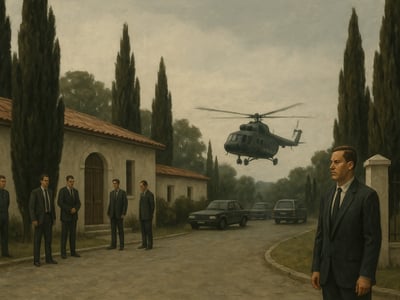
On 18 August 1991, a group of senior Soviet officials moved against President Mikhail Gorbachev at his state dacha in Foros, Crimea, setting off what became known as the August Coup. The action came just before the planned signing of a new Union Treaty on 20 August, an agreement intended to shift significant powers from the Soviet center to the republics. For hard-line figures in the state, party, security, and military leadership, that treaty represented a decisive loss of central authority. Their response was to try to halt the process by isolating Gorbachev and invoking emergency rule.
Isolation at Foros before the Union Treaty
The confrontation at Foros was the opening act of a three-day crisis. According to widely documented accounts, visitors linked to the plot demanded that Gorbachev declare a state of emergency. He did not do so. Instead, he was cut off from normal communications and effectively confined at the residence. While the exact motivations and calculations of individual participants have been debated ever since, the immediate practical aim was clear: prevent the transfer of power away from the Soviet center and present a new authority in Moscow as both legal and necessary.
The backdrop to this move lay in the final years of the Soviet Union. During the late 1980s, Gorbachev's policies of perestroika and glasnost had opened the political system and loosened controls that had long held the union together. Those reforms created space for public criticism, competitive politics, and stronger republican institutions. They also weakened old habits of command. By 1991, several republics were pressing for greater sovereignty, and the relationship between the central government and the republics had become increasingly unstable.
One of the most important political figures to emerge from that instability was Boris Yeltsin. Elected president of the Russian Soviet Federative Socialist Republic in June 1991, Yeltsin stood at the head of the largest republic within the union and had become a major rival to the Soviet center. The planned Union Treaty reflected this shifting balance. Rather than preserve the earlier structure unchanged, it would have acknowledged a looser arrangement in which republics held more power. For officials who feared disintegration, that looked less like reform than retreat.
The GKChP claims emergency power in Moscow
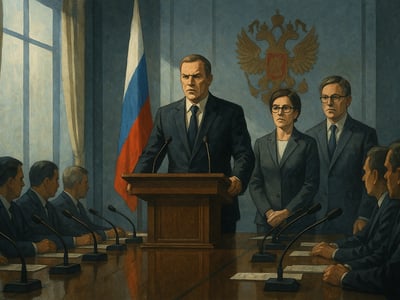
On 19 August 1991, the State Committee on the State of Emergency, usually known by its Russian initials GKChP, announced that Vice President Gennady Yanayev was assuming presidential powers because of Gorbachev's claimed inability to serve. The committee presented itself as a constitutional and stabilizing authority. It included senior figures associated with the central government, security institutions, and armed forces, among them Vladimir Kryuchkov, Dmitry Yazov, and Valentin Pavlov. The language of emergency was meant to suggest continuity, order, and legal succession at a moment of uncertainty.
That same day, armored units entered Moscow and were deployed around key sites, including areas near the Russian White House, the seat of the Russian parliament and presidency. Tanks in the capital gave visible form to the committee's claim to power, but they also exposed its dependence on coercive support. A declaration on paper was not enough. To succeed, the plot required obedience from ministries, broadcasters, regional authorities, soldiers, and the wider public. Any hesitation within those networks could become decisive.
Yeltsin's appeal and public resistance
Hesitation appeared quickly. From the Russian White House, Yeltsin rejected the GKChP's authority and issued appeals calling for opposition to its orders. His resistance became one of the defining images of the crisis. The Russian leadership treated the emergency committee not as a lawful succession but as an unconstitutional seizure of power. Crowds gathered around the White House, and makeshift barricades were erected. The confrontation in Moscow was tense, but it was also marked by uncertainty: much depended on whether military units would act against civilians and whether officials across the state would accept the committee's version of events.
The coup's weakness lay partly in that uncertainty. The plotters had important positions, formal titles, and access to the machinery of the state, yet they struggled to impose a unified chain of command. Their public appearances suggested control, but the reality was less solid. Some institutions delayed, some commanders proved reluctant, and some members of the broader Soviet apparatus waited to see which side would prevail. In a system that had long depended on vertical authority, visible hesitation could quickly erode the appearance of inevitability.
Collapse and the fracturing of Soviet authority
Across 19 to 21 August, the balance shifted further against the committee. Public resistance in Moscow continued, and the expected consolidation of military and administrative support did not fully materialize. Key backing weakened. The emergency committee, created to demonstrate that the Soviet center still had the power to command events, instead revealed how much that power had already diminished.
On 21 August 1991, the coup collapsed. Gorbachev returned to Moscow from Crimea, and the men who had attempted to rule in his name or in place of him lost their bid for control. But the failure of the coup did not restore the Soviet political system to its earlier condition. The attempted use of emergency mechanisms had shown, in real time, that the center could no longer reliably direct the union as it once had. Authority had fractured, and the effort to reverse that process had accelerated it instead.
Why it still matters
The August Coup remains important because it offers a concentrated example of how state crises unfold when constitutional procedure, emergency powers, and security institutions collide. The committee claimed legality through succession and necessity, yet its authority depended on acceptance by institutions and armed force. When that acceptance proved incomplete, the claim itself weakened. For historians and political analysts, the episode is a useful case study in the difference between formal power and effective power.
It also helps explain the final months of the Soviet Union. The coup was not the sole cause of the USSR's dissolution, but it changed the pace and sequence of events. It strengthened republican leaders, especially in Russia, and further damaged the authority of central Soviet institutions. By December 1991, the Soviet Union formally ceased to exist. The events that began at Foros on 18 August therefore matter not only as a failed seizure of power, but as a turning point in the transition from the late Soviet system to the post-Soviet order.
The episode continues to be studied as a crisis within a large federal state facing internal disagreement over sovereignty and authority. It shows how quickly institutions can be tested when competing centers of legitimacy emerge. Interpretations of the coup and its meaning still differ, but its place in the history of 1991 is clear: it marked the moment when an attempt to preserve the old center helped confirm that the old center was losing control.
Timeline
- Soviet coup attempt begins at Foros
- GKChP announces emergency committee
- Yeltsin issues opposition appeal
- Coup attempt collapses
- Dissolution of the Soviet Union
What you uncovered
When the Center Stopped Holding
You didn't just… complete a timeline puzzle; you traced the moment when an attempt to impose control instead revealed how fragile Soviet central power had become.
The coup is often remembered as a dramatic showdown, but it also exposed a deeper institutional problem: emergency powers still existed on paper while the authority needed to make them effective was already eroding. Once parts of the military, state apparatus, and republican leadership did not align behind the committee, the Soviet center could no longer reliably command the system it claimed to govern. That helps explain why the event mattered beyond three days in Moscow: it showed, in real time, that the union's formal structures were no longer enough to hold the state together.
On 19 August 1991, the GKChP declared that Vice President Gennady Yanayev was assuming presidential powers because Mikhail Gorbachev was said to be unable to serve.
FAQ
What happened on 18 August 1991 in the Soviet Union?
On 18 August 1991, senior Soviet officials moved against Mikhail Gorbachev and isolated him at his state dacha in Foros, Crimea. This began a three-day coup attempt as emergency measures were prepared in Moscow.
What was the State Committee on the State of Emergency?
The State Committee on the State of Emergency, or GKChP, was the group that announced it was taking emergency authority during the coup attempt. On 19 August 1991, it said Vice President Gennady Yanayev was assuming presidential powers because Gorbachev was claimed to be unable to serve.
Why was Mikhail Gorbachev in Foros on 18 August 1991?
He was at the presidential dacha in Foros, Crimea, when visitors linked to the plot demanded that he declare a state of emergency. After that, he was isolated there as the coup began.
What role did Boris Yeltsin play during the August Coup?
On 19 August 1991, Boris Yeltsin issued appeals from the Russian White House rejecting the GKChP and calling for opposition to its orders. His public stance became a major point of resistance in Moscow.
How did the failed coup affect the Soviet Union?
The coup collapsed on 21 August 1991 after key military support weakened, and Gorbachev returned to Moscow from Crimea. The failed attempt is widely seen as a turning point on the road to the Soviet Union's end later that year.