
About this story
On 23 August 1939 Nazi Germany and the Soviet Union signed a non-aggression pact in Moscow, known as the Molotov–Ribbentrop Pact. The public text pledged to avoid conflict, while a secret additional protocol divided parts of Eastern Europe into spheres of influence — and within two weeks war began.
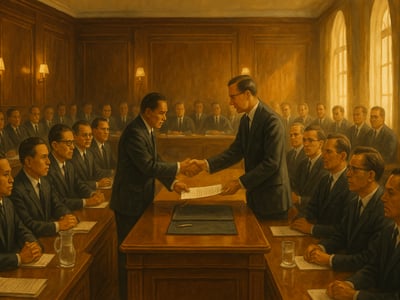
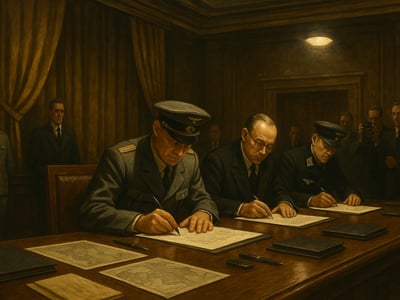
Molotov and Ribbentrop sign the German-Soviet pact in Moscow, 23 August 1939.
On August 23, 1939, Nazi Germany and the Soviet Union signed a non-aggression pact in Moscow, an agreement that surprised much of the world because the two states had long presented themselves as ideological enemies. Signed by the foreign ministers Joachim von Ribbentrop and Vyacheslav Molotov in the Kremlin, the pact stated publicly that the two governments would refrain from military conflict with one another. Behind that public text, however, stood a secret additional protocol that divided parts of Eastern Europe into spheres of influence.
A surprising deal between enemies
The agreement came at a moment of extreme tension in Europe. During 1939, Germany had already dismantled the post-World War I order step by step, and the future of Poland had become a central issue. At the same time, Soviet leaders were weighing their options in a rapidly changing diplomatic environment. Talks involving Britain, France, and the Soviet Union had failed to produce a security arrangement that Moscow considered reliable. Germany, by contrast, offered the possibility of an immediate and concrete bargain.
That bargain required both sides to put aside their public hostility. Adolf Hitler wanted freedom of action as he prepared for war against Poland and sought to avoid the danger of a two-front conflict at the start of a major campaign. Joseph Stalin, for his part, faced the risks of European war while also seeking strategic distance from potential threats along the Soviet Union’s western frontier. The result was a short-term diplomatic deal built less on trust than on calculation.
Public text and secret protocol
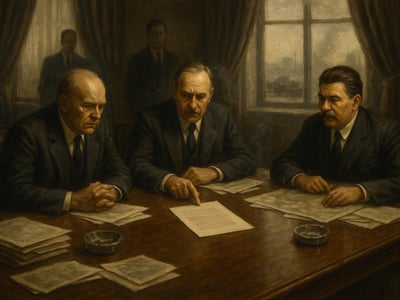
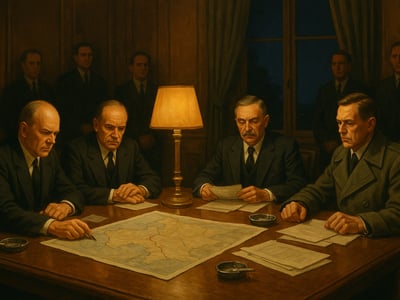
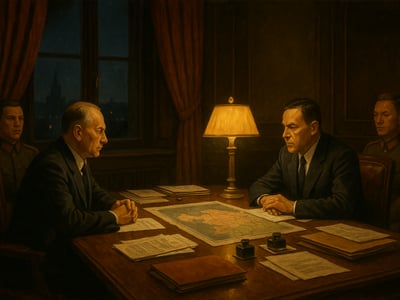
Ribbentrop traveled to Moscow for direct negotiations, a sign that the discussions had moved quickly and had become a matter of highest priority. The final talks centered not only on the wording of the non-aggression agreement itself but also on the more consequential question of territory. The secret protocol dated August 23, 1939, set out German and Soviet spheres of influence in Finland, Estonia, Latvia, eastern Poland, and Bessarabia. In public, the pact looked like a pledge of peace between two states. In private, it mapped out how both expected to benefit from the weakening or destruction of neighboring countries’ independence.
The contrast between the public and secret parts of the agreement has made the pact especially important in the history of diplomacy. Non-aggression pacts were not unusual in interwar Europe, and governments often used them to buy time or reduce immediate military risk. What made this agreement different was the extent to which it was tied to territorial planning in Eastern Europe. It was not only a promise to avoid attacking one another. It was also a framework for rearranging a region.
From Moscow to the invasion of Poland
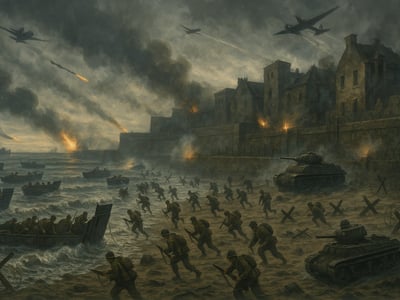
That framework mattered almost immediately. On September 1, 1939, less than two weeks after the signing in Moscow, Germany invaded Poland. The invasion marked the beginning of the European war phase of World War II. Then, on September 17, 1939, Soviet forces entered eastern Poland after the country had already been attacked from the west. These moves were not identical in purpose or presentation, but together they reflected the strategic logic made possible by the August pact and its secret protocol.
For Poland, the consequences were immediate and severe. The country faced attack from both sides, and its territory became the subject of partition arrangements made without Polish participation. For the Baltic region and for other areas named in the secret protocol, the pact also signaled that the future would be shaped by decisions taken in Berlin and Moscow rather than by the states directly affected. This is one reason the agreement occupies such a central place in the historical memory of Eastern Europe.
Memory and meaning for Eastern Europe
The pact did not create a lasting partnership between Germany and the Soviet Union. It was a temporary arrangement between regimes with opposing ideologies and incompatible long-term ambitions. Yet temporary agreements can have enormous consequences. By reducing immediate uncertainty between Berlin and Moscow, the pact removed one of the obstacles that might have complicated German plans against Poland. It also gave Soviet leaders a territorial arrangement they were prepared to accept under the conditions of late August 1939.
Later history added another layer to the story. For many years, the existence and meaning of the secret protocol remained a major point of dispute in public memory and official acknowledgment. Over time, archival publication and historical research established its place at the center of understanding the pact. Today, it is not possible to explain the significance of August 23, 1939, only through the published non-aggression text. The secret protocol is essential to the event itself.
Why it still matters
The Molotov–Ribbentrop Pact remains important because it shows how formal diplomacy can operate on two levels at once: a public agreement presented as a stabilizing measure, and a concealed arrangement determining the fate of other states. That tension continues to make the pact a key case study in international history.
It also remains central to debates about historical memory, especially in Poland and the Baltic states. In those countries, the pact is not remembered simply as a diplomatic episode but as a step tied to occupation, loss of sovereignty, and long-term political consequences. The same document that appeared publicly as a non-aggression agreement carried private terms with immediate effects on the map of Eastern Europe.
More broadly, the pact stands as a warning about what can happen when great powers negotiate security and territory over the heads of smaller nations. Its history is not only about Germany and the Soviet Union. It is also about the countries whose future was discussed, divided, and altered without their consent. That is why the agreement signed in the Kremlin on August 23, 1939, remains a reference point far beyond the diplomatic history of the Second World War.
Timeline
- Molotov–Ribbentrop Pact signed
- Germany invades Poland
- Soviet forces enter eastern Poland
What you uncovered
Diplomacy in Two Layers
You didn't just… complete a date-based challenge; you reconstructed a moment when formal diplomacy and hidden territorial planning moved in parallel.
What made this pact especially consequential was not only the public promise of non-aggression, but the fact that it sat alongside a secret map of influence. That contrast shows how states can use official legal language to project stability while privately arranging outcomes for other countries. It remains a useful case for understanding how major-power bargains can exclude the people most affected by them.
The secret additional protocol of 23 August 1939 assigned spheres of influence in Finland, Estonia, Latvia, eastern Poland, and Bessarabia.
FAQ
What was the Molotov–Ribbentrop Pact?
It was a German-Soviet non-aggression pact signed on 23 August 1939 in Moscow. The agreement said Nazi Germany and the Soviet Union would refrain from military conflict with each other.
Who signed the pact in Moscow?
Joachim von Ribbentrop signed for Germany and Vyacheslav Molotov signed for the Soviet Union. The pact was signed in the Kremlin in Moscow.
What did the secret protocol include?
A secret additional protocol dated 23 August 1939 assigned spheres of influence in Finland, Estonia, Latvia, eastern Poland, and Bessarabia. It accompanied the public non-aggression agreement.
What happened after the pact was signed?
Germany invaded Poland on 1 September 1939, less than two weeks later. On 17 September 1939, Soviet forces entered eastern Poland after the Polish state had already been attacked from the west.