
About this story
On 27 October 1949, the Slovak Philharmonic gave its first public concert in the Slovak National Theatre building in Bratislava, conducted by Ľudovít Rajter. The programme included Alexander Moyzes's Dolu Váhom and Dvořák's Symphony No. 8. The Slovak National Council had passed the law creating the orchestra on 18 December 1948, and the ensemble had begun work on 1 September 1949. The evening turned an institution on paper into a public orchestra.
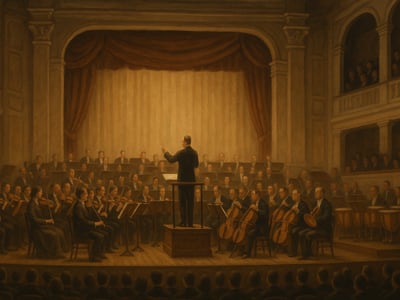
Debut public concert of the Slovak Philharmonic at the Slovak National Theatre, 1949.
On 27 October 1949, the Slovak Philharmonic gave its first public concert in the building of the Slovak National Theatre in Bratislava. Conducted by Ľudovít Rajter, the performance marked the moment when a newly organized orchestra moved from administrative existence into public musical life. In postwar Czechoslovakia, that kind of debut mattered: an institution was not fully real to audiences until it appeared before them, played together, and demonstrated that it could sustain the demands of concert performance.
A debut that had to prove an institution
The event was, on its face, a concert. But it was also a test. A new orchestra had to show more than technical ability. It had to prove that rehearsals, planning, funding, and artistic leadership could be turned into something coherent in front of listeners. Public debuts often carry a double burden. They introduce music to an audience, but they also introduce an institution to civic life. For the Slovak Philharmonic, the concert in Bratislava was the first public sign that Slovakia now had a permanent, state-supported symphonic ensemble prepared to take a place in the country’s cultural structure.
Bratislava was the natural setting for that introduction. In 1949 it was the principal Slovak cultural center within Czechoslovakia, and the Slovak National Theatre building offered a prominent venue for such an occasion. The Philharmonic did not yet have the settled identity that later generations would associate with its own home and long-established traditions. Like many cultural organizations in their early stages, it began in a shared civic space. That detail is easy to overlook, but it says something important about how institutions grow. They often start by making use of existing public buildings and established urban stages before developing a more permanent home of their own.
The choice of conductor also mattered. Ľudovít Rajter stood at the center of the orchestra’s first public appearance, shaping not only the performance itself but also the ensemble’s first impression. A founding conductor’s role is difficult to separate into neat categories. He must prepare players, define standards, create discipline, and turn a new group of musicians into something that audiences recognize as an orchestra rather than simply a collection of performers. In a debut concert, that work becomes visible all at once.
Rajter and a first audience in Bratislava
For audiences in Bratislava, the significance of the evening would have been practical as well as symbolic. Concertgoers were not attending an anniversary or a retrospective. They were witnessing a beginning. The Slovak Philharmonic was entering the city’s musical life in real time, asking to be heard and, by implication, asking to be trusted as a durable institution. A first concert cannot guarantee long-term success, but it can establish credibility. If the launch had gone poorly, the orchestra’s public standing might have been weakened at exactly the moment when it most needed authority and recognition.
That is why first performances often matter more than the simple phrase “public debut” suggests. They transform a plan into an experience. Before 27 October 1949, the Slovak Philharmonic could be described as a newly established ensemble. After the concert, it had become an orchestra with a public appearance behind it, an audience in front of it, and a place—however new—in the cultural calendar of Bratislava.
Postwar culture, before a hall of its own
The occasion also belongs to a broader postwar story. After 1945, many European states expanded or reorganized cultural institutions, including orchestras, theatres, and other publicly supported bodies. These institutions served artistic purposes, but they also reflected a belief that high culture should be organized, maintained, and made visible through permanent structures. The Slovak Philharmonic’s first public concert fits within that pattern. It was not an isolated evening detached from its time; it was part of a larger effort to build durable cultural life through formal institutions.
Over time, the orchestra would become associated with the Reduta building as its home, but on that October evening in 1949 the essential fact was simpler. A new Slovak symphony orchestra stood before a public audience and played. The importance of the performance lay less in spectacle than in confirmation. The ensemble existed, it functioned, and it had entered the public sphere.
Why it still matters
The first public concert of the Slovak Philharmonic still matters because it captures a basic truth about cultural history: institutions are not created only by decrees, budgets, or official announcements. They become real through use, repetition, and public presence. The concert of 27 October 1949 was the point at which a new orchestra became visible as a working part of Slovak musical life.
It also marks an early stage in the development of professional symphonic culture in Slovakia. Later achievements, tours, recordings, and traditions all depend on earlier moments when an ensemble first established standards and earned public recognition. Looking back at this debut helps explain how a permanent orchestral institution takes shape over time.
Finally, the event is a reminder that major cultural organizations often begin in borrowed or shared settings. Before dedicated halls and established routines, there is usually a first performance in an existing civic venue. The Slovak Philharmonic’s debut in the Slovak National Theatre building shows how lasting institutions can emerge step by step, beginning with a single evening in front of an audience.
Timeline
- Slovak National Council passes the Philharmonic law
- The ensemble begins work
- First public concert at the Slovak National Theatre
What you uncovered
When an Orchestra Becomes Public
You didn't just… complete a puzzle; you traced the moment a newly formed orchestra stepped into public life before its first audience.
A cultural institution does not become real to the public simply because it has been founded on paper. It becomes visible when people can hear it, judge it, and begin to place it within civic life. That is why a debut concert can matter beyond music itself: it marks the point where organization turns into presence.
The Slovak Philharmonic's first public concert was held in the building of the Slovak National Theatre in Bratislava and was conducted by Ľudovít Rajter.
FAQ
When did the Slovak Philharmonic give its first public concert?
The Slovak Philharmonic gave its first public concert on 27 October 1949.
Who conducted the Slovak Philharmonic's debut performance?
The debut performance was conducted by Ľudovít Rajter.
Where was the first public concert of the Slovak Philharmonic held?
It was held in the building of the Slovak National Theatre in Bratislava.
Why was the 27 October 1949 concert important?
It marked the ensemble’s public debut and introduced the newly established Slovak Philharmonic to a concert audience in Bratislava.