
About this story
On 9 November 1989, Berlin border crossings opened after Günter Schabowski said on television that new East German travel rules applied immediately. Crowds gathered at checkpoints, including Bornholmer Straße, where Harald Jäger and his staff allowed unrestricted passage that night. Other crossings opened before morning. Much of the Wall still stood; German reunification followed on 3 October 1990.
Bornholmer Straße opened to unrestricted passage late on 9 November 1989; other crossings followed overnight.
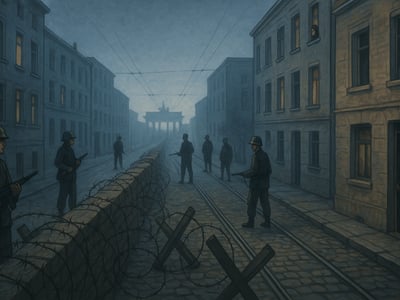
On November 9, 1989, thousands of East Germans approached Berlin’s border checkpoints expecting to be allowed into the western half of their city. A televised announcement about new travel regulations had suggested that restrictions were being lifted immediately. At the crossings, however, personnel had no clear instructions authorizing unrestricted passage. Late that evening, the checkpoint at Bornholmer Straße opened, and others followed during the night. A border that had divided Berlin since 1961 could suddenly be crossed.
Months of pressure on a closed city
The opening came after months of pressure on East Germany’s leadership. During 1989, East Germans had left the country through routes involving Hungary and Czechoslovakia, while demonstrations within East Germany demanded political change. The large demonstration in Leipzig on October 9 was a significant moment in that movement. On October 18, Erich Honecker was replaced by Egon Krenz as leader of the ruling Socialist Unity Party. The leadership changed, but demands for freedom of movement and political reform continued.
For people living with the Berlin border, travel restrictions were not an abstract policy. They shaped family relationships, friendships, employment, and the ordinary possibility of visiting another part of the city. Since the closure of the sector border on August 13, 1961, and the construction of the Wall, crossing without permission had carried grave risks. People had been killed, injured, or imprisoned in connection with attempts to escape. Those experiences remained part of the border’s meaning even as crowds gathered to cross it.
The immediate turning point began at East Berlin’s International Press Center on Mohrenstraße. During a televised press conference, Socialist Unity Party official Günter Schabowski presented changes to East Germany’s travel regulations. Asked when the rules would take effect, he answered that, according to his knowledge, they applied immediately and without delay.
A televised answer without clear orders
That answer mattered because it sounded like an announcement that people could act on at once. It did not clearly convey the administrative procedures intended to put the regulations into effect. Viewers heard an apparent opening of the border, while the personnel responsible for controlling that border had not received corresponding instructions for unrestricted movement.
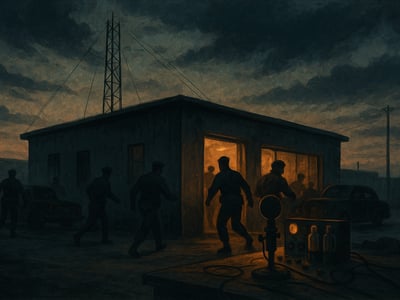
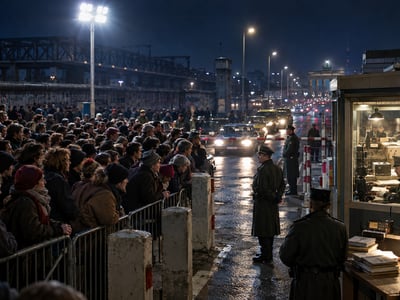
As the news spread, people began arriving at checkpoints between East and West Berlin. At Bornholmer Straße, where the crossing ran across the Bösebrücke bridge, civilians expected the announced change to be honored. Each arrival made the question less theoretical: would the checkpoint let them pass, or would the authorities continue to enforce restrictions that television appeared to have lifted?
The crowd at Bornholmer Straße
Harald Jäger, the State Security officer overseeing passport control there that evening, sought guidance from superiors as the crowd grew. Accounts differ on the precise timing and internal sequence of decisions. The broad situation is clear, however: checkpoint personnel faced increasing public pressure without clear authorization to admit everyone who wanted to cross.
The choice carried risks on both sides. Maintaining restrictions against a growing crowd could lead to a dangerous confrontation. Allowing unrestricted passage meant acting without explicit authorization to abandon the existing controls. The civilians waiting at the checkpoint could not know with certainty how the personnel would respond, and those personnel could not rely on a clear, workable order resolving the situation.
Passage opens while the Wall still stands
Late that evening, Jäger and personnel at Bornholmer Straße allowed unrestricted passage. People crossed into West Berlin through a checkpoint that had previously enforced the division of the city. During the night of November 9–10, additional crossings opened. What had begun as pressure at particular checkpoints became a broader opening of Berlin’s border.
This was not the achievement of one official or the automatic consequence of one sentence. Public demonstrations, departures from East Germany, a leadership under pressure, the arrival of crowds, and decisions made at the crossings all formed part of the outcome. Schabowski’s announcement helped bring these forces together at a particular place and time; it did not create them.
Why it still matters
The opening shows how a public announcement can change events before an administration has established how to implement it. Once people arrived expecting passage, the authorities were no longer dealing only with the wording of a regulation. They faced citizens asking them to honor what had been publicly announced. A communication failure had become an immediate test of state authority.
It also illustrates the difference between a barrier’s physical presence and its practical power. Much of the Wall remained standing after the crossings opened. Yet its function as a means of preventing movement had been fundamentally breached. Concrete did not have to disappear everywhere before people could begin passing through the border.
The familiar description of November 9 as the “fall of the Berlin Wall” captures that decisive change, but it compresses several different developments. The opening of the crossings, the subsequent dismantling of the border structures, and German reunification were not one event. Reunification followed on October 3, 1990, after further political decisions and negotiations.
For those crossing that night, the immediate change was more direct: a route that had been closed was now open. Germany’s political future remained unsettled, but movement through Berlin no longer depended on the restrictions that had divided the city for decades.
Timeline
- Berlin sector border closed
- Leipzig demonstration
- Egon Krenz replaces Erich Honecker
- Berlin border crossings open
- German reunification
What you uncovered
Between Announcement and Action
You didn't just… complete a puzzle; you traced a moment when people gained passage through a border that had restricted movement and cost lives.
Public expectations can move faster than the administrative machinery meant to govern them, leaving frontline personnel to confront the gap between an announcement and enforceable instructions. Berlin’s crossings show how a border can lose its practical force while its physical barriers remain standing. Opening passage, dismantling those barriers, and negotiating reunification were distinct processes, not a single event.
The Bornholmer Straße crossing took its name from the street that runs across the Bösebrücke bridge.
FAQ
What happened on 9 November 1989 in Berlin?
On 9 November 1989, Berlin border crossings began opening after Günter Schabowski announced changes to East German travel regulations at a televised press conference. Late that evening, the Bornholmer Straße crossing allowed unrestricted passage, and other crossings opened during the night of 9–10 November.
Who was Günter Schabowski in this event?
Günter Schabowski was a Socialist Unity Party official who presented the travel regulation changes at the International Press Center in East Berlin. When asked when the rules would take effect, he said, according to his knowledge, immediately and without delay.
Why did crowds gather at the border checkpoints?
People assembled at Berlin border checkpoints, including Bornholmer Straße, because they expected the announced travel changes would let them cross to West Berlin. The checkpoint personnel, however, still lacked clear instructions for how to implement the new rules.
What happened at Bornholmer Straße that night?
Late on 9 November 1989, Harald Jäger and personnel at Bornholmer Straße allowed unrestricted passage through the checkpoint. Accounts differ on the precise timing and decision sequence, so minute-by-minute reconstructions depend on the source.
Did the Berlin Wall disappear on 9 November 1989?
No. The opening of the border crossings was not the same as the Wall being physically demolished, and German reunification came later, on 3 October 1990.