
About this story
At 11 a.m. French time on 11 November 1918, the armistice between Germany and the Allied powers halted fighting on the Western Front. Matthias Erzberger, Ferdinand Foch, and Rosslyn Wemyss were among those who signed in a railway carriage in the Forest of Compiègne around 5 a.m. Hostilities had continued in the hours before the ceasefire. The Treaty of Versailles was signed on 28 June 1919.
Signed near Rethondes, the armistice halted fighting on the Western Front at 11 a.m. on 11 November 1918.
At 11 a.m. French time on 11 November 1918, the armistice between Germany and the Allied powers took effect, bringing fighting on the Western Front of the First World War to a halt. Across the battlefields of France and Belgium, armies were required to cease hostilities at a common hour. The agreement marked a decisive break after more than four years of war, but it was not a final peace settlement.
A military halt, not yet a peace
The document had been signed earlier that morning in a railway carriage in the Forest of Compiègne, near Rethondes in France. Its immediate purpose was military: to stop hostilities under agreed conditions. The work of establishing a postwar settlement would follow through a separate diplomatic process.
By the autumn of 1918, the military situation had turned against Germany. The Allied Hundred Days Offensive had driven German forces back, and Germany had sought an armistice. An agreement nevertheless required more than a willingness to stop fighting. The two sides had to establish the conditions under which military operations would cease and determine what Germany would be required to withdraw or surrender.
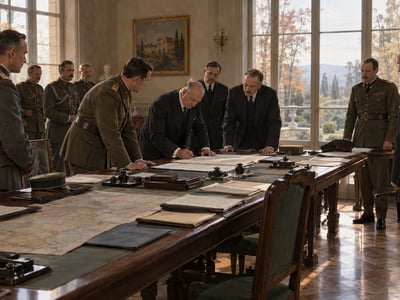
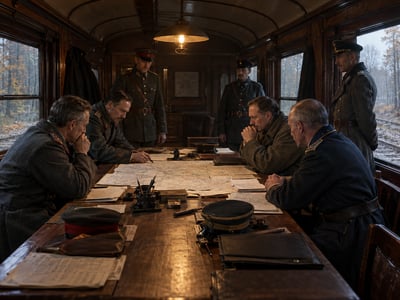
On 8 November, a German delegation headed by Matthias Erzberger met Ferdinand Foch, the Allied supreme commander, in his railway carriage in the Forest of Compiègne. There the delegates received the Allied terms. Rosslyn Wemyss, the British First Sea Lord, represented the Allied naval position and would be among the signatories.
Terms in a railway carriage
For Erzberger and his colleagues, accepting the terms meant agreeing to substantial military obligations, including withdrawals and the surrender of equipment. These provisions were intended to do more than interrupt the fighting: they would limit Germany’s ability to resume it. Refusing an agreement, however, meant that hostilities would continue. The delegation’s decision therefore concerned both the immediate cessation of combat and the military position that would follow.
At approximately 5 a.m. on 11 November, the armistice was signed. Erzberger, Foch, and Wemyss were among those who signed the document. The setting was a railway carriage rather than a diplomatic palace, but the agreement reached there had to be carried out by forces spread across an extensive front.
Six hours between signature and silence
Article I required the cessation of hostilities on land and in the air six hours after signing. The ceasefire took effect at 11 a.m. French time. That interval separated the decision made by the representatives from its implementation by the armies. Orders had to pass through military chains of command and reach formations whose actions needed to conform to the same deadline.
Fighting continued during the hours before the ceasefire came into force, and lives were still lost. The existence of a signed agreement did not itself silence weapons. Its effect depended on orders being transmitted, received, and obeyed. The familiar hour of eleven thus marks the implementation of the agreement, not the moment when the delegates put their names to it.
From a 30-day armistice to Versailles
The armistice also contained a time limit. Article XXXIV established an initial duration of 30 days, with the possibility of extension. It was subsequently extended while preparations and negotiations for peace continued. This provisional structure mattered: the agreement stopped military operations without claiming to resolve all the questions left by the war.
The Treaty of Versailles was signed at the Palace of Versailles on 28 June 1919 and entered into force on 10 January 1920. It belonged to a different stage of the process, setting out peace terms with Germany rather than simply ordering a cessation of hostilities. Neither the November armistice nor that treaty should be treated as a single instrument that ended every conflict associated with the First World War.
Why it still matters
The distinction between an armistice and a peace treaty helps explain how wars move from fighting toward settlement. A military agreement can stop operations while leaving major political and legal questions unresolved. In this case, the guns on the Western Front fell silent months before the treaty with Germany was signed, and longer still before it entered into force.
The events also show that an agreement is only one part of a ceasefire. A specified hour has practical meaning only when commands can communicate it and forces can act on it. The railway carriage and the front line were connected by the institutions and communications needed to turn a written obligation into a coordinated halt.
Over time, 11 November and the hour of eleven became central to remembrance practices in several countries. Such observances give communities a shared moment in which to remember those who died and those whose lives were changed by the war, though traditions and interpretations differ.
Remembering the armistice accurately means holding its achievement and its limits together. It halted fighting on the Western Front. It did not complete the peace settlement or remove the consequences of the war. The silence that began that morning was a profound change, and the beginning of another, longer process.
Timeline
- Armistice terms presented
- Armistice takes effect
- Treaty of Versailles signed
- Treaty of Versailles enters into force
What you uncovered
Between Agreement and Action
You didn't just… complete a puzzle; you revisited the moment when an agreement to stop fighting took effect across the Western Front.
The familiar 11 a.m. moment marks implementation, not signature: an agreement depended on orders reaching armies and being carried out at a shared hour. Its renewable terms also separated the immediate task of stopping hostilities from the longer process of establishing a legal peace. Remembering a single moment can give history a clear marker without making that moment the end of every unresolved question.
The German delegation headed by Matthias Erzberger first received the Allied armistice terms in Foch’s railway carriage on 8 November 1918.
FAQ
When did the armistice with Germany take effect?
It took effect at 11 a.m. French time on 11 November 1918. The agreement had been signed earlier that morning.
Where was the armistice signed, and who signed it?
It was signed near Rethondes in the Forest of Compiègne, France, in a railway carriage. The signatories included Matthias Erzberger, Ferdinand Foch, and Rosslyn Wemyss.
Why did the ceasefire begin at 11 a.m. instead of right after signing?
Article I required hostilities to stop six hours after the signing. That delay gave armies time to receive and carry out the orders.
What was the difference between the armistice and the Treaty of Versailles?
The armistice was a temporary cessation of hostilities, initially set for 30 days and extendable. The Treaty of Versailles was the later peace settlement, signed on 28 June 1919 and entering into force on 10 January 1920.