
About this story
On 14 November 1969, at 11:22 a.m. Eastern Standard Time, Apollo 12 lifted off from Launch Complex 39A at Kennedy Space Center. Charles Conrad, Richard Gordon, and Alan Bean were aboard when lightning disrupted the spacecraft’s electrical systems during ascent. The crew and mission control recovered the vehicle and continued. Conrad and Bean landed on the Moon on 19 November, four months after Apollo 11.
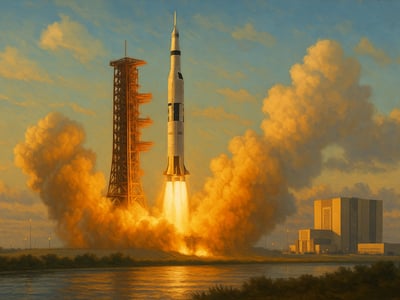
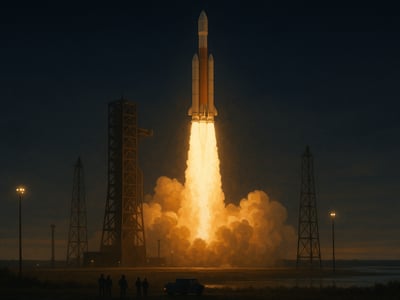
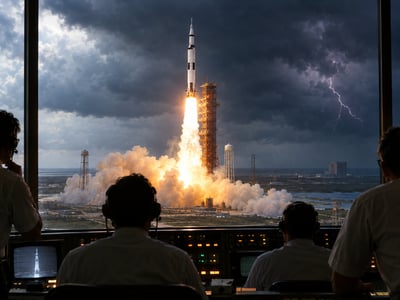
Apollo 12 launched from Kennedy Space Center's Launch Complex 39A on November 14, 1969.
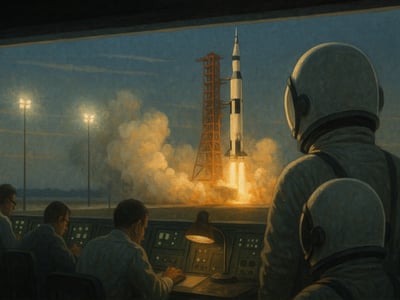
On November 14, 1969, at 11:22 a.m. Eastern Standard Time, Apollo 12 lifted off from Launch Complex 39A at Kennedy Space Center in Florida. Aboard the Saturn V were commander Charles “Pete” Conrad, command module pilot Richard Gordon and lunar module pilot Alan Bean. Their mission was the next crewed attempt to land on the Moon after Apollo 11. Shortly after liftoff, lightning disrupted the spacecraft’s electrical systems, confronting the crew and mission controllers with an unexpected problem during ascent.
Four months after Apollo 11
Only four months earlier, Apollo 11 had achieved the first crewed lunar landing. Apollo 12 followed that success, but the earlier mission could not remove the hazards facing the next flight. A new crew still had to leave Earth, travel to the Moon and return. Before any lunar operations could begin, the spacecraft had to pass through the atmosphere above its Florida launch site.
The three astronauts had distinct responsibilities. Conrad commanded the mission. Gordon was the command module pilot, responsible for the spacecraft that would remain in lunar orbit during the landing expedition. Bean was the lunar module pilot and would accompany Conrad to the surface. At launch, however, all three were aboard the command module, beginning the journey together on top of the Saturn V.
Lightning during ascent
Liftoff marked the start of a tightly sequenced flight. The launch vehicle had to carry the spacecraft away from the pad and accelerate it toward Earth orbit before the mission could proceed toward the Moon. During this phase, the astronauts and controllers depended on instruments and communications to understand how the flight was progressing. An unexpected electrical disturbance therefore presented both a systems problem and a problem of assessment: what was happening, and what did it mean for continuing the mission?
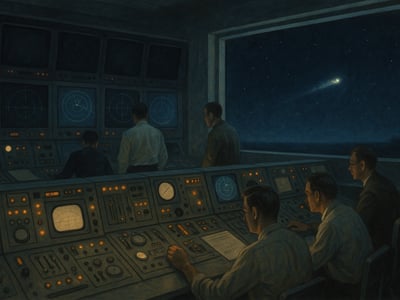
Lightning struck during the ascent and temporarily disturbed the spacecraft’s electrical systems. This was not simply bad weather observed from a distance. It directly affected the vehicle carrying the astronauts. The crew and the ground team had to evaluate the spacecraft’s condition while the launch was already underway, with limited time to interpret the disruption.
Recovering the spacecraft
The central question was whether Apollo 12 could safely continue. A disturbance serious enough to compromise the spacecraft could have prevented the lunar mission from proceeding. At the same time, an electrical anomaly did not by itself establish the condition of every part of the flight system. The immediate task was to assess the actual effects rather than assume either that the mission was lost or that the problem was harmless.
Apollo 12 continued its ascent without an abort. The electrical disruption was temporary, and the mission went on toward the Moon. That outcome is the essential fact of the launch-day episode, but it should not obscure the uncertainty faced while the incident was unfolding. Knowing the eventual result is different from making a decision with the information available at the time.
The landing on 19 November
The launch and the lunar landing were separate milestones. Apollo 12 left Earth on November 14; Conrad and Bean landed on the Moon on November 19. The later landing established that the expedition had continued beyond its troubled departure, but the launch deserves attention in its own right. Before the astronauts could carry out their work at the Moon, the crew and controllers had to get through an electrical disruption close to Earth.
Why it still matters
Apollo 12’s launch remains a useful case study in assessing failures under time pressure. During ascent, identifying a warning is only the beginning. Operators must also determine its scope, consider its consequences and decide whether the conditions for continuing flight still hold. The episode illustrates why spacecraft operations require both technical knowledge and a structured way to evaluate incomplete information.
It also connects spaceflight engineering with the environment in which a launch takes place. A rocket does not leave weather behind the moment it lifts off. Atmospheric hazards can affect the vehicle during departure, making weather assessment part of the engineering and operational problem rather than a separate concern. The incident became part of NASA’s examination of lightning hazards and launch-weather criteria.
The lesson is not that a successful outcome makes the original risk negligible. Apollo 12 reached the Moon despite a disruption that could have ended its lunar mission. Its departure shows how the history of exploration includes not only destinations reached, but also the assessment of unexpected failures along the way.
Timeline
- Apollo 11 lunar landing
- Apollo 12 launch
- Apollo 12 lunar landing
What you uncovered
Between Disruption and Decision
You didn't just… complete a puzzle; you revisited a launch that tested how crews and controllers assessed an unexpected disruption.
Detecting a malfunction and deciding whether to abort are distinct judgments: the second depends on what the disturbance means for continued flight. Apollo 12 illustrates why time-critical operations require an assessment of consequences, not simply recognition that something has gone wrong. The mission’s continuation did not, by itself, establish that the weather risk had been acceptable.
Apollo 12’s Saturn V lifted off from Launch Complex 39A at Kennedy Space Center at 16:22 UTC.
FAQ
When did Apollo 12 launch from Kennedy Space Center?
Apollo 12 launched on 14 November 1969 at 16:22 UTC, which was 11:22 a.m. Eastern Standard Time. The launch took place from Launch Complex 39A at Kennedy Space Center in Florida.
Who were the Apollo 12 astronauts?
The crew consisted of commander Charles “Pete” Conrad, command module pilot Richard Gordon and lunar module pilot Alan Bean.
What happened when lightning struck Apollo 12 during ascent?
During Apollo 12's ascent on 14 November 1969, lightning strikes caused temporary disturbances in spacecraft electrical systems. The launch continued without an abort.
How is Apollo 12's launch date different from its lunar landing date?
Apollo 12 launched on 14 November 1969. Its lunar landing happened later, on 19 November 1969.