
About this story
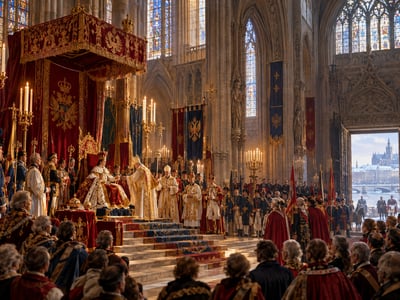
On 15 November 1790, Leopold II was crowned king of Hungary at St Martin’s Cathedral in Pressburg, now Bratislava. He had succeeded his brother Joseph II, who died in Vienna on 20 February 1790 without a Hungarian coronation. Leopold was elected Holy Roman emperor in Frankfurt am Main on 30 September and crowned emperor there on 9 October. The Bratislava rite accepted the Hungarian kingdom’s own obligations; it did not settle every dispute in his realms.
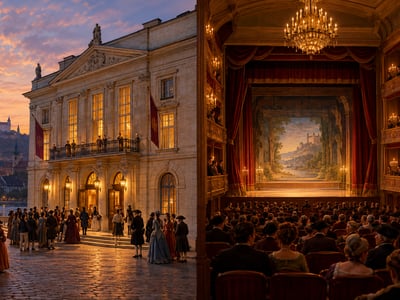
Leopold II's Hungarian coronation, Pressburg (now Bratislava), 15 November 1790.
On November 15, 1790, Leopold II was crowned king of Hungary at St Martin’s Cathedral in the city now known as Bratislava. Then part of the Kingdom of Hungary, the city was known as Pressburg in German and Pozsony in Hungarian. Leopold had received the imperial crown in Frankfurt just 37 days earlier, but that ceremony did not replace the separate coronation required by Hungary’s constitutional traditions.
Two crowns, two political orders
The two ceremonies belonged to different political frameworks. Leopold’s titles connected territories and institutions through a shared ruler, not through a single, uniform system of government. His arrival at the Hungarian coronation therefore marked more than another celebration of his accession. He was accepting obligations attached to a particular crown, in a kingdom where relations between ruler and estates had become strained under his predecessor.
That predecessor was his brother, Joseph II, who died in Vienna on February 20, 1790. Leopold succeeded him in the Habsburg hereditary territories, inheriting both extensive responsibilities and unresolved political disputes. In Hungary, an important part of that inheritance was Joseph’s troubled relationship with the estates, the privileged bodies that participated in the kingdom’s political institutions.
Joseph II dies without a Hungarian coronation
Joseph had not undergone a Hungarian coronation. His decision mattered because coronation was connected to the ruler’s constitutional obligations, rather than being only a public acknowledgment of dynastic succession. Leopold faced a different course: he needed the cooperation of the estates, and accepting coronation offered a way to recognize the kingdom’s established political framework. It did not, by itself, settle every disagreement about how royal power should be exercised.
Meanwhile, Leopold’s accession to the imperial title followed its own sequence. On September 30, 1790, he was elected Holy Roman emperor in Frankfurt am Main. On October 9, he received the imperial crown there. Election and coronation established his imperial position, but neither procedure could stand in for Hungary’s distinct requirements. The Holy Roman Empire and the Kingdom of Hungary were not interchangeable jurisdictions, even when their crowns were held by the same person.
From Frankfurt to St Martin’s
The journey from Frankfurt’s imperial ceremony to the Hungarian coronation thus reveals the limits of treating Leopold’s accession as one event. Succession in the hereditary territories, election to the imperial office, and coronation as king of Hungary were connected through the ruler, yet remained institutionally different. Each must be understood in its own setting rather than folded into a general account of an emperor taking power.
Pressburg supplied the setting for the Hungarian ceremony. The city had a long-established coronation role: Hungarian coronations took place there between 1563 and 1830. St Martin’s Cathedral was therefore not an incidental venue chosen simply because of its proximity to the Habsburg court. Leopold entered an existing tradition associated with the kingdom and its crown.
What the rite did not settle
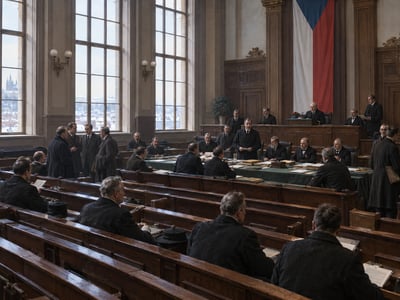
His coronation on November 15 distinguished his approach from Joseph’s refusal to be crowned. By undergoing the ceremony, Leopold accepted the constitutional obligations accompanying Hungarian kingship. The Hungarian Diet of 1790–1791 provided the wider setting for negotiations over royal authority and the kingdom’s constitutional position. The coronation belongs within that political process, not outside it as an isolated religious or ceremonial occasion.
There are limits, however, to what the event demonstrates. Acceptance of coronation obligations is not evidence that all disputes were resolved, nor does it establish Leopold’s private reasoning. Likewise, the estates should not be understood as representing every inhabitant of the kingdom on equal terms. Their cooperation mattered within a political order structured by privileges and inherited institutions.
Why it still matters
Leopold’s two coronations offer a concrete way to understand a monarchy whose territories did not all operate under the same rules. A shared sovereign could connect different constitutional systems without erasing their distinctions. Reading the imperial and Hungarian ceremonies separately helps explain why a title secured in Frankfurt did not remove the need for another act of recognition in Pressburg.
The location also requires care. Bratislava is now the capital of Slovakia, but in 1790 it belonged to the historical Kingdom of Hungary. That kingdom cannot simply be equated with the territory of modern Hungary. Describing the coronation accurately means holding both facts together: it was a Hungarian royal ceremony, and it took place in a city now within Slovakia. Neither fact cancels the other.
The city’s names provide another useful guide. Pressburg, Pozsony, and Bratislava can appear in accounts of the same place, reflecting different linguistic traditions and historical contexts. Recognizing those connections helps readers follow maps, archives, and heritage accounts without assuming that a change of name necessarily identifies a different city.
At St Martin’s Cathedral, Leopold’s accession took a form specific to the kingdom he was to govern. The enduring significance of that November ceremony lies not in the accumulation of royal titles alone, but in the distinction between possessing a dynastic claim and accepting the obligations attached to a particular crown.
Timeline
- Death of Joseph II in Vienna
- Election of Leopold II as Holy Roman emperor in Frankfurt am Main
- Imperial coronation of Leopold II in Frankfurt am Main
- Leopold II crowned King of Hungary in Bratislava
What you uncovered
The Limits of a Crown
You didn't just… complete a puzzle; you revisited a coronation that linked Leopold's authority to the Kingdom of Hungary's constitutional traditions.
A dynasty could connect territories without making their institutions interchangeable: hereditary succession, imperial election, and Hungarian constitutional recognition were distinct foundations of authority. Reading Leopold's accession through these differences helps explain why a shared ruler did not mean a uniform state. Accepting coronation obligations also should not be mistaken for proof that political disagreements had been resolved.
Leopold's election as Holy Roman emperor took place in Frankfurt on 30 September 1790, nine days before his imperial coronation.
FAQ
When was Leopold II crowned king of Hungary in Bratislava?
Leopold II was crowned king of Hungary on 15 November 1790. The ceremony took place at St Martin's Cathedral in Pressburg, the city now known as Bratislava.
Why was the coronation held in Pressburg?
Pressburg, now Bratislava, was the Hungarian coronation city at the time. The ceremony reflected the separate constitutional position of the Kingdom of Hungary within the Habsburg monarchy.
Why did Leopold II still need a Hungarian coronation?
His imperial coronation did not replace the separate Hungarian crown. The Hungarian coronation also carried constitutional obligations tied to the kingdom's own traditions and estates.
How long after his imperial coronation was Leopold II crowned in Hungary?
Leopold II's Hungarian coronation on 15 November 1790 came 37 days after he received the imperial crown in Frankfurt am Main on 9 October 1790.
Why is Bratislava also called Pressburg or Pozsony in sources from 1790?
Those names reflect the city's different historical languages and political contexts. In 1790, the city was known in German as Pressburg and in Hungarian as Pozsony; today it is Bratislava.