
About this story
On 25 November 1952, Agatha Christie’s The Mousetrap opened at the Ambassadors Theatre in London. Peter Saunders produced it and Peter Cotes directed a cast of eight, including Richard Attenborough and Sheila Sim. The play had already toured, starting in Nottingham on 6 October. In 1974 the London production moved to St Martin’s Theatre. The opening night did not guarantee the long run that followed.
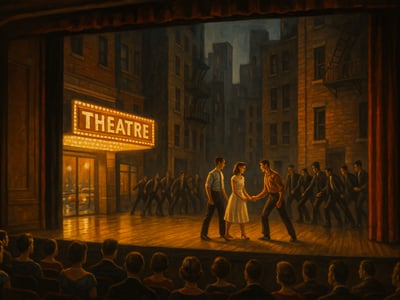
The Mousetrap opened at the Ambassadors Theatre in 1952, with Richard Attenborough and Sheila Sim in the cast.
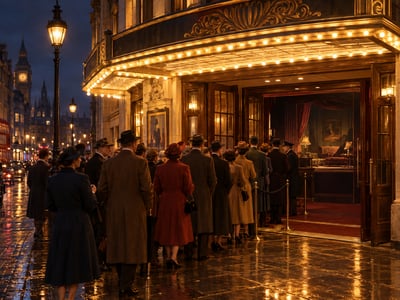
On 25 November 1952, Agatha Christie's *The Mousetrap* opened at the Ambassadors Theatre in London's West End. Produced by Peter Saunders and directed by Peter Cotes, the murder mystery had an eight-member cast, including Richard Attenborough and Sheila Sim. The evening marked the beginning of its London engagement, not its first public performance: the production had already begun a provincial tour.
A tour before the West End
That distinction places the opening in its proper theatrical setting. *The Mousetrap* began its pre-London tour at the Theatre Royal in Nottingham on 6 October 1952, several weeks before reaching the capital. Its arrival at the Ambassadors was therefore a new stage in an existing production's life. Saunders was bringing a show already performed outside London into the commercial environment of the West End, where its future would depend on attracting paying audiences.
Christie supplied a work in a form closely associated with her name: the murder mystery. The stage, however, gave that form particular requirements. An audience had to follow dialogue and action as they unfolded, without the opportunity a reader has to turn back a page. Information needed to be intelligible without making the conclusion apparent too soon. The challenge was not simply to withhold an answer, but to sustain attention through the sequence that led towards it.
A mystery built for the stage
Cotes directed the original production, while the performers gave its characters their first London interpretations. Attenborough played Detective Sergeant Trotter, and Sim played Mollie Ralston. Their names remain part of the opening production's history, but they belonged to an ensemble of eight. A stage mystery depends on the relationships among its characters, making the work of the whole cast central to the audience's experience.
The opening also represented a commercial commitment by Saunders. Bringing a production into London involved resources without a guarantee of a lengthy engagement. Christie's authorship provided a recognizable name, but recognition alone could not ensure continuing ticket sales. From the perspective of November 1952, the practical question was whether enough people would choose to see the play to keep it running. Its later longevity should not obscure the uncertainty inherent in that initial decision.
From the Ambassadors to St Martin’s
The Ambassadors remained the production's London home for more than two decades. On 25 March 1974, *The Mousetrap* opened at St Martin's Theatre, also on West Street. This was a transfer of the London production rather than the beginning of an unrelated engagement. The change of theatre became a major landmark in a history that had already extended far beyond the opening cast's time on stage.
The two venues help make that history concrete. The Ambassadors is the site of the 1952 West End opening; St Martin's is the theatre to which the production moved in 1974. Treating those milestones separately avoids compressing a long theatrical life into a single address. The production's identity continued even as its venue and performers changed.
Why it still matters
*The Mousetrap* offers a useful example of how commercial theatre can sustain a title across successive generations of performers. Unlike a recorded performance, a stage production must be enacted again whenever an audience attends. Its continuity therefore involves both an established work and the ongoing labour of people performing and presenting it. The original London cast is historically significant, but it is only the beginning of that larger production history.
The play also illustrates a distinctive relationship between storytelling and spectatorship. A mystery asks its audience to listen, observe and assess information while the performance continues. Viewers are not merely waiting for events to finish; they are considering how the details might fit together. That makes the management of evidence a practical theatrical concern, shaped by delivery, timing and the audience's attention.
Its history also requires care with the word “continuous.” The London run was suspended from 16 March 2020 during the COVID-19 theatre closures. Performances resumed at St Martin's on 17 May 2021. Any account that describes performances as uninterrupted since 1952 overlooks that substantial break. A production can retain its continuing identity without having maintained an unbroken performance schedule.
The opening at the Ambassadors remains the starting point of that London history. Remembering the earlier Nottingham performances, the later theatre transfer and the pandemic suspension does not diminish the milestone. It gives it definition: a particular production, brought to the West End by Saunders and Cotes, with eight actors performing Christie's play before its first London audiences.
Timeline
- Provincial tour opens in Nottingham
- The Mousetrap opens in the West End
- Production transfers to St Martin’s Theatre
- London run is suspended
- London run resumes
What you uncovered
A Mystery Renewed on Stage
You didn't just complete a puzzle; you revisited the London opening of a play that also invites its audience to piece together clues.
A stage mystery can remain familiar as a title while its solution stays unknown to each new audience. Conventions of secrecy help preserve that balance, while successive casts renew how the clues are presented. Its continuity depends not on keeping every performance identical, but on sustaining the conditions for audiences to make their own deductions.
Before its West End opening, The Mousetrap began its pre-London tour at Nottingham's Theatre Royal on 6 October 1952.
FAQ
Was 25 November 1952 the world premiere of The Mousetrap?
No. It was the London opening at the Ambassadors Theatre in the West End. The production had first begun its pre-London tour at the Theatre Royal in Nottingham on 6 October 1952.
Who produced and directed the original London production?
The West End production was produced by Peter Saunders and directed by Peter Cotes. It opened as Agatha Christie's The Mousetrap at the Ambassadors Theatre.
Who was in the original London cast of The Mousetrap?
The opening London cast on 25 November 1952 included Richard Attenborough as Detective Sergeant Trotter and Sheila Sim as Mollie Ralston. The production had an eight-member cast.
When did The Mousetrap move to St Martin's Theatre?
The London production transferred to St Martin's Theatre on 25 March 1974. It continues to be associated with that theatre.
Has the London run continued without interruption since 1952?
No. The London run was suspended from 16 March 2020 during COVID-19 theatre closures and resumed at St Martin's Theatre on 17 May 2021.