
About this story
Mečiar and Klaus in Bratislava during talks on dissolving the federation, 23 July 1992.
On 23 July 1992, in Bratislava, Slovak Prime Minister Vladimír Mečiar and Czech Prime Minister Václav Klaus reached an agreement on a course toward dissolving the Czech and Slovak Federal Republic. The meeting did not by itself legally end the state, but it marked a decisive political turn. After weeks of mounting constitutional strain, the leaders of the two republics moved away from trying to preserve a shared federation and toward negotiating how it would be brought to an end.
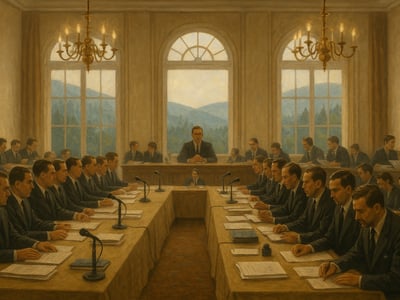
The agreement came after a rapid series of events in the summer of 1992. Parliamentary elections held on 5 and 6 June had produced strong but different mandates in the two parts of the federation. In the Czech lands, Klaus and his Civic Democratic Party emerged as the leading force. In Slovakia, Mečiar's Movement for a Democratic Slovakia took the lead. Those results did not simply reflect different party preferences. They also pointed to different ideas about what the state should become.
By that point, the Czech and Slovak Federal Republic was still the common state created after the end of communist rule, but its future constitutional shape had become the central political question. Could the federation be redesigned to satisfy both sides? Could powers be redistributed between federal and republican institutions? Or had the gap grown too wide for a single arrangement to command support in both republics?
That tension sharpened in July. On 17 July 1992, the Slovak National Council adopted the Declaration of Sovereignty of the Slovak Nation in Bratislava. The declaration did not itself create an independent Slovak state, but it carried strong political weight. It signaled that Slovak leaders were asserting a higher level of political authority and that the existing federal framework was under direct pressure.
Just a few days later, on 20 July, President Václav Havel resigned after failing to secure re-election by the Federal Assembly. Havel had been associated with the effort to maintain a common state, and his resignation underscored the depth of the constitutional impasse. Without a renewed presidential mandate and without agreement on the federation's future design, the room for preserving the existing structure narrowed further.
It was in this atmosphere that Mečiar and Klaus met in Bratislava on 23 July. The key problem before them was not only political disagreement but also institutional risk. If no path were agreed, the federation could drift into a prolonged deadlock over federal authority, the legal basis of common institutions, and the division of responsibilities between Prague and Bratislava. The two leaders chose instead to pursue separation through negotiation.
What they agreed was a political course rather than a single final legal document. The federation would not continue in its current form, and attention would shift to the terms of dissolution. That meant preparing for questions that are unavoidable when a state comes to an end: how federal property would be divided, how institutions would be wound down or transferred, how laws would be succeeded, and how two new states would present themselves internationally.
The significance of the Bratislava meeting lies partly in its timing. It linked several earlier developments into a workable sequence. The elections had produced divergent mandates. The sovereignty declaration had increased pressure on the federal structure. Havel's resignation had exposed the weakness of the center. The meeting between Mečiar and Klaus then turned these pressures into a clearer political direction.
That direction still required formal constitutional steps. The breakup of a state could not rest on a political understanding alone. Over the following months, negotiations continued over constitutional arrangements, succession issues, and the legal mechanics of ending the federation. The process moved through parliamentary institutions rather than through an abrupt collapse.
A major legal milestone came on 25 November 1992, when the Federal Assembly adopted Constitutional Act No. 542/1992 on the dissolution of the Czech and Slovak Federal Republic, effective 31 December 1992. With that act, the end of the federation was given a formal legal basis. On 1 January 1993, the Czech Republic and Slovakia emerged as separate successor states.
The event is often remembered through the phrase "Velvet Divorce," a shorthand that reflects the relatively orderly and negotiated character of the separation. Even so, the politics around the breakup have long remained sensitive. Interpretations differ over whether dissolution was unavoidable, whether other federal models might have survived, and how closely elite negotiations matched public preferences at the time. For that reason, the Bratislava agreement is best understood not as the sole cause of Czechoslovakia's end, but as one critical moment in a wider constitutional process.
Why it still matters
The July 1992 agreement remains important because it offers a clear example of state dissolution managed through negotiation, parliamentary procedure, and constitutional law rather than immediate institutional collapse. The end of Czechoslovakia required not only political will but also careful work on succession, legality, and recognition.
It also shaped the practical foundations of two independent states. Questions of assets, institutions, and legal continuity were not secondary details; they were essential to making separation workable. The path chosen in 1992 helped determine how the Czech Republic and Slovakia entered international life on 1 January 1993.
More broadly, the episode continues to be studied as a case of how multinational federations respond when elections produce competing political mandates and no shared constitutional formula can be found. The meeting in Bratislava did not settle every issue, but it established that the central task was no longer to preserve the federation at all costs. It was to end it through an agreed legal sequence.
Timeline
- Czechoslovak federal elections
- Slovak sovereignty declaration
- Václav Havel resignation
- Bratislava agreement on dissolution
- Federal Assembly dissolution act
- Czech Republic and Slovakia established
What you uncovered
A State Ends by Sequence
You didn't just… place names and dates; you traced how political leaders turned a federal crisis into a negotiated path toward separation.
What stands out about late July 1992 is not a single dramatic break, but the way several decisions quickly aligned into a usable legal and political sequence. Election results produced conflicting mandates, the sovereignty declaration sharpened the constitutional problem, Havel's resignation showed the federal center was weakening, and the Bratislava agreement gave the process direction. That combination helps explain why the end of Czechoslovakia is often studied less as a sudden collapse than as a negotiated redesign of state authority.
The federal parliament did not make the dissolution legally effective until 25 November 1992, when it adopted Constitutional Act No. 542/1992.
FAQ
What happened in Bratislava on 23 July 1992?
On 23 July 1992, Vladimír Mečiar and Václav Klaus met in Bratislava and agreed on a course toward dissolving the Czech and Slovak Federal Republic.
Why did the June 1992 elections matter for Czechoslovakia?
The 5 and 6 June 1992 elections produced different mandates in the Czech lands and Slovakia. Václav Klaus's Civic Democratic Party won in the Czech lands, while Vladimír Mečiar's Movement for a Democratic Slovakia led in Slovakia.
How did the Bratislava agreement relate to events in July 1992?
It came after the Slovak National Council adopted the Declaration of Sovereignty of the Slovak Nation on 17 July 1992. It also followed Václav Havel's resignation on 20 July 1992 after he failed to secure re-election by the Federal Assembly.
When did the dissolution of Czechoslovakia take legal effect?
On 25 November 1992, the Federal Assembly adopted Constitutional Act No. 542/1992 on the dissolution of the Czech and Slovak Federal Republic. The act became effective on 31 December 1992, and the Czech Republic and Slovakia emerged on 1 January 1993.