
About this story
United States v. Nixon centered on White House tapes sought for a Watergate trial.
On July 24, 1974, the U.S. Supreme Court ruled unanimously that President Richard Nixon had to comply with a judicial subpoena for White House tape recordings and documents sought in a Watergate-related criminal case. The decision in *United States v. Nixon*, delivered by Chief Justice Warren E. Burger, came at a moment when a political scandal had become a constitutional test: whether a president could withhold evidence from a court by claiming executive privilege.
The case did not begin in the Supreme Court. It grew out of the wider Watergate investigation, which followed the June 1972 break-in at the Democratic National Committee headquarters in Washington, D.C. As investigators and congressional committees dug deeper, the central question shifted from the burglary itself to whether senior officials had tried to conceal what had happened. In that expanding inquiry, access to reliable evidence became crucial.
A major turning point came on July 16, 1973, when former White House aide Alexander Butterfield revealed before the Senate Watergate Committee that conversations in the White House had been automatically recorded. That disclosure transformed the investigation. What had previously depended on testimony, notes, and recollections now involved the possibility of verbatim records from the Oval Office and other presidential spaces.
The existence of the taping system set off a struggle over who could demand those recordings and under what authority. Special Prosecutor Archibald Cox sought access to the tapes, arguing that they could contain evidence relevant to criminal proceedings. Nixon resisted, asserting executive privilege and arguing that presidential confidentiality was necessary for the functioning of the office. The clash soon became one of the defining legal disputes of the Watergate era.
That conflict intensified in October 1973 during the episode known as the Saturday Night Massacre. Nixon ordered Cox dismissed after the special prosecutor refused a proposed compromise over the tapes. The resignations and dismissal that followed deepened public and institutional concern about the administration's handling of the investigation. Yet the effort to obtain the recordings did not end there. Leon Jaworski succeeded Cox as special prosecutor and continued pressing for the evidence.
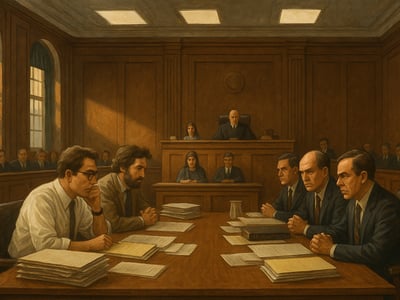
Meanwhile, the courts were becoming more directly involved. On October 24, 1973, Judge John J. Sirica of the U.S. District Court for the District of Columbia ordered Nixon to produce subpoenaed recordings and documents for in camera review, meaning the judge would examine them privately rather than release them immediately to the public. This was an important procedural step. It showed that the judiciary was not simply weighing a political controversy from afar; it was actively managing an evidentiary dispute in a criminal matter.
The stakes rose again on March 1, 1974, when a federal grand jury in Washington, D.C., indicted seven Watergate defendants and named Nixon an unindicted co-conspirator. That designation did not charge the president with a crime, but it indicated that prosecutors believed he was connected to the events under investigation. The subpoenaed materials therefore mattered not only to public debate or congressional inquiry, but to an ongoing federal criminal prosecution.
By the summer of 1974, the legal question had narrowed and sharpened. Could a president claim an absolute privilege to withhold materials relevant to a criminal trial? Nixon's position rested on the idea that confidential presidential communications deserved strong protection. The special prosecutor's position was that the courts had the authority to require evidence needed for the fair administration of justice.
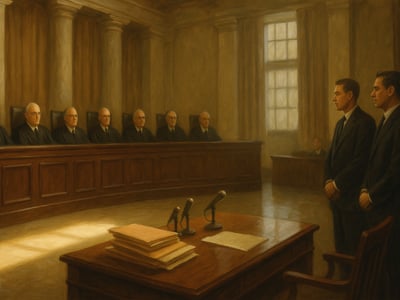
The Supreme Court heard oral arguments on July 8, 1974, on an expedited basis. The speed reflected the urgency of the dispute. A criminal trial was pending, the House Judiciary Committee was engaged in impeachment proceedings, and the presidency itself was under extraordinary strain. Delay was not a neutral option: postponement could have affected the prosecution, the political process, and public trust in the legal system.
When the Court issued its decision on July 24, it rejected Nixon's claim of an absolute, unqualified executive privilege in the circumstances before it. The Court acknowledged the importance of confidentiality in presidential communications, especially in matters involving the duties of the office. But it held that a generalized interest in confidentiality could not automatically override the demonstrated, specific need for evidence in a criminal trial.
The ruling did not declare executive privilege meaningless. Instead, it set limits. The justices recognized that some presidential communications may deserve protection, but they concluded that the judiciary, not the president alone, had the authority to decide whether a subpoena in a criminal case had to be obeyed. In practical terms, that meant Nixon had to turn over the requested recordings and documents.
The decision was notable not only for its substance but also for its unanimity. Burger, a Nixon appointee, wrote for a Court that spoke with one voice. At a time of intense political conflict, that unanimity strengthened the force of the ruling and emphasized that the case was being resolved as a matter of law and judicial process.
The consequences were immediate. Once the tapes were produced, one recording in particular—the so-called "smoking gun" tape—provided powerful evidence of Nixon's involvement in efforts to obstruct the investigation. The Court's ruling did not itself remove Nixon from office, but it eliminated a major barrier to evidence that shaped the final phase of the Watergate crisis. Nixon resigned on August 9, 1974.
Why it still matters
*United States v. Nixon* remains one of the best-known judicial statements about the limits of presidential power in the face of a criminal subpoena. It is regularly taught in constitutional law because it shows how courts handle claims of executive privilege without denying that such claims can exist.
The case also illustrates how ordinary legal mechanisms—subpoenas, trial court orders, review by higher courts—continue to function even when the dispute involves the nation's highest elected official. Rather than treating the presidency as beyond judicial reach, the Court placed the conflict within established legal procedure.
For that reason, the ruling still serves as a reference point whenever questions arise about presidential confidentiality, access to evidence, and the role of courts in investigations touching the executive branch. Its enduring significance lies less in a broad slogan than in a practical conclusion: in a criminal proceeding, claims of confidentiality can be weighed, but they are not automatically final when a court has lawfully asked for evidence.
Timeline
- White House taping system disclosed
- District court order for tape production
- Federal grand jury indicts Watergate defendants
- Supreme Court oral arguments
- U.S. Supreme Court decision in United States v. Nixon
- Richard Nixon resigns
What you uncovered
When Evidence Reached the Presidency
You didn't just… complete a puzzle; you traced the moment a dispute over White House tapes became a direct test of whether a president could withhold evidence from a criminal court.
What made the ruling durable was not only its result, but the way it framed the conflict. The Court treated executive confidentiality as a real institutional interest, yet not an unlimited shield when judges needed evidence for a criminal proceeding. That balance is why the case still matters: it showed that disputes over presidential power can be narrowed into procedural questions courts know how to answer.
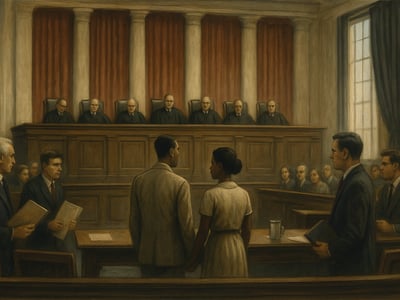
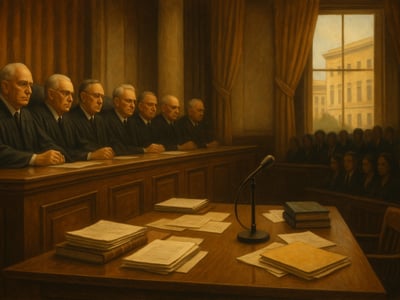
The Supreme Court heard oral arguments in United States v. Nixon on 8 July 1974, just over two weeks before issuing its unanimous decision.
FAQ
What did the Supreme Court decide on 24 July 1974 in United States v. Nixon?
The Court ruled that President Richard Nixon had to comply with the judicial subpoena for tape recordings and documents from the White House. It rejected an absolute claim of executive privilege in this case.
Why were the White House tapes subpoenaed?
They were sought for use in a Watergate-related federal criminal trial in Washington, D.C. The subpoena aimed to obtain evidence considered relevant to that proceeding.
What role did Judge John J. Sirica play before the Supreme Court ruling?
On 24 October 1973, Judge John J. Sirica ordered Nixon to produce the subpoenaed recordings and documents for in camera review. That order helped move the dispute into the Supreme Court.
Why was United States v. Nixon heard so quickly?
The Supreme Court heard oral arguments on 8 July 1974 and issued its decision on 24 July 1974. The case was expedited because it involved a pending criminal proceeding and an urgent dispute over evidence.
Why is United States v. Nixon still important?
It remains a key reference point for how courts handle executive privilege claims in criminal proceedings. The ruling is also widely taught as an example of judicial authority over evidence disputes involving a president.