
About this story
On 17 August 1968 János Kádár of Hungary met Alexander Dubček in Komárno, a Danube border town in southern Slovakia, during the final days of the Prague Spring crisis. The encounter came after the Bratislava Declaration of 3 August and only four days before Warsaw Pact forces entered Czechoslovakia on the night of 20–21 August.
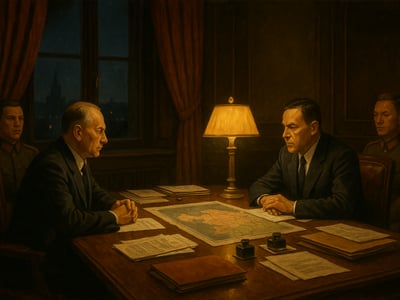
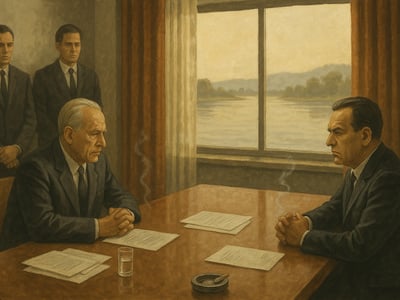
Dubček and Kádár in Komárno on 17 August 1968, days before the invasion
On August 17, 1968, János Kádár of Hungary met Alexander Dubček in Komárno, a town on the Danube in southern Slovakia. The meeting came at a tense moment in the Prague Spring crisis, only four days before Warsaw Pact forces entered Czechoslovakia during the night of August 20–21. Because later accounts differ on the exact language used and on how much either man believed could still be changed, the encounter is best understood not as a single decisive scene, but as part of the final period of pressure placed on the Czechoslovak leadership.
A border-town meeting in the Prague Spring crisis
By the time Kádár and Dubček sat down together, the reform movement associated with Dubček had already transformed politics inside Czechoslovakia. Dubček had become First Secretary of the Communist Party of Czechoslovakia on January 5, 1968. Under his leadership, censorship was loosened, public debate widened, and the idea of building a more open form of socialism drew broad attention at home and abroad. For many people in Czechoslovakia, these changes created hope that political life could become less rigid without abandoning the socialist system.
That same process, however, alarmed several allied communist governments. Leaders in Moscow and other Warsaw Pact capitals worried that reforms in Czechoslovakia might weaken party control, encourage similar demands elsewhere, and disrupt the balance of the Soviet-led alliance. Throughout the spring and summer of 1968, this disagreement produced repeated meetings, letters, and warnings. The argument was not only about policy details. It was also about who had the authority to define acceptable change inside a socialist state that belonged to the bloc.
One important step in that mounting confrontation came on August 3, 1968, when the leaders of the Soviet Union, Czechoslovakia, East Germany, Poland, Hungary, and Bulgaria met in Bratislava. The Bratislava Declaration that followed spoke in public language about socialist unity. Yet the underlying disagreement remained unresolved. The declaration did not remove the distrust felt by the Soviet leadership and its allies, nor did it settle the question of how far Czechoslovakia would go in its reforms.
Reform hopes and allied distrust
In that setting, the Komárno meeting acquired special importance. It brought together Dubček, whose authority rested partly on his promise to continue reforms, and Kádár, whose own position was complicated. As Hungary's leader, Kádár had experience with both domestic change and Soviet expectations. He was therefore in a position that later observers have often described as uneasy: close enough to understand some of the reform impulse in Czechoslovakia, but also part of the alliance system that was turning against it.
What exactly passed between the two men in Komárno is difficult to fix with complete certainty. Historians generally agree on the date, the place, and the broader context. They also agree that the meeting belonged to the last phase before armed intervention. But the exact wording, tone, and significance of the exchange have been interpreted differently across sources and later national historiographies. Some accounts emphasize warning, some stress persuasion, and some place more weight on uncertainty and misunderstanding. For that reason, careful historical writing avoids presenting the conversation as if one fully verified transcript settled every question.
After Bratislava, before the invasion
Even without a definitive reconstruction of every sentence, the meeting clearly illustrates the narrowing options facing Dubček. By mid-August, he and the Czechoslovak reform leadership were trying to preserve their domestic program while reducing external suspicion. That was an increasingly difficult balance. Any retreat risked disappointing reform supporters at home and weakening the political credibility of the leadership. Yet standing firm risked convincing allied governments that internal pressure and formal declarations would not be enough.
For Kádár, the meeting also reflected the political limits of smaller states inside the Soviet bloc. Hungary was not the Soviet Union, and Kádár was not the main architect of bloc strategy. But Hungary was still a member of the Warsaw Pact, and its leadership participated in the collective processes through which pressure on Czechoslovakia was applied. The Komárno conversation therefore belonged to a wider pattern in which official summits, private discussions, party communications, and military planning all overlapped.
What the Komárno encounter can and cannot settle
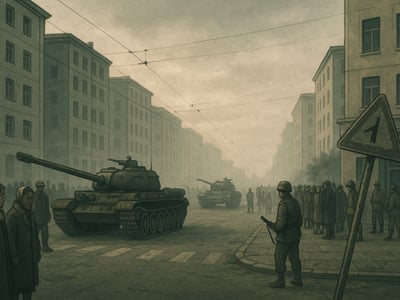
The closeness of dates matters. The meeting took place on August 17. Three days later, during the night of August 20–21, Warsaw Pact forces entered Czechoslovakia. Hungary was one of the states that took part in the intervention. Seen from that sequence alone, Komárno stands as one of the last face-to-face contacts before events moved from political pressure to military action.
That does not mean the meeting caused the invasion or could, by itself, have prevented it. The decision-making that led to intervention involved wider Warsaw Pact deliberations, above all in Moscow. Leonid Brezhnev and the Soviet leadership were central to those decisions. Still, the Komárno encounter offers a close-range view of a larger crisis. It shows how, in the final days, leaders still spoke directly even as the space for compromise was shrinking.
Why it still matters
The Komárno meeting remains important because it helps explain how power worked inside the Warsaw Pact. Domestic reform in one member state did not unfold in isolation. It was constrained by alliance expectations, ideological boundaries, and the strategic calculations of stronger partners, especially the Soviet Union. Looking at Komárno makes that structure visible in a human scale: two leaders talking across a table while much larger forces closed in around them.
The episode also reminds historians to distinguish between documented facts and later interpretation. We know the meeting happened in Komárno on August 17, 1968. We know it came after the Bratislava meeting and before the invasion. We know Hungary later joined the intervention. But when it comes to motive, tone, and private meaning, the evidence requires caution. That is not a weakness in the story. It is part of what makes the event useful for understanding how Cold War crises are reconstructed from incomplete and contested records.
Finally, Komárno matters because it captures a Central European crisis at the point where political language and military reality nearly met. The Prague Spring is often remembered through its broad reform hopes or through the shock of the invasion itself. This meeting sits between those two moments. It marks the final stage when leaders were still trying, in conversation and under pressure, to shape an outcome that was rapidly moving beyond their control.
Timeline
- Dubček becomes party leader
- Bratislava Declaration
- Kádár-Dubček meeting in Komárno
- Warsaw Pact invasion of Czechoslovakia begins
- Warsaw Pact forces enter Czechoslovakia
What you uncovered
Pressure at Close Range
You didn't just… complete a historical scene; you traced one of the tense personal encounters that came just before the Prague Spring was crushed by outside force.
The Komárno meeting matters less as a single decisive turning point than as a close view of how power moved inside the Warsaw Pact. Formal declarations, private conversations, and military preparation could all unfold at once, with leaders trying to influence events without always stating everything openly. Because sources differ on the exact tone and wording of the exchange, the meeting is often most useful not as proof of one final warning, but as evidence of how constrained Czechoslovakia's reform leadership had become.
The Komárno meeting took place just two weeks after the Bratislava Declaration of 3 August 1968, which publicly affirmed socialist unity among several Warsaw Pact states.
FAQ
What happened in Komárno on 17 August 1968?
On 17 August 1968, János Kádár met Alexander Dubček in Komárno, a border town in southern Slovakia. The meeting took place during the Prague Spring crisis, four days before the Warsaw Pact invasion of Czechoslovakia.
Who met in Komárno during the Prague Spring crisis?
The meeting was between Hungarian Socialist Workers' Party leader János Kádár and Czechoslovak Communist Party First Secretary Alexander Dubček. Dubček had become First Secretary on 5 January 1968.
Why was the Komárno meeting significant?
It brought the two leaders into direct contact during the final days before the intervention of Warsaw Pact forces. The meeting is generally seen as part of the mounting pressure on the Czechoslovak leadership.
Did the Komárno conversation clearly warn Dubček?
Sources do not fully agree on the exact wording, tone, or significance of what was said. Because of that, the meeting is best described as a documented encounter whose precise meaning remains interpreted differently.