About this story
On 1 September 1992 in Bratislava the Slovak National Council adopted the Constitution of the Slovak Republic by a three-fifths majority. Czechoslovakia still existed, but the July declaration of Slovak independence had already marked a political break. The constitution gave the future state its legal architecture before formal independence on 1 January 1993.
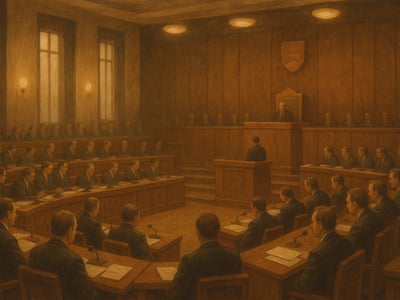
Bratislava parliament vote adopting the Slovak Constitution, 1 September 1992
On 1 September 1992, in Bratislava, the Slovak National Council adopted the Constitution of the Slovak Republic by the required three-fifths majority. The decision came at a moment of transition: Czechoslovakia still formally existed, but its future was being negotiated, and Slovak political leaders were moving from declarations of sovereignty toward the practical legal framework of a state. The vote did not itself create independence, which would come on 1 January 1993, but it established the institutional design that an independent Slovak Republic would soon use.
A constitution before formal independence
That timing is what makes the event historically important. Constitutions are often associated with already existing states, but this one was adopted before the republic it was meant to govern had formally begun. In that sense, the vote was both constitutional and transitional. It answered an immediate question facing Slovak deputies in 1992: if sovereignty was to become a political reality, what legal order would stand behind it?
The background lay in the unsettled final year of the Czech and Slovak Federative Republic. After the 1992 parliamentary elections, political leaders in both the Czech and Slovak parts of the federation were under pressure to define the next stage of relations between the two republics. In Slovakia, expectations for greater sovereignty had intensified. But political ambition alone could not run ministries, define powers, or establish the basic relationship among parliament, government, courts, and the head of state. Those matters required a constitutional text.
A key step had already taken place on 17 July 1992, when the Slovak National Council adopted the Declaration of Independence of the Slovak Nation. That declaration was politically significant, but a declaration and a constitution are not the same thing. A declaration states an intention or principle. A constitution creates a binding legal framework. The September vote therefore carried a different kind of weight. Deputies were no longer deciding only how to express a political claim; they were deciding how state institutions would be organized and on what legal basis they would act.
From July’s declaration to September’s legal text
The session in Bratislava unfolded under that pressure. The Slovak National Council had 150 members, and the constitution required a three-fifths majority to pass. That threshold mattered. It meant that adoption could not rest on a narrow or accidental margin alone; a constitution needed broader parliamentary support than ordinary legislation. Failure to meet that requirement would have left a serious gap between the political movement toward Slovak statehood and the legal preparation needed to sustain it.
Among the leading figures of the period were Vladimír Mečiar, then the central political force in the Slovak government, Ivan Gašparovič, who was closely associated with parliamentary leadership, and Milan Čič, who was involved in the constitutional and legal life of the emerging republic. Their roles belonged to a wider process in which political leaders, legal experts, and deputies had to move quickly from negotiation to institutional design. The challenge was not simply to affirm sovereignty in principle, but to build an operational system in advance of formal independence.
A three-fifths vote under pressure
When the vote succeeded, it gave the future Slovak Republic exactly that: a constitutional foundation already in place before 1 January 1993. The document set out the structure of state authority and established legal continuity for the transition ahead. In practical terms, this reduced uncertainty during the breakup of the federation. As political arrangements changed, there was already a supreme legal text defining the framework within which the new republic would function.
The adoption also illustrates the distinction between the symbolic and the procedural sides of state formation. Public memory often emphasizes landmark declarations or the date when independence formally begins. Those moments matter, but institutions depend on law as much as on symbolism. The constitution translated broad political aims into a system of offices, powers, and responsibilities. It linked the summer's declarations and negotiations to the mechanics of government.
Legal continuity into 1 January 1993
This is especially important in understanding the final months of Czechoslovakia. The dissolution of the federation on 1 January 1993 was not a single isolated act; it was the culmination of a sequence of political and legal steps. The constitutional vote of 1 September 1992 was one of the clearest of those steps on the Slovak side. It showed that the emerging republic was preparing not only to exist formally, but to function from the first day of independence.
The event should also be placed within the broader legal culture of Central Europe's post-communist transition. Across the region, constitutions and constitutional revisions played a central role in redefining political systems after 1989. In Slovakia's case, the constitution of 1992 belonged both to that wider transformation and to the particular circumstances of a federation coming to an end. It was a foundational legal act shaped by local political negotiations, but also part of a broader effort to anchor public authority in constitutional rules.
Why it still matters
The adoption of the Slovak Constitution remains central because it shows that modern Slovak statehood was built through a concrete legal act, not only through political rhetoric or retrospective symbolism. The constitution provided a working framework for institutions before independence took effect, helping explain how the transition from a dissolving federation to an independent republic could proceed with legal continuity rather than institutional emptiness.
It also offers a useful case study in what constitutions do during moments of transition. They are not merely statements of identity. They can serve as bridges between one political order and another, converting an uncertain project into a functioning system of government. In the Slovak case, the constitution stood between the weakening federal framework of 1992 and the independent republic that began on 1 January 1993.
For that reason, 1 September 1992 remains more than a date in parliamentary history. It marks the moment when the future Slovak state was given its basic legal architecture while that future was still being negotiated. The vote in Bratislava did not end every debate about the breakup of Czechoslovakia or the meaning of Slovak statehood. But it did provide something essential at a decisive moment: a constitution ready to govern when the new republic began.
Timeline
- Declaration of Independence of the Slovak Nation
- Mečiar–Klaus talks advance the dissolution path
- Slovak National Council adopts the Constitution
- Slovak Republic becomes independent
What you uncovered
A Constitution Before Independence
You didn't just… complete a puzzle about a parliamentary vote; you traced the moment when an emerging state put its institutions into legal form before independence formally began.
This constitution mattered not only because it expressed sovereignty, but because it turned a political goal into a working framework for authority, offices, and legal continuity. In that sense, it served as a bridge between a weakening federal structure and a state that still had to function on day one. The event shows how constitutions can operate as transition tools, not just national symbols.
The Constitution of the Slovak Republic was approved on 1 September 1992 by a three-fifths majority in the 150-member Slovak National Council.
FAQ
What happened on 1 September 1992 in Bratislava?
On 1 September 1992, the Slovak National Council approved the Constitution of the Slovak Republic in Bratislava. The vote was part of the final months before Slovak independence took effect.
Who adopted the Constitution of the Slovak Republic?
The Constitution of the Slovak Republic was adopted by the 150-member Slovak National Council. It passed by the required three-fifths majority.
What majority was needed for the Slovak constitution to pass?
A three-fifths majority of the 150-member Slovak National Council was required. The constitution was approved with that threshold on 1 September 1992.
Why was the constitution adopted before independence?
It was adopted while the Czech and Slovak Federative Republic still formally existed. The constitution set the legal structure of Slovak state institutions before independence on 1 January 1993.