
About this story
On 10 October 1919 the University Library in Bratislava was established in the Clariseum on Klariská Street. Czechoslovakia had been founded on 28 October 1918, and the city was building university institutions for the new state. The library’s first recorded holdings were 84,826 units, so it opened with a working scholarly collection rather than an empty building. Pavol Blaho and Vavro Šrobár were among the figures tied to that early institutional work.
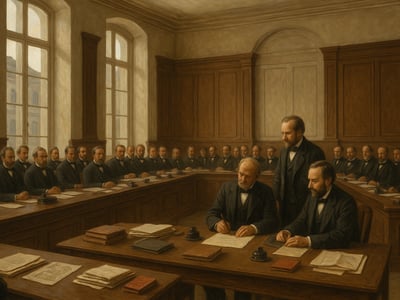
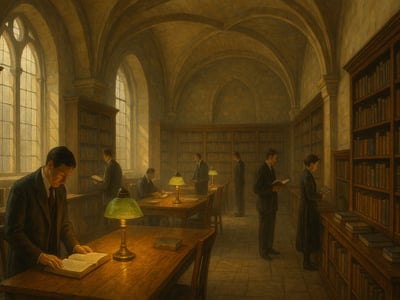
University Library in Bratislava at its 1919 founding in the Clariseum building
On 10 October 1919, the University Library in Bratislava was established in the Clariseum building on Klariská Street, giving the city a formal scholarly collection at a moment of rapid institutional change. Its initial holdings were recorded at 84,826 library units, a substantial base for a new academic center in the first full year of Czechoslovakia.
A library for a new state
The date matters partly because of what had changed in the region just before it. Czechoslovakia had been created in 1918, and with the new state came the practical work of building institutions that could support administration, education, and public life. A modern university environment could not exist on lecture rooms and professors alone. It also needed books, reference works, periodicals, cataloguing systems, staff, and a place where students and scholars could reliably find them. In Bratislava, that need was especially clear as the city took on a larger role in Slovak higher education.
The founding of the library answered a basic but demanding question: where would organized scholarly resources be gathered, and how would they be made usable? Establishing a library was not simply a ceremonial act. It required a decision about premises, the transfer or assembly of holdings, and the creation of routines that could turn a large accumulation of printed material into a functioning institution. The Clariseum building on Klariská Street became the first home for that effort.
The Clariseum on Klariská Street
That location also says something about the period. Across Central Europe, older religious and civic buildings were often adapted for new public purposes as political structures shifted and educational systems expanded. The Clariseum provided a physical setting in the historic city for a distinctly modern task: supporting organized higher learning. A building with an earlier life was drawn into a new network of lectures, reading, research, and administration.
The reported size of the initial collection gives the event unusual clarity. Many institutional foundings are remembered in broad terms, but the figure of 84,826 library units shows that this was not an empty shell waiting for books to arrive years later. From the start, the library had a recorded body of material large enough to matter. That did not mean every practical problem had been solved. A collection of that size had to be ordered, housed, and made accessible. Shelving, catalogues, internal rules, and preservation all shaped whether the library would become a stable part of academic life or remain only a formal establishment on paper.
84,826 units from the start
The library's creation was closely connected to the university environment then taking shape in Bratislava. In 1919, institutions of higher learning in the city were being organized within the framework of the new state. Figures such as Pavol Blaho and Vavro Šrobár belonged to the broader political and public world in which Slovak educational and cultural institutions were being defined. The library emerged within that same atmosphere of construction: not only buildings and offices, but the intellectual tools needed for teaching and study.
For students and teachers, a university library was a form of infrastructure as real as any classroom. Courses could be announced and faculties could be established, but sustained study depended on access to texts. In law, medicine, philosophy, history, languages, and other fields, books were not supplementary. They were central to how knowledge was transmitted and tested. A library also gave continuity to a university's work, because collections outlasted individual semesters, professors, and administrative changes.
Infrastructure for study
Bratislava in 1919 was therefore not just receiving a new institution. It was acquiring a mechanism for academic continuity. The library linked the city's educational ambitions to the slow, methodical work of collecting and organizing knowledge. That work is less visible than political declarations, but it is often more enduring. Founding a library meant planning for repeated use over time: for readers who had not yet enrolled, for research not yet begun, and for an academic culture still being formed.
The risk at the beginning was practical rather than dramatic. A new institution might have inadequate space, uncertain administration, or collections too difficult to use effectively. Early continuity could easily have been weakened by disorganization or by a lack of clear purpose. The fact that the library was founded with specified premises and a documented starting collection suggests an effort to avoid that outcome. Its establishment gave structure to what might otherwise have remained scattered resources.
Why it still matters
The founding of the University Library in Bratislava still matters because it shows how states and cities build intellectual life through institutions that may appear quiet compared with parliaments, ministries, or monuments. Libraries are part of the machinery of higher education. They preserve texts, support instruction, and make advanced study possible beyond the authority of any single teacher.
The 1919 establishment also offers a clear example of how political change becomes material reality. After the creation of Czechoslovakia, educational ambitions had to be translated into rooms, shelves, catalogues, and collections. A library in the Clariseum on Klariská Street was one such translation. It connected public authority, urban space, and scholarly access in a concrete form.
There is a longer cultural significance as well. Academic libraries do more than serve universities in a narrow sense. Over time, they help shape a city's cultural memory, preserve printed heritage, and widen access to scholarship. The beginnings of the University Library in Bratislava remind us that intellectual communities depend not only on ideas, but on institutions capable of carrying those ideas across generations.
What happened on 10 October 1919 was therefore modest in appearance but durable in consequence. A library was established, a building was assigned, and 84,826 recorded units became the foundation of a scholarly resource. In the early life of Czechoslovakia and in the development of higher learning in Bratislava, that was a significant step from aspiration to structure.
Timeline
- Czechoslovakia is established
- University Library opens in the Clariseum on Klariská Street
- Initial holdings recorded at 84,826 library units
What you uncovered
Building Knowledge Infrastructure
You didn't just… complete a puzzle; you traced the founding of an institution meant to give a new university city the books, space, and structure scholarly work depends on.
A library's founding can look administrative, but it often marks the moment when political change becomes daily academic reality. In this case, premises, organization, and a substantial starting collection turned the idea of higher learning in Bratislava into something usable by students and scholars. It is a reminder that new states are built not only through laws and offices, but through systems that preserve and circulate knowledge.
At its establishment, the library's initial holdings were recorded at 84,826 library units.
FAQ
When was the University Library in Bratislava established?
It was established on 10 October 1919. The library opened during the early period of Czechoslovakia.
Where was the University Library in Bratislava first located?
It was founded in the Clariseum building on Klariská Street in Bratislava. That was its original location at the time of establishment.
How large was the library's initial collection in 1919?
Its initial holdings were recorded at 84,826 library units. That collection formed the library base at its founding.
Why was the library important for Bratislava's academic life?
It provided an organized scholarly collection and a library base for higher learning in the city. The institution became part of the university environment forming in Bratislava in 1919.