
About this story
On 24 September 1957 President Dwight D. Eisenhower issued Executive Order 10730, federalizing the Arkansas National Guard and sending U.S. Army troops to Little Rock. The order enforced a court ruling that nine Black students attend Central High. The next day the 101st Airborne escorted the Little Rock Nine into the school.
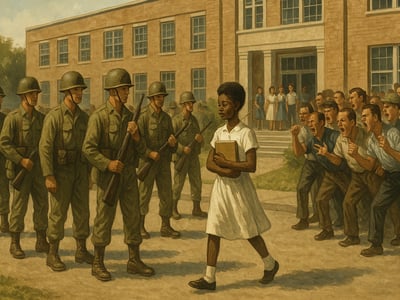
Federal intervention at Central High School during the Little Rock desegregation crisis, 1957
On September 24, 1957, President Dwight D. Eisenhower ordered federal intervention in Little Rock, Arkansas, turning a school desegregation dispute into a direct test of constitutional authority in the United States. By issuing Executive Order 10730, he federalized the Arkansas National Guard and sent U.S. Army troops to enforce a federal court order requiring the admission of nine Black students to Central High School.
Brown’s ruling meets state resistance
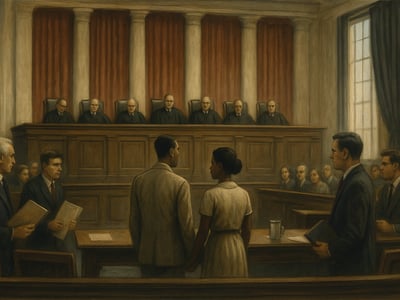
The crisis had been building for years. In *Brown v. Board of Education* on May 17, 1954, the U.S. Supreme Court declared segregated public schools unconstitutional. That decision established the legal principle, but it did not automatically change conditions in every school district. Across the South, local officials and state governments responded in very different ways. In Little Rock, the question became whether a federal ruling would be carried out when state authorities chose to resist it.
Central High School soon became the focal point of that conflict. The students later known as the Little Rock Nine were selected to enroll there for the 1957 school year. Their attempt to attend school was not simply an administrative step. It unfolded in a public atmosphere of organized opposition, intimidation, and political confrontation.
On September 2, 1957, Arkansas Governor Orval Faubus ordered the Arkansas National Guard to surround Central High School. He presented the move as a measure to preserve order, but the practical effect was to block the court-ordered desegregation of the school. The next day and in the days that followed, the standoff drew national attention.
Crowds at Central High
One image from the crisis became especially enduring. On September 4, 1957, Elizabeth Eckford arrived at Central High alone and was turned away as white crowds gathered outside the building. Photographs of her walking amid hostility made visible what had previously been described in legal language and political statements. The issue was no longer abstract. A constitutional dispute could now be seen in the experience of individual students trying to enter a public school.
Behind the scenes, local and national civil rights figures were deeply involved. Daisy Bates, a leading figure in the Arkansas NAACP, helped support the students and their families. Thurgood Marshall, already well known for his legal work against school segregation, was part of the broader legal and strategic effort that connected Little Rock to the longer struggle that had produced *Brown*. Yet even with court victories and organized advocacy, implementation remained uncertain.
Eisenhower federalizes the Guard
That uncertainty was the central fact of the Little Rock crisis. Federal courts had spoken, but their rulings depended on public officials to carry them out. In Little Rock, state power was being used to obstruct enforcement rather than support it. A governor had placed the National Guard at the school, while white segregationist crowds added the threat of mob pressure. The question before Eisenhower was not only about one school building. It was whether a state could openly defy a federal court order in full public view.
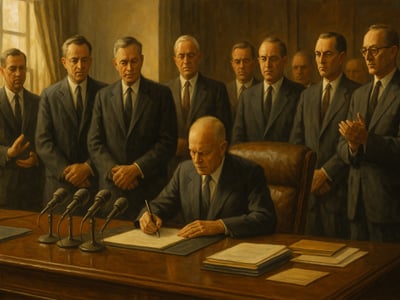
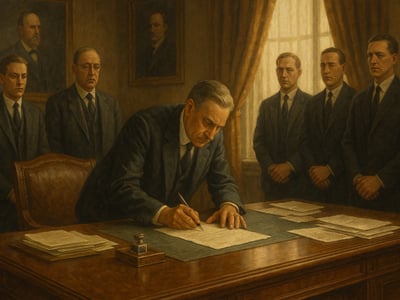
Eisenhower had not sought this confrontation, and he was often cautious in public statements about civil rights. But by late September, the challenge to federal authority had become impossible to ignore. On September 24, he issued Executive Order 10730. The order placed the Arkansas National Guard under federal control and authorized the use of troops from the 101st Airborne Division to enforce the court's decision.
This was a striking use of presidential power. Eisenhower was not creating a new constitutional principle; the Supreme Court had already done that in *Brown*. What he did was supply the enforcement capacity that the court itself did not possess. His action demonstrated that a constitutional ruling could require executive action, including military force, when state officials refused compliance.
Nine students under escort
The next day, September 25, 1957, soldiers from the 101st Airborne escorted the Little Rock Nine into Central High School. Their entry did not end the tension. The students continued to face hostility, isolation, and abuse during the school year. Federal protection secured access to the building, but it could not instantly transform the social reality inside it. The event was therefore both a legal milestone and a reminder of the limits of formal orders alone.
The Little Rock crisis also unfolded before an international audience. During the Cold War, racial segregation and violence in the United States were watched closely abroad. The confrontation in Arkansas drew attention not only because it involved troops and constitutional law, but because it exposed a gap between American democratic ideals and the realities of segregated public life. That wider visibility added pressure, though the immediate issue remained the enforcement of rights at home.
Why it still matters
Little Rock remains important because it shows that a court decision, even one as significant as *Brown v. Board of Education*, is only part of how rights become real. Laws and rulings can define principles, but implementation depends on institutions willing and able to enforce them. In 1957, the federal executive branch became the mechanism that made a constitutional guarantee operative on the ground.
The episode also remains a key reference point in the relationship between state governments and federal authority. It illustrates how conflicts over public education can become constitutional conflicts when states resist federally protected rights. In that sense, Little Rock was not only about one city or one school year. It became a demonstration of how governance works when different levels of authority collide.
Finally, the crisis underscores the central role of schools in the history of civil rights. Public education was not a peripheral arena but one of the main institutions through which equality, citizenship, and state power were contested. The Little Rock Nine were students, but their attempt to attend school forced the country to confront the practical meaning of constitutional law.
What happened in Little Rock in September 1957 did not settle the larger struggle over civil rights. It did, however, establish something essential in public view: federal court orders could not be left as symbolic declarations when states chose resistance. The admission of nine students to Central High became one of the clearest demonstrations that constitutional rights required enforcement as well as recognition.
Timeline
- Brown v. Board of Education
- Arkansas National Guard deployed at Central High
- Elizabeth Eckford denied entry
- Eisenhower issues Executive Order 10730
- Little Rock Nine enter Central High with 101st Airborne
What you uncovered
Rights and Enforcement
You didn't just… reconstruct a political crisis; you traced the moment when constitutional rights had to be enforced in public, under federal protection.
Little Rock showed that a court decision alone did not guarantee change. Rights on paper still depended on officials willing and able to carry them out, especially when state authorities resisted. That is part of why the crisis still matters: it exposed how public schools became a testing ground for whether federal law could reach everyday life.
Eisenhower's Executive Order 10730, issued on September 24, 1957, both federalized the Arkansas National Guard and authorized the use of federal troops in Little Rock.
FAQ
What happened in Little Rock on September 24, 1957?
On September 24, 1957, President Dwight D. Eisenhower issued Executive Order 10730 and federalized the Arkansas National Guard. He did this to enforce court-ordered desegregation at Central High School in Little Rock, Arkansas.
Why did Eisenhower order federal intervention?
Arkansas state authorities and local segregationist crowds were blocking the enrollment of the Little Rock Nine at Central High School. Federal intervention was ordered to enforce the court desegregation ruling after state resistance prevented it from being carried out.
What was Executive Order 10730?
Executive Order 10730 was the order President Dwight D. Eisenhower issued on September 24, 1957. It federalized the Arkansas National Guard so it would help enforce desegregation at Central High School.
Who were the Little Rock Nine?
The Little Rock Nine were nine Black students who sought to enter Central High School in Little Rock, Arkansas, in 1957. Their enrollment became the focus of the confrontation over desegregation.