
About this story
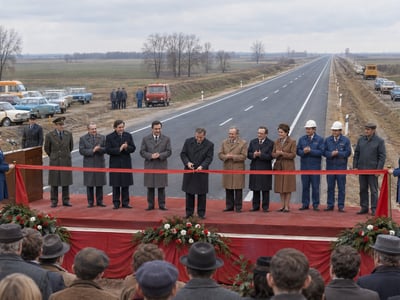
On 7 November 1978, a 19.3-kilometre motorway section between Senec and Trnava was ceremonially opened in Slovakia, then part of Czechoslovakia. It extended the Bratislava–Senec route, opened on 12 December 1975, and carried the designation D-61. The same corridor is now part of the D1. The ceremony is not, by itself, proof of the first day of traffic.
The Senec–Trnava section of D-61 was ceremonially opened on 7 November 1978.
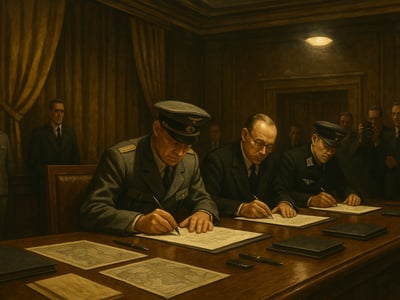
On 7 November 1978, a 19.3-kilometre motorway section between Senec and Trnava was ceremonially opened in the Slovak part of Czechoslovakia. It continued the already operating Bratislava–Senec motorway, extending a route that had previously reached Senec. At the time, the motorway carried the designation D-61. The section is now part of the D1 corridor.
An extension, not a whole motorway
The event marked the completion of a particular addition, not the opening of an entire motorway. That distinction sets the scale of the achievement: a defined stretch of road had been added to an existing route. Its importance lay both in its length and in its connection to what was already there.
Before the November ceremony, the Bratislava–Senec section was already operating. The new work therefore did not begin an isolated motorway route between two towns. It continued an established route toward Trnava, moving the extent of the motorway beyond its previous endpoint at Senec. The earlier section provided the essential context for understanding the addition.
Senec as the joint between two sections
A motorway network is built through such connections. A completed section has a place within a larger system, but the system does not have to be finished for an individual addition to matter. In this case, the measurable change was 19.3 kilometres of motorway extending the existing route. The opening was one stage in the development of the network on the territory of present-day Slovakia.
The place names help make that sequence clear. Bratislava and Senec identify the preceding route; Senec and Trnava identify the extension. Senec appears in both because it was the point at which the earlier motorway and the new section connected. Reading the two section names together reveals the progression more clearly than treating the November opening as a standalone event.
D-61 on the day, D1 on the later map
The contemporary designation also matters. An account of the inauguration should call the route D-61, rather than apply today's D1 label without explanation. D1 identifies the corridor as it is known now; D-61 identifies it in the context of the 1978 ceremony. Both names can refer to the history of the same infrastructure, but they belong to different points in that history.
This is more than a question of choosing an old or new name. Route numbers provide a framework for reading transport records. Someone following the present-day D1 corridor through earlier accounts may encounter D-61 and need to understand that the numbering differs. The modern label helps locate the section, while the historical label preserves how it was identified when it was inaugurated.
A ceremony is not the first vehicle
There is a second distinction to preserve: the documented event was a ceremonial opening. That establishes what happened on 7 November, but it does not, by itself, establish the exact moment when public traffic began using the section. Without separate evidence for the start of traffic operation, the ceremony should not automatically be treated as proof that both occurred simultaneously.
Keeping that boundary does not diminish the event. It makes the chronology more precise. The firm facts are the section's endpoints, its length, its designation at the time, and the date of its ceremonial inauguration. Claims about particular construction difficulties, individual decisions or the first vehicles to use the road would require additional documentation.
Why it still matters
The Senec–Trnava opening illustrates how a familiar motorway can emerge through separately completed sections. A present-day map brings those sections together into a continuous corridor. A historical account separates them again, showing which part already existed and which part was added at a particular stage. Both views are useful, but they answer different questions.
The 19.3-kilometre figure gives this stage a concrete scale. Rather than describing motorway development only as a broad national undertaking, it identifies a specific addition between named places. That makes the event a useful marker for tracing how the network expanded, without suggesting that the rest of the corridor was completed at the same time.
The opening also offers a practical lesson in reading infrastructure history: distinguish the section from the whole route, the contemporary designation from the current one, and a ceremony from the start of traffic operation. These distinctions keep a concise account accurate even when later maps make the road appear to be a single, timeless feature.
What was ceremonially inaugurated that November was a defined extension beyond Senec toward Trnava. Its place in history rests on that connection: another completed section joined the existing motorway, contributing to the corridor travellers now know as the D1.
Timeline
- Work on the Bratislava–Senec section is under way
- Bratislava–Senec section opens
- Senec–Trnava section is ceremonially opened
What you uncovered
The Layers Behind a Route
You didn't just complete a puzzle—you revisited the ceremonial opening of one section in a gradually expanding motorway network.
A continuous line on today’s map can make a motorway look like a single project rather than a sequence of connected sections. Reading older D-61 records alongside the present D1 designation helps reveal those layers without mistaking a change in numbering for a different road. Individual section openings therefore offer a more precise way to trace the network’s development than the modern route label alone.
The Senec–Trnava section inaugurated in November 1978 measured 19.3 kilometres.
FAQ
What was ceremonially opened on 7 November 1978?
On 7 November 1978, the Senec–Trnava motorway section was ceremonially opened. It was a new link beyond the already operating Bratislava–Senec segment.
How long was the Senec–Trnava motorway section?
The section measured 19.3 kilometres. That length is given for the section opened on 7 November 1978.
Why do sources call it D-61 instead of D1?
At the November 1978 inauguration, the route carried the designation D-61. D1 is the present-day corridor name for the same motorway route.
Did the ceremony open the whole motorway?
No. The record describes the ceremonial opening of one section, not the entire motorway. It extended the motorway beyond the Bratislava–Senec part.