
About this story
On 3 September 1967 Sweden switched from left-hand to right-hand traffic in a single nationwide operation known as Dagen H. A 1955 referendum had rejected the change, so the later switch depended on legislation, the Högertrafikkommission, and a mass public-information campaign. Before dawn, non-essential vehicles stopped, moved to the right, and resumed under the new rule.
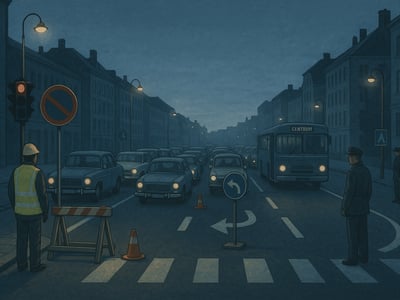
Traffic pause in Stockholm during Sweden’s Dagen H changeover on 3 September 1967.
On 3 September 1967, Sweden carried out one of the most carefully managed traffic changes in modern European history: it moved from driving on the left to driving on the right. The operation was called *Dagen H*, from the Swedish word *höger*, meaning right. What sounds simple in principle required the temporary reordering of an entire national road system. Laws had to be enforced at the same moment across the country, signs and markings had to match the new rule, and millions of drivers had to do something unfamiliar without hesitation.
Why left-hand traffic no longer fitted Sweden
For generations, left-hand traffic had been part of everyday life in Sweden. Yet by the mid-20th century, the system no longer fit neatly with the country’s surroundings or with the design of many vehicles in use. Sweden’s neighbors largely used right-hand traffic, and cross-border road movement highlighted the mismatch. The issue was not merely symbolic. It affected road design, traffic flow, vehicle placement, and the practical habits of drivers moving between different systems.
The question had already been put before the public. In the 1955 Swedish referendum on traffic direction, voters rejected a switch to right-hand traffic. That result matters because it shows the later change was not the product of broad public enthusiasm. The move that finally happened in 1967 followed a different path: legislative approval by the Riksdag and an extensive state planning effort to turn policy into reality.
To manage the transition, authorities established the Statens Högertrafikkommission, the body responsible for planning the changeover. Its work reached into ordinary life in ways that made the scale of the task unmistakable. Road signs had to be replaced or uncovered at the proper time. Lane markings and intersection arrangements had to align with the new direction of movement. Public transport operations needed revision, especially where boarding patterns, stop locations, and vehicle layouts depended on the side of the road. What had previously been background infrastructure suddenly became visible as a network of interdependent systems.
A rejected referendum and a planned state switch
The change could not rely on legislation alone. It demanded mass coordination and public obedience down to the minute. That is why the run-up to Dagen H included a large information campaign. Authorities needed every driver, passenger, cyclist, and pedestrian to understand not just that a legal rule was changing, but exactly when it would change and how behavior had to change with it. The challenge was practical: confusion for even a few minutes could produce congestion, misdirection, or collisions.
Prime Minister Tage Erlander led the government during the period in which the decision was implemented, and Olof Palme was among the prominent political figures associated with the era of state administration and public communication surrounding major reforms. But Dagen H was not chiefly a story of individual political personalities. It was a story of administration: committees, schedules, engineering adjustments, public notices, and precise sequencing.
Signs, buses, and a campaign down to the minute
The most famous moment came before dawn on the morning of 3 September. At 04:50, non-essential vehicles were required to stop. Drivers then had to move their vehicles from the left side of the road to the right side in preparation for the new traffic pattern. The pause created a controlled break between one system and the next. Instead of allowing traffic habits to change gradually or unpredictably, the state imposed a synchronized reset. After the repositioning, traffic resumed under the new rule.
That image of vehicles paused in place became the enduring symbol of Dagen H. A widely documented photograph from Kungsgatan in Stockholm shows traffic halted during the changeover, a city street turned for a moment into a carefully staged administrative threshold. The photograph remains striking because it captures something unusual: not a disaster, not a celebration, but a population waiting for procedure to take effect.
The visible street scene was only the surface of the operation. Beneath it was years of preparation. Bus operations had to be adapted. In places where trams still ran, networks and street use required attention. Signs that had long guided drivers according to one logic had to be made to serve another. Every altered curb approach, every changed arrow, every instruction given over radio or print had to support the same objective: that ordinary movement could resume quickly under a different legal and physical order.
The pause before dawn on Dagen H
The risks were obvious. If signage lagged behind the legal switch, drivers would be receiving contradictory instructions. If drivers misunderstood the timing, roads could become chaotic at exactly the worst moment. If public transport systems were not ready, the disruption would spread beyond private motorists to the rhythm of work, travel, and city life. The success of the operation depended on reducing uncertainty as much as possible.
Sweden’s switch is often remembered because it was dramatic and highly photogenic, but its real significance lies in how undramatic the desired outcome was. The goal was not spectacle. It was continuity. A major national change would count as successful only if daily life could continue after a short interruption and if the new system quickly came to feel routine.
Why it still matters
Dagen H remains a useful example of how a government carries out a synchronized national transition that combines law, infrastructure, and public behavior. It was not enough for officials to announce a new rule. They had to align physical roads, visual information, transport services, and the expectations of millions of people on the same timetable.
That makes the event relevant far beyond the question of which side of the road a country uses. It illustrates a broader problem in public administration: how to convert a legal decision into coordinated action across many systems at once. Transport policy, emergency planning, urban management, and infrastructure reform all face versions of that same challenge.
It also shows how deeply ordinary routines depend on planning that usually goes unnoticed. Driving to work, boarding a bus, reading a sign, entering an intersection—these feel personal and immediate, but they rest on shared rules and physical design. On 3 September 1967, Sweden made that dependence visible by changing those rules all at once.
In the end, Dagen H was a rare moment when administration itself became historical drama. Not because it was chaotic, but because it demonstrated that careful planning could temporarily stop a nation’s traffic, redirect it, and send it forward again under a new order.
Timeline
- Swedish referendum rejects a switch to right-hand traffic
- Traffic halted before dawn for the nationwide changeover
- Dagen H: Sweden begins driving on the right
What you uncovered
A Nation in Coordination
You didn't just…complete a scene from Swedish traffic history; you traced a moment when millions of everyday movements had to be reorganized at the same time.
Dagen H is revealing not because cars changed sides, but because the state had to translate a formal decision into coordinated physical reality. Laws alone could not do that: road markings, signs, intersections, bus operations, and public habits all had to shift together on a fixed schedule. That is why the event still matters as an example of infrastructure governance, where success depends as much on timing and communication as on legislation. It also shows how administrative planning can reshape ordinary routines at national scale without changing the basic purpose of the system.
At 04:50 on 3 September 1967, non-essential vehicles had to stop so drivers could move to the right side before traffic resumed.
FAQ
What happened in Sweden on 3 September 1967?
On 3 September 1967, Sweden carried out Dagen H, the nationwide change from left-hand to right-hand road traffic. The switch applied across the country's road system.
How was the traffic switch carried out in practice?
At 04:50, non-essential vehicles were required to stop so drivers could move to the right side before traffic resumed. The changeover depended on precise timing and public compliance.
What was decided in the 1955 Swedish referendum?
In the 1955 referendum on traffic direction, Swedish voters rejected a switch to right-hand traffic. The change was approved later by the Riksdag.
What did Sweden need to change for Dagen H?
The transition required coordinated changes to road signs, lane markings, intersections, and public transport operations. The Statens Högertrafikkommission was established to plan the switch.