
About this story
On 28 July 1984, the Summer Olympics opened at the Los Angeles Memorial Coliseum despite a Soviet-led boycott. A record number of National Olympic Committees still took part, making the ceremony a Cold War-era test of the Olympic system.
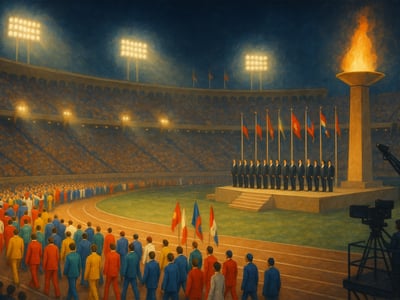
Opening ceremony of the 1984 Summer Olympics in Los Angeles on 28 July
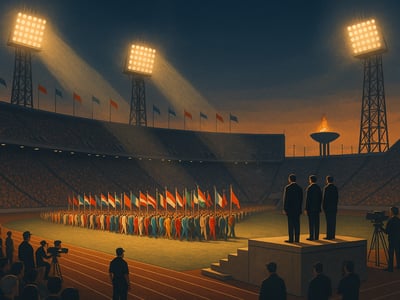
On July 28, 1984, the Summer Olympics officially opened at the Los Angeles Memorial Coliseum in Los Angeles, California, marking the start of the Games of the XXIII Olympiad. The ceremony was the formal beginning of an event that had been planned for years and watched closely around the world. By the time the athletes entered the stadium, the Los Angeles Games were already carrying more than the usual Olympic expectations. They were taking place in the middle of the Cold War, only weeks after it became clear that the Soviet Union and several allied states would not attend.
Games under a boycott shadow
That boycott created an immediate question for organizers and for the International Olympic Committee: could the Games still project the image of a truly international gathering if a major bloc of countries stayed away? The answer, at least on opening day, was visible in the scale of participation. The International Olympic Committee recorded 140 National Olympic Committees at the Los Angeles Games, the highest number in Olympic history up to that point. Whatever the absence of the Soviet-led group meant politically, the opening still presented a vast assembly of teams, officials, and symbols of national representation.
A different kind of host city
Los Angeles had arrived at this moment through a different path from many previous host cities. The city’s organizing effort was led by Peter Ueberroth, president of the Los Angeles Olympic Organizing Committee. In the years before the Games, planners had to address concerns that hosting the Olympics could become financially risky. Those worries were not abstract. Recent Olympic hosts had faced intense costs, and there was no guarantee that a large event in Southern California would attract the confidence of sponsors, broadcasters, or the public on the scale required.
The opening ceremony therefore carried a practical importance as well as a ceremonial one. It was not just a tradition-filled event to begin the competition calendar. It was also a public demonstration that the host city had delivered an Olympics large enough, orderly enough, and internationally visible enough to withstand political strain. If the ceremony had looked diminished, or if attendance had seemed thin, doubts about the entire enterprise would have grown immediately.
Those doubts had sharpened on May 8, 1984, when the Soviet Union announced that it would not send a team to Los Angeles. The decision invited comparisons with the previous Summer Olympics, held in Moscow in 1980, which had been affected by a U.S.-led boycott. The Olympic movement was again confronting the reality that global sport did not stand apart from state relations. Yet the Los Angeles opening was not framed as an argument about ideology. Its function was to begin the Games and to do so in a way that emphasized continuity: athletes arriving, delegations assembling, officials presiding, and the host city taking its place in Olympic history.
Opening day at the Coliseum
That continuity depended on a sequence of recognizable acts. The ceremony at the Coliseum brought together the host organizers, the International Olympic Committee, and the assembled national teams in a setting already linked to Olympic memory. The Los Angeles Memorial Coliseum had hosted the Games once before, in 1932, giving the 1984 opening a connection to an earlier era of the modern Olympics while also placing it in a sharply different political and media environment.
Juan Antonio Samaranch, who was serving as president of the International Olympic Committee, stood at the center of the official Olympic side of the occasion. The presence of IOC leadership mattered because the opening ceremony is more than a local celebration. It is the formal transfer of the Games from preparation into competition under the authority of the Olympic institution. In Los Angeles, that institutional continuity was especially important. The event had to show not only that a host city was ready, but also that the Olympic framework itself could absorb another major geopolitical rupture and still function.
For the United States, the opening also had an obvious national profile. Ronald Reagan was the sitting president during the Games, and the ceremony unfolded as an event of domestic and international visibility. But the most enduring image from the opening was not political speechmaking. It was the lighting of the Olympic cauldron by Rafer Johnson. Johnson, an Olympic champion and a widely respected figure in American sport, carried out one of the ceremony’s most symbolic acts. The cauldron lighting linked the Los Angeles Games to the broader ritual language of the Olympics: continuity, competition, and public memory.
Seen from the stands or on television, that moment helped define the day’s meaning. The opening was meant to establish confidence. It said that the Games had begun, that the athletes were present, and that the host city was ready to proceed despite the visible absence of one group of states. In that sense, the ceremony did not erase the boycott. Instead, it moved the focus toward what was verifiably in front of the world: a functioning Olympic event with record participation by National Olympic Committees.
Absence and presence
The contrast between absence and presence is what made the opening so significant. Some countries were missing for political reasons, and that could not be ignored. At the same time, more National Olympic Committees than ever before were represented at the Games. Those two facts existed together. The Los Angeles opening showed how the Olympics could be weakened by international conflict and yet still expand as a global gathering. That tension was central to the meaning of July 28, 1984.
Why it still matters
The opening of the 1984 Los Angeles Olympics is still studied for reasons that go well beyond ceremony. One is organizational. The Games became an important reference point for how host cities think about financing, sponsorship, and budget management. Los Angeles did not invent commercial support for sport, but the structure built around the 1984 Olympics became influential in later discussions of how to stage a large international event without relying on the same assumptions that had shaped earlier host models.
The day also remains relevant as an example of how international sport is affected by state relations. The Soviet-led boycott demonstrated that Olympic participation could be altered by decisions made far from stadiums and athletes’ villages. The ceremony itself, however, showed the other side of that reality: even under political strain, the Olympic system still depended on institutions, procedures, and a large number of participating committees willing to take part.
Finally, the opening matters because it captures the Olympics as both spectacle and system. The image of Rafer Johnson lighting the cauldron is easy to remember, but behind it stood years of planning, negotiation, logistics, and diplomacy. On July 28, 1984, Los Angeles presented a Games that were plainly shaped by Cold War conflict, yet also unmistakably global in scale. That combination helps explain why the opening ceremony is still recalled not only as a moment in sports history, but as a case study in how international events endure under pressure.
Timeline
- Los Angeles Olympic Organizing Committee planning
- Soviet Union boycott announcement
- Los Angeles Summer Olympics opening ceremony
What you uncovered
Spectacle and Legitimacy
You didn't just…complete a puzzle; you traced how the 1984 Los Angeles opening helped present the Games as credible and fully underway despite Cold War absences.
The opening ceremony mattered not only as a celebration, but as a public test of whether the Olympics could still look authoritative when a major bloc stayed away. By combining a large recorded field of participating committees with a carefully staged international presentation, organizers reinforced the idea that the Games were bigger than one geopolitical split. That helps explain why 1984 is still studied as both a sports event and a case in how institutions use ceremony, scale, and administration to protect legitimacy.
Rafer Johnson lit the Olympic cauldron during the opening ceremony at the Los Angeles Memorial Coliseum on 28 July 1984.
FAQ
When did the 1984 Summer Olympics open?
The opening ceremony of the Games of the XXIII Olympiad was held on 28 July 1984.
Where was the opening ceremony held?
It was held at the Los Angeles Memorial Coliseum in Los Angeles, California, United States.
How many National Olympic Committees took part in the Games?
The International Olympic Committee recorded 140 National Olympic Committees participating in the 1984 Los Angeles Games.
Why did the Soviet Union skip the 1984 Olympics?
On 8 May 1984, the Soviet Union announced that it would not send a team to the Los Angeles Olympics.
Who lit the Olympic cauldron in Los Angeles?
Rafer Johnson lit the Olympic cauldron during the opening ceremony on 28 July 1984.