About this story
Slovakia's 2006 election led to coalition talks and Robert Fico's appointment.
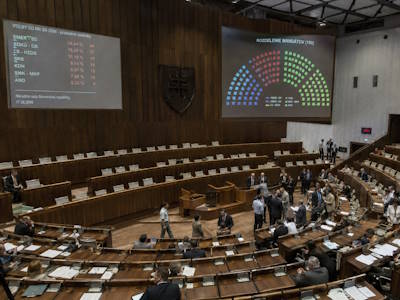
On 17 June 2006, voters in Slovakia went to the polls to choose all 150 members of the National Council of the Slovak Republic. The election ended the parliamentary term that had run under Prime Minister Mikuláš Dzurinda and opened a new phase in the country’s politics. When the votes were counted, Smer–SD had emerged as the largest party, with 29.1% of the vote and 50 seats. That was enough to place Robert Fico at the center of events, but not enough to govern alone.
The result illustrated a basic feature of parliamentary politics in Slovakia’s proportional system: finishing first is only the beginning. A party that leads the field may still be far from a majority, and the decisive question becomes whether it can assemble partners to command the confidence of parliament. In 2006, that arithmetic mattered immediately. With 150 seats in the chamber, a governing coalition needed support well beyond Smer–SD’s own total.
The election took place in a political landscape shaped by the years after Slovak independence in 1993 and by the experience of Dzurinda’s governments. By 2006, voters were choosing among several established parties with distinct traditions, rival electorates, and different views on the country’s direction. The vote therefore did more than rank parties by popularity; it set the terms for coalition bargaining in Bratislava.
Smer–SD’s first-place finish gave Fico a strong claim to try to form a government. But the numbers alone did not decide the outcome. Other party leaders also had to weigh their options, measuring not only ideological fit but practical viability. In any parliamentary system, coalition talks combine principle with necessity: parties must ask which alliance is politically defensible, which is numerically sufficient, and which can actually hold together once in office.
That was the tension in the days after the election. If Smer–SD could not secure enough parliamentary support, its plurality would remain only that: a first-place result without executive power. Alternative combinations, or a more prolonged period of uncertainty, were still conceivable while negotiations continued. The published results established the balance of forces, but they did not by themselves produce a cabinet.
The key figures in this moment were not only Robert Fico and the outgoing prime minister Mikuláš Dzurinda, but also leaders of parties that could become coalition partners. Among them were Ján Slota of the Slovak National Party and Vladimír Mečiar of the People’s Party – Movement for a Democratic Slovakia. Their choices mattered because the path from election day to government depended on finding a workable parliamentary majority.
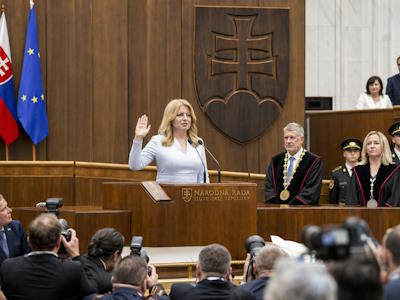
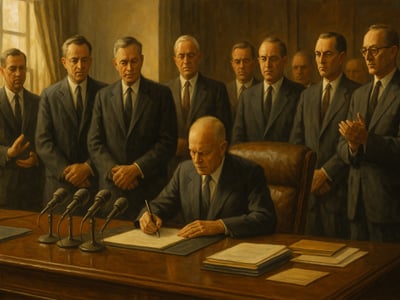
That path became clear within a little over two weeks. On 4 July 2006, President Ivan Gašparovič appointed Robert Fico prime minister. On the same day, a coalition cabinet was formed by Smer–SD, the Slovak National Party, and the People’s Party – Movement for a Democratic Slovakia. The transition from election result to executive authority was thus completed through formal constitutional procedure: votes were translated into seats, seats into coalition negotiations, and negotiations into a government recognized by presidential appointment.
Seen in sequence, the 2006 election was a straightforward but important example of how democratic institutions operate when no single party wins outright control. The voters determined the composition of parliament. The parties then tested which combinations were possible. The president, acting within the constitutional framework, appointed a prime minister once a governing arrangement had taken shape. Each step was distinct, and each was necessary.
The election also marked the end of one governing period and the beginning of another. Dzurinda’s second term had run its course, and the June vote created the conditions for a transfer of executive power. That transfer did not happen because one party swept the field. It happened because the largest party was able to convert its electoral lead into a coalition that could govern.
Why it still matters
The 2006 Slovak parliamentary election remains a useful reference point because it shows, in a measurable way, how proportional representation affects political outcomes. Smer–SD won 29.1% of the vote and 50 seats, a clear lead but not a majority. The gap between “largest party” and “governing party” had to be bridged by coalition bargaining. For anyone trying to understand parliamentary systems, that distinction is essential.
It also matters as an example of how executive power changes hands through institutions rather than through a single dramatic act. The election on 17 June established the parliamentary balance. Coalition talks followed. The president’s appointment of Robert Fico on 4 July formalized the outcome. The process shows how electoral legitimacy, party negotiation, and constitutional procedure interact.
Finally, the result remains part of the broader story of party-system change in post-1993 Slovakia. It is regularly cited because it marked the start of Fico’s first premiership and because it demonstrated the importance of coalition partner choice in shaping a government’s final form. The exact distribution of seats, the negotiations that followed, and the cabinet formed on 4 July 2006 all continue to matter as documented facts in the country’s recent political history.
What happened in Slovakia in June and July 2006 was not simply that one party won an election. It was that an electoral plurality, short of a majority, was turned into governing authority through coalition agreement. That sequence helps explain both the immediate result and the lasting significance of the vote.
Timeline
- Slovak parliamentary election
- Robert Fico appointed prime minister
What you uncovered
When Plurality Became Power
You didn't just… complete a puzzle; you traced how an election result without a majority still became governing power through coalition-building.
This result is a useful reminder that in a parliamentary system, finishing first is not the same as being able to govern alone. Smer–SD's 50 seats mattered only because they could be combined with specific partners into a workable majority. That makes the 2006 election less a story of a single party's win than of how proportional systems turn vote totals into bargaining power, cabinet formulas, and executive authority.
Robert Fico's cabinet, formed on 4 July 2006, brought together Smer–SD, the Slovak National Party, and the People's Party – Movement for a Democratic Slovakia.
FAQ
What happened in Slovakia on 17 June 2006?
Slovakia held parliamentary elections on 17 June 2006 to choose all 150 members of the National Council of the Slovak Republic.
How many seats did Smer–SD win in the 2006 election?
Smer–SD received 29.1% of the vote and won 50 seats. That made it the largest party in the chamber, but not a majority.
Who became prime minister after the election?
President Ivan Gašparovič appointed Robert Fico as prime minister on 4 July 2006.
Which parties formed the new government in July 2006?
The cabinet formed on 4 July 2006 included Smer–SD, the Slovak National Party, and the People's Party – Movement for a Democratic Slovakia.
Why were coalition talks necessary after the vote?
No party won a majority of the 150 seats, so a governing cabinet depended on coalition negotiations. Smer–SD's plurality had to be turned into a parliamentary majority through partners.