
About this story
Title IX entered U.S. law with the Education Amendments of 1972 in Washington, D.C.
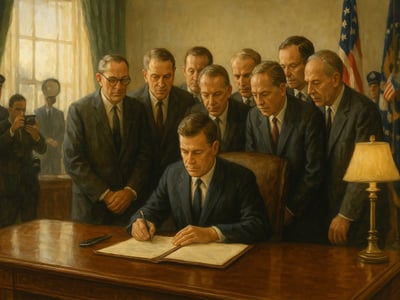
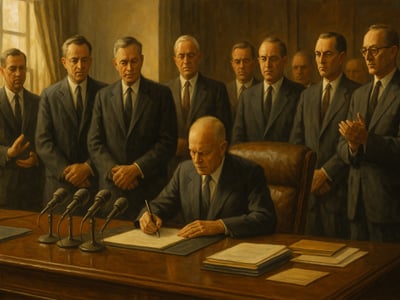
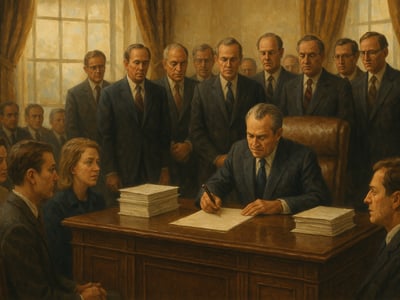
On June 23, 1972, President Richard Nixon signed the Education Amendments of 1972 into law in Washington, D.C. Inside that large education bill was a short provision that would become one of the best-known clauses in U.S. education law: Title IX. Its opening language was direct: no person in the United States, on the basis of sex, could be excluded from participation in, denied the benefits of, or subjected to discrimination under education programs or activities receiving federal financial assistance.
The wording was brief, but getting it into law required more than a simple statement of principle. Title IX did not arrive as a standalone act with a single public campaign built around it. Instead, it moved through Congress as part of a broader legislative package, the Education Amendments of 1972, known in legal citation as Public Law 92-318. That meant supporters had to preserve the anti-discrimination language while the larger bill was assembled, debated, and finalized.
At the center of that effort was Senator Birch Bayh, the Senate figure most closely associated with the provision during its passage. In the House, Representative Edith Green was an important supporter in education legislation, and Representative Patsy Mink was closely linked to the cause of equal opportunity in education. Their work took place in a period when lawmakers were paying increased attention to discrimination, civil rights law, and the role of federal authority in shaping access to public institutions.
The key question was not only whether sex discrimination in education was wrong in principle, but whether Congress would attach consequences to that principle. A general declaration might have carried symbolic force, yet Title IX was designed to operate through a practical mechanism already familiar in federal law: schools, colleges, and universities that received federal financial assistance would be expected to comply. That connection to funding gave the provision administrative weight. It also made the stakes of congressional drafting unusually high. If the language were narrowed, diluted, or removed, the final law would offer far less leverage over institutions that depended on federal support.
This legislative setting shaped the form Title IX took. Rather than listing every possible discriminatory practice, the statute used broad terms. That breadth helped it endure, because it could be applied across many education programs and activities. At the same time, broad language almost always invites later interpretation. Once enacted, the law would need regulations, enforcement procedures, and administrative guidance to explain how compliance should work in practice.
That process began soon after passage. The Department of Health, Education, and Welfare, which then had major responsibility for federal education oversight, took on early implementation. In 1975, federal athletics regulations were issued, helping define how schools were expected to apply Title IX in sports. Later, the 1979 Policy Interpretation on intercollegiate athletics became especially influential in explaining how compliance could be evaluated in that area.
Although athletics later became the part of Title IX most widely recognized by the public, the law was broader from the start. Its language addressed education programs and activities receiving federal financial assistance, which meant questions of admissions, access, treatment, and institutional policy all fell within its reach. The statute created a legal basis on which students and federal agencies could press schools to change practices that excluded or disadvantaged people on the basis of sex.
The history that followed shows how durable that basis proved to be. In 1984, the Supreme Court's decision in *Grove City College v. Bell* narrowed how Title IX applied by treating coverage more program by program rather than institution wide. Congress responded with the Civil Rights Restoration Act of 1988, which broadened the reach of federal civil rights laws in federally funded institutions. The sequence illustrated something important about Title IX: its meaning did not remain fixed only in the moment of Nixon's signature. It continued to be shaped by courts, agencies, and Congress itself.
The law's public memory also evolved. In 2002, it was formally renamed the Patsy T. Mink Equal Opportunity in Education Act, honoring Representative Patsy Mink's role and legacy. That renaming did not change the original event of 1972, but it did reflect how later generations understood the significance of the statute and the people who worked to secure it.
What stands out about June 23, 1972, is how much rested on a few lines of legal text. Title IX did not promise equal opportunity by rhetoric alone. It embedded the principle into the structure of federal education funding. That design gave the provision a lasting place in American law, because it linked a national standard to institutions that wanted continued access to federal support.
Why it still matters
Title IX still matters because it showed how civil rights rules in education could be made effective through administration as well as declaration. By tying compliance to federal financial assistance, Congress created a framework in which schools and universities had to consider not only broad legal principles but also concrete institutional obligations.
That framework influenced how educational access is organized in the United States. Questions involving admissions, participation, and athletics oversight have all been shaped by the idea that equal opportunity rules can be built into the everyday governance of schools. Even where interpretation has changed over time, the law's basic structure has remained a model for how federal policy can affect educational institutions.
It also remains an important reference point beyond its immediate historical setting. Title IX is often cited not simply because it was passed in 1972, but because it demonstrated how a compact statutory clause could generate regulations, enforcement systems, court cases, and long-term institutional change. Its history is a reminder that in legislation, a few sentences can matter for decades when they are tied to the machinery that makes institutions respond.
Timeline
- Congressional debate on Education Amendments
- Education Amendments signed into law
- Title IX athletics regulations
- HEW Policy Interpretation on athletics
- Grove City College v. Bell
- Civil Rights Restoration Act
- Patsy T. Mink renaming
What you uncovered
A Short Clause, Lasting Reach
You didn't just…complete a puzzle; you traced the moment a few lines of federal law began reshaping how schools receiving public funds were expected to treat students.
Title IX mattered not only because it stated a principle, but because it attached that principle to federal financial assistance. That link turned a general ban on sex discrimination into an administrative system of rules, oversight, and compliance. In practice, it helped make equal-opportunity standards part of how schools and universities were governed, not just how they described themselves.
Title IX was enacted as part of Public Law 92-318, the Education Amendments of 1972, signed by President Richard Nixon on June 23, 1972.
FAQ
What happened on June 23, 1972?
On 1972-06-23, President Richard Nixon signed the Education Amendments of 1972 into law in Washington, D.C. Title IX was enacted as part of that law.
Who is most closely associated with Title IX in Congress?
Senator Birch Bayh was the Senate sponsor most closely associated with the Title IX provision during congressional passage in 1972. Representative Patsy Mink was later honored in the law’s 2002 renaming.
What does the original Title IX text say?
The statutory text of 20 U.S.C. § 1681 begins: “No person in the United States shall, on the basis of sex...” It bars sex discrimination in education programs or activities receiving federal financial assistance.
Why was Title IX tied to federal education funding?
It was linked to federal financial assistance so the rule could operate through the conditions attached to education funding. That gave the provision practical leverage over federally funded schools and colleges.