
About this story
Opening ceremony of the 1992 Summer Olympics in Barcelona on 25 July 1992
On 25 July 1992, the opening ceremony of the Games of the XXV Olympiad took place at Estadi Olímpic de Montjuïc in Barcelona, Spain, formally beginning a Summer Olympics that the International Olympic Committee records as running until 9 August. For the host city, the evening was more than a scheduled ritual. It was a live international presentation in which timing, symbolism, and technical precision had to work together in front of a stadium crowd and a worldwide television audience.
By the time the ceremony began, Barcelona had spent years preparing for the event. The city had been chosen as host in 1986, and the Olympic project became closely associated with work on venues and the wider presentation of Montjuïc as a central stage for the Games. Opening night was the point at which those preparations became visible all at once. The ceremony had to fulfill Olympic protocol, introduce the host city to viewers around the world, and set the tone for more than two weeks of competition.
Official records list 169 National Olympic Committees and 9,356 athletes at the Barcelona Games. That scale mattered on the first night. The opening ceremony was not simply a performance but the start of a logistical sequence involving delegations, officials, performers, music, broadcasting crews, and stadium staff. Every part had to fit a rigid order. The athletes' parade, the arrival of dignitaries, the formal speeches, and the oath and flame sequence all depended on exact coordination.
Such ceremonies are designed to look effortless, but they are built on the opposite principle. Each transition is timed. Cameras must be in position. Performers and participants must enter at the right moment. The audience in the stadium experiences the event as a continuous spectacle, while television turns it into a shared global broadcast. If any major element fails, the mistake is immediately public and difficult to correct. That pressure was especially strong in Barcelona, where the ceremony carried the additional burden of representing the host city at a highly visible post-Cold War Olympic gathering.
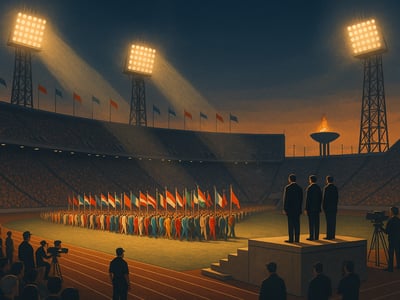
As athletes from 169 National Olympic Committees entered the stadium, the ceremony moved through one of the most familiar Olympic rhythms: national delegations arriving one by one, the host nation appearing last, and the arena gradually shifting from staged performance to sporting assembly. The moment is ceremonial, but it also changes the meaning of the evening. Until then, the event belongs mainly to organizers and directors. Once the athletes arrive, the Games themselves feel present.
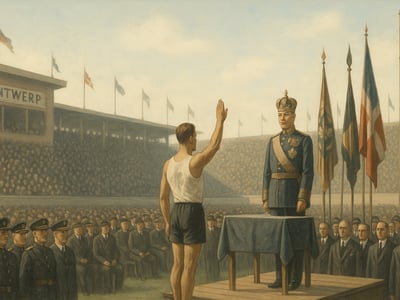
Among the central public figures of the night was Juan Antonio Samaranch, the president of the International Olympic Committee. During the ceremony, he formally declared the Barcelona 1992 Summer Olympics open. That declaration is brief in wording but central in function. It marks the transition from anticipation to official competition. However elaborate the show around it may be, the opening ceremony remains anchored in that act of protocol.
The best-remembered sequence came at the climax: the lighting of the Olympic cauldron. Barcelona's ceremony became especially associated with the archer Antoni Rebollo, whose role in the flame sequence turned the final minutes into a test of live execution. This was the point at which weeks of rehearsal met the uncertainty of a single real-time attempt. There was no practical reset in front of the world. The effect depended not only on one visible participant but also on all the unseen coordination behind him: the pacing of the ceremony, the placement of equipment, the control of the stadium environment, and the broadcast framing that would make the moment legible to viewers everywhere.
That concentration of risk is one reason opening ceremonies are remembered so vividly. They gather many functions into a few minutes. The Olympic movement's formal traditions must be respected. The host city wants to communicate identity and competence. Television demands clarity and rhythm. Safety requirements limit what can be improvised. Yet the event must still appear spontaneous enough to feel thrilling. In Barcelona, the cauldron-lighting sequence became the image that tied those demands together.
The ceremony's success also helped define the opening of the Games for the 9,356 athletes who had come to compete. For them, the evening was both spectacle and threshold. After years of qualification and preparation, the Olympics had finally begun in a formal and visible way. The parade and declaration placed individual competitors into a much larger framework: a gathering of delegations, symbols, and rules that made the event recognizably Olympic before any medals were awarded.
Why it still matters
The Barcelona opening ceremony remains one of the most cited visual memories of the 1992 Olympics because it showed how much can depend on a single live sequence. What audiences saw as a few decisive moments was the result of tightly integrated planning among ceremony directors, stadium staff, Olympic officials, and broadcasters. That makes the event useful not only as a cultural memory but also as an example of how modern mega-events function.
It also illustrates the special role of opening ceremonies in shaping how a host city is perceived. Unlike an individual competition, a ceremony is designed to communicate at once: place, competence, atmosphere, and symbolism. Barcelona 1992 is often referenced in that context, not because every later claim about Olympic legacy can be proved from one night, but because the opening offered an unusually clear image of a city presenting itself on a global stage.
Looking back, the ceremony stands out not just for scale but for control. Its most famous moment felt dramatic precisely because it had to balance danger, precision, and protocol without visible hesitation. That combination helps explain why the opening of the Barcelona Games still occupies such a durable place in Olympic history.
Timeline
- Barcelona selected as 1992 Olympic host city
- Barcelona 1992 Olympic opening ceremony
- Barcelona 1992 Olympic Games begin
- Barcelona 1992 Olympic Games end
What you uncovered
A Ceremony Built on Timing
You didn't just… complete a puzzle; you traced a moment when choreography, protocol, and live television had to align exactly for the Olympics to begin as planned.
What made the Barcelona opening ceremony memorable was not only its imagery, but the system behind it. A live Olympic ceremony compresses officials, performers, venue operations, and broadcast timing into one sequence where each part depends on the others. That is why such events often shape how a host city is remembered: they turn logistics and symbolism into a single public performance.
IOC records list 169 National Olympic Committees and 9,356 athletes at the Barcelona 1992 Summer Olympics.
FAQ
What happened at the Barcelona 1992 opening ceremony on 25 July?
On 25 July 1992, the opening ceremony of the Games of the XXV Olympiad took place at Estadi Olímpic de Montjuïc in Barcelona. IOC President Juan Antonio Samaranch declared the Games open during the ceremony.
Which stadium hosted the Barcelona 1992 opening ceremony?
The opening ceremony was held at Estadi Olímpic de Montjuïc in Barcelona, Spain. It marked the formal start of the Summer Olympics in the host city.
Who declared the 1992 Summer Olympics open in Barcelona?
IOC President Juan Antonio Samaranch declared the Barcelona 1992 Summer Olympics open during the opening ceremony on 25 July 1992.
How many teams and athletes took part in Barcelona 1992?
IOC records list 169 National Olympic Committees at the Barcelona 1992 Games. Official Barcelona 1992 totals record 9,356 athletes competing.