
About this story
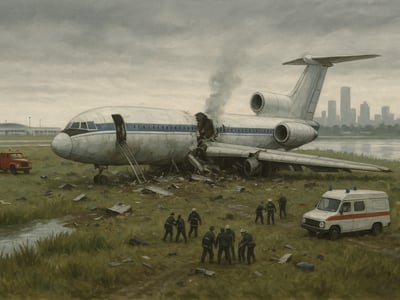
On 28 July 1976, ČSA Flight 001, an Ilyushin Il-18, crashed near Zlaté Piesky by Bratislava Airport with 79 people on board. The disaster remains a major civil-aviation landmark in Bratislava’s transport history.
ČSA Flight 001 crashed near Zlaté Piesky by Bratislava Airport on 28 July 1976.
On 28 July 1976, ČSA Flight 001 crashed near Zlaté Piesky, close to Bratislava Airport in what was then Czechoslovakia. The aircraft was an Ilyushin Il-18 operated by Czechoslovak Airlines, and sources agree that 79 people were on board. What should have been the last minutes of a routine arrival instead became one of the most serious aviation disasters associated with Bratislava, leaving a lasting mark on the city’s transport history and on the safety record of civil aviation in former Czechoslovakia.
Final approach breakdown
The known outline of the event is clear even where some details remain subject to the hierarchy of sources. The flight was on final approach to Bratislava Airport when the landing sequence broke down at low altitude. At that stage of flight, crews have very little margin for correction. Speed, descent rate, alignment, and altitude all have to remain within narrow limits. If that stability is lost close to the ground, there may be only seconds in which to recover the approach, discontinue the landing, or avoid impact.
That is the central tension in the history of Flight 001. The crew, facing the compressed timing of a low-altitude approach, had to assess whether the aircraft could still be brought safely onto the runway. The brief factual record available in later summaries indicates that something went wrong in those final moments near the airport. Whatever corrective actions were attempted, they proved insufficient. The Il-18 came down near Zlaté Piesky, creating a major crash scene on the edge of Bratislava.
Crash scene and rescue
For people on the ground, the crash turned an airport approach path into a place of emergency almost instantly. Rescue and recovery became the immediate priority. Witnesses, local authorities, airport-linked responders, and other emergency personnel were confronted not only with the impact itself but with the practical consequences that often follow an air disaster: fire, wreckage spread over a limited area, the need to reach survivors quickly, and the task of securing the scene so that investigators could later reconstruct what had happened.
Aircraft and airport context
The aircraft type involved also forms part of the broader context. The Ilyushin Il-18 was a familiar part of Eastern Bloc civil aviation in the mid-20th century, including in Czechoslovak service. It was a long-established turboprop airliner used on regular passenger routes, and by 1976 it was not an experimental or unusual machine. That matters because the crash was not historically notable for involving an obscure aircraft or an unfamiliar airfield. It occurred within a well-developed system of scheduled civil transport, which made the accident more significant for public confidence and for the official record of airline operations.
Bratislava Airport in the 1970s was an important node in the country’s domestic and international air network. An approach into that airport should have represented the concluding, controlled phase of a commercial flight. Instead, the disaster highlighted how vulnerable that phase can be. Across aviation history, final approach has often been recognized as one of the moments when small deviations can rapidly become catastrophic because there is so little height and time available for recovery. Flight 001 entered that danger zone at exactly the wrong moment.
Establishing the record
In the aftermath, the work of establishing facts did not end with the rescue effort. It shifted into investigation, documentation, and record-keeping. That process is especially important in this case because one of the most frequently repeated details—the death toll—has not been presented consistently across all secondary sources. Immediate reporting and later summaries have differed. Such discrepancies are not unique to this accident. Early reports after major disasters are often assembled under pressure, while later retellings may repeat earlier numbers without checking them against primary documentation.
For that reason, the most reliable basis for the final casualty count is not a later summary on its own, but the official accident investigation record or the relevant civil aviation registry. Secondary accounts remain useful for understanding how the event was remembered and reported, but they do not carry the same authority when they conflict with formal records. In a tragedy involving so many lives, precision matters. It matters historically, administratively, and personally.
The crash near Zlaté Piesky therefore belongs to two histories at once. One is the history of a specific air disaster near Bratislava on 28 July 1976. The other is the history of how such disasters are documented: what is known immediately, what is revised later, and what eventually stands as the official account. Even when every mechanical or operational detail is not widely repeated in public summaries, the surviving documentary structure still preserves the essential facts of place, date, aircraft, operator, and scale.
Why it still matters
ČSA Flight 001 remains significant because it forms part of the civil aviation safety record of former Czechoslovakia. Aviation history is not made only of routes opened, aircraft introduced, or airports expanded. It is also shaped by accidents that exposed the limits of procedures, the risks of final approach, and the importance of careful investigation after a crash.
The event also remains relevant as an example of how historical facts are verified. In this case, the core facts are stable: the date, the airline, the aircraft type, the location near Zlaté Piesky, and the presence of 79 occupants on board. What varies in some published accounts is the final number of those who died. That difference is a reminder that historical writing depends on source quality. When accounts diverge, official investigation files and civil aviation registries matter more than repeated summaries.
Finally, the crash connects geography and memory in Bratislava itself. Zlaté Piesky, the airport, and the surrounding urban landscape are not abstract locations in an archive. They are real places where transport systems, local experience, and public history intersect. Remembering Flight 001 means remembering both a specific disaster and the disciplined work required to document it accurately.
Timeline
- Bratislava Airport operations in the 1970s
- Use of the Ilyushin Il-18 in Czechoslovak civil aviation
- ČSA Flight 001 crash near Bratislava
What you uncovered
When Records Diverge
You didn't just… complete a puzzle; you traced a historical event whose basic facts are clear, even as some of its most cited numbers remain contested across sources.
Aviation disasters are often remembered through a mix of urgent reporting, later retellings, and formal investigation records, and those layers do not always match perfectly. In cases like this, the disagreement itself becomes part of the history, showing how public memory can settle around a tragedy before the documentary record is fully aligned. That is why transport history depends not only on eyewitness accounts and summaries, but also on the quieter work of official record-keeping.
The aircraft involved in the crash was an Ilyushin Il-18 operated by Czechoslovak Airlines.
FAQ
What happened to ČSA Flight 001 on 28 July 1976?
On 28 July 1976, ČSA Flight 001 crashed near Zlaté Piesky by Bratislava Airport in Czechoslovakia. The aircraft was an Ilyushin Il-18 operated by Czechoslovak Airlines.
Where did the ČSA Flight 001 crash happen?
The crash happened near Zlaté Piesky, close to Bratislava Airport in Bratislava, Czechoslovakia.
How many people were on board ČSA Flight 001?
Sources cited for the event say there were 79 occupants on board the aircraft. That figure is the common factual anchor for the flight.
Why do sources disagree on the death toll for ČSA Flight 001?
Immediate reporting and later summaries did not always give the same final death toll. The official accident investigation record or civil aviation registry should be used as the controlling source for the final casualty count.