
About this story
On 4 September 1843 Ján Levoslav Bella was born in Liptovský Mikuláš, then in the Kingdom of Hungary. His later path ran through church schooling in Banská Bystrica, ordination in 1866, a choirmaster post in Kremnica, and a long career in Hermannstadt (Sibiu). The birth date matters because later institutions turned a local beginning into a central name in Slovak art-music history.
Birthplace context for Ján Levoslav Bella in Liptovský Mikuláš, 1843
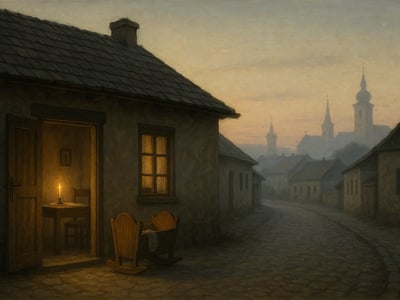
On 4 September 1843, Ján Levoslav Bella was born in Liptovský Mikuláš, then part of the Kingdom of Hungary within the Habsburg monarchy. At the time, this was simply a local birth in a provincial town. Nothing in the record of that day could have shown that the child would later become one of the figures most closely associated with Slovak musical culture of the 19th century.
A provincial birth without a ready destiny
That uncertainty is part of what makes the date historically interesting. Birth anniversaries often seem important only in retrospect. In Bella’s case, the significance of 4 September 1843 did not come from a dramatic event at the moment itself, but from the network of institutions that later shaped his life. His path toward public recognition depended on education, church structures, musical training, and the kinds of appointments that made a career in Central European music possible.
Bella’s early life belonged to a world in which ambitious young men often advanced through schooling connected to the church. Musical ability alone was rarely enough. Progress usually required literacy, discipline, language skills, and access to teachers and institutions that could support serious study. For someone born in a town like Liptovský Mikuláš, the route to a larger cultural role often led outward through regional centers of education.
Bella later studied at the Catholic gymnasium in Banská Bystrica. That step mattered because schools of this kind were not only places of general instruction. They also formed part of a broader social system that trained clergy, administrators, and educated professionals. In the 19th-century Habsburg lands, church-related education could open doors into music as well as religion. A student who moved successfully through this world might find opportunities as an organist, choirmaster, teacher, or composer.
Church schooling and ordination
Bella continued on that path and was ordained a Catholic priest in 1866 in Banská Bystrica. Ordination placed him firmly inside one of the most important institutional frameworks for music in the period. Church music was a living practical tradition, not a separate artistic specialty. It required regular performance, knowledge of vocal writing, familiarity with liturgical needs, and the ability to work with singers and instrumentalists. For a trained musician, the church offered both responsibility and continuity.
After ordination, Bella served as choirmaster in Kremnica during the later 1860s. This kind of post was an important test of professional skill. A choirmaster had to manage repertory, train performers, and respond to the expectations of local religious and civic life. Such work connected composition to daily practice. Music was not produced in isolation; it was written, adapted, rehearsed, and heard within institutions that relied on capable organizers.
Kremnica, Hermannstadt, and working music posts
Seen from that perspective, Bella’s career illustrates a broader pattern in 19th-century Central Europe. The musical world was held together by towns, churches, schools, and municipal bodies rather than by a single national system. Composers from Slovak-speaking regions developed in contact with wider Habsburg-era networks. Their careers could move across languages and jurisdictions, and their work often circulated through institutions that were local in function but international in structure.
Bella’s later move to Hermannstadt, now Sibiu, belongs to that same story. He held a major long-term music post there, extending his career beyond the environment of his birthplace and early training. Even without relying on disputed details of title or exact dates, the broad fact is clear: his professional life expanded into a larger urban setting where his abilities as a musician, conductor, and teacher could be exercised over many years. That later service is one reason his name remained visible in musical history.
Why the date later entered cultural memory
What makes this especially notable is that Bella’s public importance was not prewritten in 1843. It depended on later decisions by family, schools, church authorities, and employers, as well as on his own ability to work within those systems. Without such support, the birth recorded in Liptovský Mikuláš might have remained a private fact known only to relatives and local archives. Instead, it became the starting point of a documented career that later historians could place within the development of Slovak art music.
His life also helps explain how cultural history is often built. Nations later celebrate composers as representative figures, but those composers usually emerged from mixed and overlapping environments. Bella’s biography links local Slovak history with the institutional world of the Kingdom of Hungary and the wider Habsburg monarchy. That does not reduce his importance; it clarifies the setting in which his work became possible.
Why it still matters
Bella still matters because his career offers a concrete example of how music functioned in the 19th century. It shows that composition was supported by schools, clergy training, church performance, and urban institutions. Rather than imagining musical culture as the product of isolated genius alone, his story points to the systems that trained and employed musicians.
He also remains important in the history of Slovak music because later scholars and performers have used his work to trace the growth of concert, choral, and art-music traditions connected with Slovak cultural life. His name appears in discussions not just because he wrote music, but because his career helps map the emergence of a repertoire and a professional musical identity in a region where such institutions were still taking shape.
Finally, Bella’s birth in Liptovský Mikuláš connects a specific local place to wider Central European history. A single birth record from 1843 leads outward to Banská Bystrica, Kremnica, and Hermannstadt, and beyond them to the educational and musical networks of the Habsburg world. That is why the date matters today: not because anyone at the time could foresee the outcome, but because Bella’s later life gave enduring meaning to an otherwise ordinary beginning.
Timeline
- Birth of Ján Levoslav Bella in Liptovský Mikuláš
- Ordained a Catholic priest in Banská Bystrica
- Serves as choirmaster in Kremnica
- Long music post in Hermannstadt (Sibiu)
What you uncovered
A Career Built by Institutions
You didn't just… complete a biography clue; you traced the starting point of a career that depended on the schools, churches, and civic music life of 19th-century Central Europe.
Bella's significance is not only about individual talent, but about the kind of institutions that made a musical career possible in his time. In the 19th century, composers from Slovak-speaking regions often advanced through church education, clerical training, and urban appointments rather than through dedicated national music structures. That makes his life useful for understanding how local culture was shaped inside wider Habsburg-era networks.
Bella was ordained a Catholic priest in Banská Bystrica in 1866.
FAQ
When was Ján Levoslav Bella born?
Ján Levoslav Bella was born on 4 September 1843.
Where was Ján Levoslav Bella born?
He was born in Liptovský Mikuláš, then in the Kingdom of Hungary within the Habsburg monarchy.
Who was Ján Levoslav Bella?
Ján Levoslav Bella was a composer, conductor, and teacher. He is associated with Slovak musical culture in the 19th and early 20th centuries.
Why is Ján Levoslav Bella important in Slovak music history?
He is regarded as one of the foundational figures of Slovak classical music. His career helped shape Slovak art music within the church and urban musical institutions of his time.