
About this story
On 9 September 1941 the wartime Slovak Republic issued Government Decree 198/1941, the Jewish Code, in Bratislava. The measure gathered anti-Jewish restrictions on status, property, work, and public life into one legal frame under President Jozef Tiso. It organized persecution through administration, and it belongs to the sequence that later included Aryanization and the 1942 deportations.
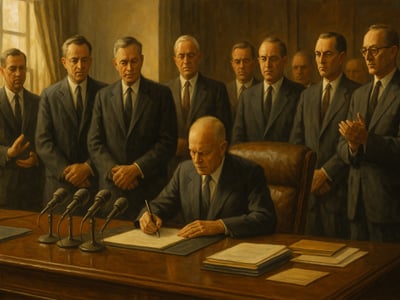
Government Decree No. 198/1941 in Bratislava, the Slovak Jewish Code of 9 September 1941.
On September 9, 1941, the government of the wartime Slovak Republic issued Government Decree No. 198/1941 concerning the legal status of Jews. Promulgated in Bratislava, the measure became commonly known as the Jewish Code, or *Židovský kódex*. It marked a decisive stage in the Slovak state's anti-Jewish policy by gathering a wide range of restrictions into a single legal framework that applied across the country.
A decree, not scattered rules
The decree did not appear in isolation. By the autumn of 1941, anti-Jewish policy in the Slovak Republic had already developed through earlier discriminatory measures. What changed on that September day was the scale and clarity of the legal structure. Instead of relying mainly on separate rules and scattered provisions, the state set out a more comprehensive system for defining who was considered Jewish and for regulating everyday life accordingly.
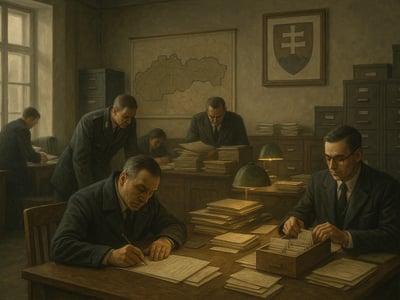
That shift mattered because law gave persecution an administrative form. The Jewish Code affected civil status, property, employment, and participation in public life. In practical terms, it expanded the state's ability to intervene in routine aspects of life through offices, paperwork, inspections, and enforcement. Discrimination was not only declared as policy; it was written into procedures that officials could apply throughout Slovak territory.
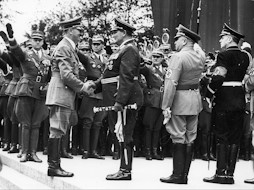
The decree was issued while Jozef Tiso was president of the Slovak Republic. The government in Bratislava was headed by Vojtech Tuka, and Alexander Mach was among the leading officials associated with the regime's internal security and anti-Jewish policy. Their leadership formed the political setting in which the decree was adopted and enforced. The code therefore stands not only as a text of law, but also as evidence of decisions made at the highest levels of the Slovak state.
Classification, property, and public life
The title "concerning the legal status of Jews" may sound technical, but its consequences were anything but abstract. Legal classification determined who could own property, what work could be done, and how fully a person could remain part of civic life. By placing these matters under a consolidated decree, the government strengthened its capacity to exclude Jews from ordinary social and economic participation.
This is one reason historians treat the Jewish Code as a major turning point in the persecution of Jews in Slovakia. It represented the transformation of antisemitic policy into a more complete legal system. The effect was cumulative: each provision reinforced the broader aim of isolating Jews from the surrounding society and placing them under tighter state control.
Tiso, Tuka, Mach, and state machinery
Administrative consolidation also changed how persecution functioned. A fragmented system can be inconsistent, uneven, or difficult to implement. A single decree, by contrast, gives officials a clearer basis for action. Ministries, local authorities, employers, police bodies, and other institutions can work from the same framework. In that sense, the Jewish Code did more than express prejudice. It organized it.
The wartime context is essential here. The Slovak Republic, established in 1939, was a state allied with Nazi Germany. Within that setting, anti-Jewish policy was shaped by both domestic political choices and the broader radicalization of Europe under German influence. Even so, the Jewish Code is specifically important in Slovak history because it shows how the Slovak state itself codified persecution in its own legal order.
From the Code toward deportation
The issuance of the code in September 1941 also sits within a larger sequence that later included the "Aryanization" of Jewish property and the deportations of Jews from Slovakia in 1942. The decree should not be treated as identical to those later events, but it formed part of the administrative and legal environment in which persecution intensified. It helped create the conditions in which exclusion could be implemented more thoroughly and with greater official coordination.
For that reason, the Jewish Code is often studied not only as a legal document but as a warning about bureaucratic power. Many forms of persecution do not begin with open violence alone. They can also proceed through definitions, registrations, restrictions, and decrees that make unequal treatment appear routine inside state institutions. The language of administration can conceal the human reality of exclusion.
Why it still matters
The Jewish Code remains important because it shows how persecution can be organized through formal law. Its historical significance lies not only in what it said on paper, but in what that paper allowed institutions to do. By translating antisemitic policy into enforceable rules, the Slovak state gave discrimination a durable administrative structure.
It also remains a central reference point in Holocaust remembrance and education in Slovakia. The date of September 9 later became associated with public commemoration, linking the decree to broader efforts to document and remember the destruction of Jewish life in Slovakia during the war. In classrooms, archives, museums, and memorial discussions, the code stands as a concrete example of how rights can be stripped away step by step.
Remembering the decree requires precision. It means recognizing that the persecution of Jews in Slovakia was not only a matter of rhetoric or isolated acts, but of official policy expressed through government action. The Jewish Code endures in historical memory because it reveals how a state can use legal authority to normalize exclusion, and how that process became part of the history of the Holocaust in Slovakia.
Timeline
- Wartime Slovak Republic is declared
- Government Decree 198/1941, the Jewish Code, is issued in Bratislava
- First deportation transport of Jews leaves Slovakia from Poprad
- Further deportations from Slovak towns continue into the spring
What you uncovered
When Exclusion Became Law
You didn't just…complete a puzzle; you traced the moment when persecution in the Slovak Republic was consolidated into enforceable law.
The significance of the Jewish Code lies not only in what it restricted, but in how it organized exclusion through formal state procedure. When separate anti-Jewish measures were gathered into one decree, discrimination became easier to administer across work, property, and public life. That shift helps explain why 9 September later became associated with remembrance in Slovakia: it marks a point at which policy was systematized and documented in legal form.
The decree issued on 9 September 1941 was Government Decree No. 198/1941 and is commonly known as the Jewish Code.
FAQ
What was issued in Slovakia on 9 September 1941?
On 9 September 1941, the Slovak government issued Government Decree No. 198/1941 concerning the legal status of Jews. It is commonly known as the Jewish Code.
What was the Jewish Code in wartime Slovakia?
The Jewish Code was the common name for Government Decree No. 198/1941. It set out a broad legal framework of anti-Jewish restrictions in the Slovak Republic.
Who led the Slovak Republic when the decree was issued?
Jozef Tiso was president of the Slovak Republic when the decree was issued in September 1941. Vojtech Tuka headed the Slovak government in Bratislava at the time.
What did the Jewish Code affect in daily life?
According to the brief, it affected civil status, property, work, and public life. The decree consolidated these restrictions into a nationwide legal measure.