
About this story
On 14 September 2003 Pope John Paul II beatified Greek Catholic bishop Vasiľ Hopko and Sister Zdenka Schelingová at an outdoor Mass in Bratislava-Petržalka during his visit to Slovakia. The ceremony joined papal liturgy with memory of communist-era persecution. Hopko’s church had been suppressed in 1950; Schelingová died in 1955 after imprisonment.
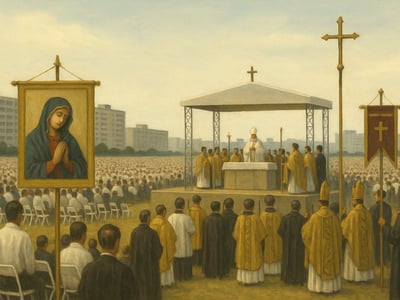
Beatification of Vasiľ Hopko and Zdenka Schelingová at the Petržalka Mass in 2003.
On September 14, 2003, Pope John Paul II celebrated an outdoor Mass in the Petržalka district of Bratislava during his visit to Slovakia and used the occasion to beatify two Slovak Catholic figures: Greek Catholic bishop Vasiľ Hopko and Roman Catholic sister Zdenka Schelingová. The ceremony brought together a papal journey, a major public liturgy, and two biographies closely associated with persecution under the communist regime in former Czechoslovakia. In one of the country’s most visible religious events of that year, the Vatican formally placed both names before a national audience as examples of fidelity under pressure.
A papal Mass in Petržalka
The setting mattered. Petržalka, a large urban district of Bratislava, provided space for a mass gathering, and the event was part of John Paul II’s broader September 2003 pastoral visit to Slovakia. Papal visits are always carefully planned occasions, but beatifications add another layer of institutional meaning. They are not simply commemorations. In Catholic practice, beatification is a formal step in the canonization process, one that authorizes public veneration in specified contexts and presents the person’s life as worthy of recognition by the Church. By conducting the beatifications during a public Mass, John Paul II joined liturgy, historical memory, and national visibility.
The two causes were distinct, and that was part of the significance of the ceremony. Vasiľ Hopko belonged to the Greek Catholic Church, an Eastern Catholic church in communion with Rome that had a particularly difficult history under communist rule in Czechoslovakia. After the suppression of the Greek Catholic Church in 1950, its structures were dismantled, clergy were pressured, and many church leaders faced imprisonment or forced marginalization. Hopko, who served as a bishop, was among those caught in that repression. His beatification publicly linked his name to that suppressed chapter of church history and highlighted a specifically Greek Catholic experience within the wider religious history of the country.
Two causes, two churches
Zdenka Schelingová’s story came from a different part of Slovak Catholic life. A member of the Sisters of Charity of the Holy Cross, she was imprisoned by communist authorities and died in 1955. Her case reflected the pressure placed not only on bishops and priests but also on women religious and the institutions in which they worked. In public memory, that distinction mattered. The Petržalka ceremony did not honor only a church leader; it also presented the life of a nun as part of the same broader history of repression. By beatifying Hopko and Schelingová together, the Vatican framed communist-era persecution as something experienced across different parts of Catholic life.
That framing required careful presentation. A papal Mass is a large ceremonial event with its own liturgical order, but a beatification also depends on years of documentation, testimony, and review. The causes of Hopko and Schelingová had developed through the Church’s formal procedures before ever reaching the altar in Bratislava. What happened on September 14 was therefore the public culmination of work that had often taken place in archives, tribunals, and church offices. The ceremony translated those institutional processes into a visible act of commemoration that ordinary participants could witness directly.
From archives to the altar
John Paul II’s decision to beatify both figures in Slovakia was also consistent with a larger pattern in his papacy. He often emphasized Christians who had suffered under totalitarian regimes and gave considerable attention to the religious history of Central and Eastern Europe. In the Slovak context, this emphasis resonated strongly. After 1989, public discussion of the communist period expanded through newly open archives, anniversaries, memorials, and renewed religious life. By 2003, a papal ceremony could speak not only to believers but also to a wider post-communist culture trying to decide how repression should be remembered in public.
At the same time, the event was not a general historical conference or a state memorial. It remained a Catholic act, shaped by Catholic categories. Beatification does not function like a secular award or a court judgment. It interprets a life through the Church’s own understanding of holiness, witness, and suffering. That distinction is important for understanding both the power and the limits of the Petržalka Mass. It did not settle every historical debate about the communist period. What it did do was give two church causes an unmistakably public form and attach them to one of the most recognizable religious figures of the era, the pope himself.
Remembering repression in public
For many observers in Slovakia, the pairing of Hopko and Schelingová also conveyed a message about breadth. Their lives represented different rites, different church roles, and different paths through repression. One was a bishop in the Greek Catholic tradition, affected by the state’s campaign against an entire church structure. The other was a Roman Catholic religious sister whose imprisonment and death became part of the remembered suffering of religious orders under communist authority. Bringing them together in a single ceremony suggested a shared historical landscape without erasing those differences.
Why it still matters
The Petržalka beatifications remain relevant because they show how religious institutions shape public memory through formal procedures as well as public ritual. Long before September 14, 2003, the lives of Hopko and Schelingová had been preserved in testimony, church records, and the work of canonization causes. But the beatification Mass moved those materials from specialized ecclesiastical processes into a highly visible public setting. In that sense, the ceremony helped turn private witness and institutional documentation into a national moment of remembrance.
The event also illustrates how post-communist societies revisit the past. In Slovakia, as in other countries once governed by communist regimes, public memory has been constructed through many channels: state archives, scholarship, monuments, family stories, and religious commemoration. The beatification of Hopko and Schelingová belongs to that wider landscape. It shows that churches were not only subjects of history but also active participants in narrating it.
Finally, the ceremony still matters because it preserved distinctions within Slovak church history rather than flattening them. Hopko’s beatification recalled the suppression of the Greek Catholic Church in 1950 and the particular vulnerability of that community. Schelingová’s beatification highlighted the experience of a Roman Catholic woman religious imprisoned by the regime. Remembered together, they offered a broader account of repression while still pointing to different institutional and spiritual histories.
What took place in Bratislava-Petržalka on that September day in 2003 was therefore more than a stop on a papal itinerary. It was a carefully staged public act in which the Catholic Church identified two Slovak lives as worthy of formal honor and connected them to a difficult twentieth-century past. Whether viewed primarily as liturgy, as commemoration, or as an episode in post-communist memory, the ceremony marked a moment when church process, national audience, and historical interpretation met in the same place.
Timeline
- Suppression of the Greek Catholic Church in Czechoslovakia
- Death of Zdenka Schelingová
- Beatification Mass in Bratislava-Petržalka
What you uncovered
Public Memory and Recognition
You didn't just… complete a date puzzle; you traced how a papal ceremony in Bratislava publicly connected two religious lives with the remembered experience of communist-era repression.
Beatification is not only a religious step within the Catholic Church; it also helps decide which lives are formally preserved and retold in public. In post-communist Slovakia, that gave the ceremony a second function beyond devotion: it made previously contained stories of suffering visible at a national scale. By honoring both a Greek Catholic bishop and a Roman Catholic sister together, the event also reflected how different strands of church history were being placed side by side in public memory.
Vasiľ Hopko was imprisoned after the 1950 suppression of the Greek Catholic Church in Czechoslovakia.
FAQ
What happened in Bratislava-Petržalka on 14 September 2003?
On 14 September 2003, Pope John Paul II celebrated Mass in Bratislava-Petržalka during his visit to Slovakia. At that ceremony, he beatified Vasiľ Hopko and Zdenka Schelingová.
Who were Vasiľ Hopko and Zdenka Schelingová?
Vasiľ Hopko was a bishop of the Greek Catholic Church in Czechoslovakia, and Zdenka Schelingová was a member of the Sisters of Charity of the Holy Cross. Both were later beatified by Pope John Paul II.
Why were Hopko and Schelingová linked to communist persecution?
Vasiľ Hopko was imprisoned after the suppression of the Greek Catholic Church in 1950. Zdenka Schelingová was imprisoned by the communist authorities and died in 1955.
What does beatification mean in the Catholic Church?
Beatification is a formal recognition in the Catholic Church that allows public veneration of a person in a limited context. It is one step in the broader canonization process.