

About this story
On 25 September 2015 the UN General Assembly in New York adopted the 2030 Agenda for Sustainable Development, with 17 goals and 169 targets accepted by all 193 member states. Secretary-General Ban Ki-moon backed the post-2015 process that succeeded the 2000 Millennium Development Goals. The Paris Agreement followed the same year.
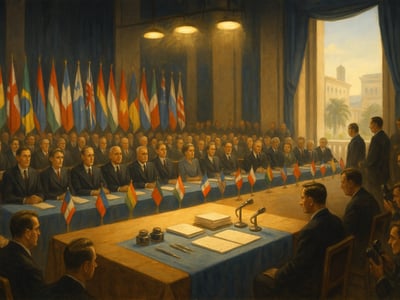
UN member states adopt the 2030 Agenda at the General Assembly in New York, 25 September 2015.
On September 25, 2015, the United Nations General Assembly adopted the 2030 Agenda for Sustainable Development at United Nations Headquarters in New York City. Approved by all 193 member states during the assembly’s seventieth session, the agreement set out 17 Sustainable Development Goals and 169 targets to guide international action through 2030. Its ambition was broad: to place poverty, health, education, inequality, environmental pressures, and international cooperation within a single common framework.
After the Millennium Goals
The adoption came at the end of a long period of discussion about what should follow the Millennium Development Goals, the development framework launched in 2000. Those earlier goals had helped concentrate global attention on issues such as extreme poverty, child mortality, and access to education. But by the early 2010s, many governments and international organizations were asking for a more expansive approach, one that reflected not only social development but also economic change, environmental sustainability, governance, and the different circumstances of countries at different income levels.
That search for a successor framework unfolded through negotiations and consultations that brought together a large range of states and institutions. The Rio+20 conference in 2012 had already pushed the process forward with its outcome document, *The Future We Want*, which called for the development of a set of sustainable development goals. From there, the post-2015 development process moved through working groups, consultations, drafts, and diplomatic bargaining. The central challenge was clear: delegates had to produce one text that 193 member states could all accept, even though they did not approach development priorities from the same position.
Bargaining a universal text
Some states emphasized poverty reduction and financing. Others focused strongly on climate, environmental protection, or sustainable consumption. Still others sought language that recognized inequality, gender issues, infrastructure, institutions, or peace-related concerns. A document that was too narrow risked excluding major priorities. A document that was too broad risked becoming unmanageable. The task was not simply to name worthy aims, but to shape them into a structure that could be recognized, cited, measured, and used across the UN system and beyond it.
The final resolution, formally titled *Transforming our world: the 2030 Agenda for Sustainable Development*, was the answer that emerged. Rather than a short declaration with general principles alone, it offered a numbered architecture: 17 goals supported by 169 associated targets. That format mattered. It translated a wide and sometimes abstract conversation about development into a framework that ministries, UN agencies, researchers, and non-governmental organizations could organize around. The list ranged from ending poverty and hunger to improving health, education, and gender equality; from water and energy to decent work, infrastructure, reduced inequalities, sustainable cities, responsible consumption, climate action, and global partnerships.
Seventeen goals, 169 targets
Several institutional figures were closely associated with the moment. Ban Ki-moon, then Secretary-General of the United Nations, had supported the push for a new post-2015 agenda and framed the summit as a major opportunity for collective action. Mogens Lykketoft, President of the seventieth session of the General Assembly, presided over the session in which the agenda was adopted. Amina J. Mohammed, who served as Special Adviser to the Secretary-General on Post-2015 Development Planning during the process, was also an important figure in shaping and advancing the negotiations that led to the agreement.
Consensus at the General Assembly did not mean that every debate had disappeared. The balance between universal goals and national circumstances remained delicate. Wealthier and poorer countries often differed on financing, technology, responsibilities, and pace. There were also practical questions about how progress would be measured, how the targets would be interpreted, and how governments would connect an international agreement to domestic policy. Yet the member states chose to endorse a universal agenda rather than settle for a looser or more fragmented set of commitments.
A framework institutions still use
That choice was significant because the agenda applied to all countries, not only to those traditionally classified as developing. In that sense, the 2030 Agenda marked a shift in how the UN described development. It treated social welfare, economic systems, and environmental limits as interconnected rather than separate policy areas. It also made comparison easier by placing them inside a shared vocabulary of goals, targets, and later indicators.
The timing of the adoption also gave 2015 a distinct place in the history of international policy. Later that same year, governments adopted the Paris Agreement on climate change. The two agreements were separate, but together they reflected an effort to define long-term international objectives in a more systematic way. The 2030 Agenda did this across a broad development landscape, setting out a framework that could be revisited in annual reviews and national reporting.
Why it still matters
The 2030 Agenda still matters because it provided a standard reference point that many institutions continue to use. Governments, UN bodies, development agencies, universities, businesses, and NGOs often organize planning and reporting with the SDGs in mind. Even where implementation differs widely, the framework offers a common language for discussing priorities and comparing efforts across sectors and countries.
Its influence also lies in its structure. By breaking broad aspirations into goals and targets, the agenda made it easier to create indicators, scorecards, progress reports, and voluntary national reviews. The High-level Political Forum and related UN reporting processes have helped reinforce that pattern. In practice, this means that the SDGs are not only a statement of intent; they are also a template for how international development policy is categorized and monitored.
The agenda’s staying power is therefore tied less to a single summit day than to the administrative system it helped create. It shows how international institutions can convert a large, contested set of global concerns into standardized policy language. Whether one studies education funding, urban planning, public health, biodiversity, or infrastructure, the imprint of the 17-goal framework is easy to find.
The adoption on September 25, 2015, was, in that sense, both a diplomatic conclusion and an organizational beginning. It closed one round of post-2000 development debate while opening a new phase in which governments and institutions would measure themselves against a shared set of objectives. Whatever judgments are made about progress toward 2030, the framework adopted that day remains one of the clearest examples of how the United Nations turns negotiation into a durable global reference.
Timeline
- UN Millennium Summit / MDGs
- Rio+20 The Future We Want
- UN adopts the 2030 Agenda
- Paris Agreement adopted
What you uncovered
A Framework in Numbers
You didn't just… complete a puzzle; you revisited the moment when 193 UN member states agreed on a shared framework for defining and tracking development goals.
The lasting significance of the SDGs is not only in the issues they name, but in the format they gave those issues. By turning development into numbered goals, targets, and indicators, the agenda made priorities easier to compare across countries and institutions. That structure helped governments, UN agencies, and NGOs translate broad ideals into reports, benchmarks, and planning tools.
The resolution adopted on 25 September 2015 was formally titled "Transforming our world: the 2030 Agenda for Sustainable Development."
FAQ
What happened on 25 September 2015 at the UN?
On 25 September 2015, the UN General Assembly adopted the resolution "Transforming our world: the 2030 Agenda for Sustainable Development" in New York. The adoption took place during the Assembly’s seventieth session at United Nations Headquarters.
Who adopted the 2030 Agenda for Sustainable Development?
The 193 member states of the United Nations General Assembly approved the agenda. Mogens Lykketoft was President of the seventieth session when it was adopted, and Ban Ki-moon was UN Secretary-General at the time.
How many goals and targets does the SDG framework include?
The framework established 17 Sustainable Development Goals and 169 associated targets. These targets were meant to be pursued by 2030.
Why is the 2030 Agenda important?
It created a shared framework that governments, UN bodies, and NGOs can use for reporting and planning. Its goal-and-target structure also made development priorities easier to measure and compare.