
About this story
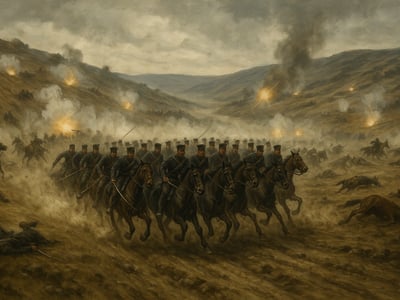
On 25 October 1854, during the Battle of Balaklava, the British Light Brigade rode down the North Valley toward Russian guns. About 670 men advanced under fire after an order passed from Lord Raglan through Lord Lucan to Lord Cardigan. The charge became a lasting case of command, confusion, and loss in the Crimean War.
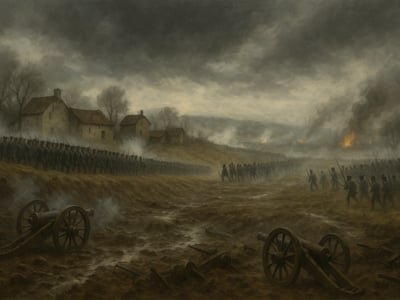
Light Brigade advance at Balaklava, Crimea, during the battle of 25 October 1854.
On October 25, 1854, during the Battle of Balaklava in Crimea, a British cavalry force later known simply as the Light Brigade rode down the North Valley toward Russian guns under heavy fire. The action lasted only a short time, but it became one of the best-known episodes of the Crimean War because it combined speed, confusion, discipline, and loss in a single dramatic movement across open ground.
A valley the commanders did not share
The battle that day unfolded within a larger Allied effort to maintain positions around the Black Sea during the Crimean War. Earlier on October 25, Russian forces had captured Ottoman redoubts that formed part of the defenses near Balaklava. Their movement altered the situation on the field and created pressure on British commanders to respond quickly. From higher ground, Lord Raglan could see more of the battlefield than some of the officers below him. That difference in viewpoint mattered.
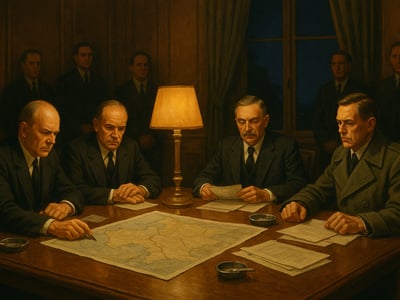
The British cavalry command structure was not simple. Raglan, the commander-in-chief, issued orders. Lord Lucan commanded the cavalry division. Lord Cardigan, his brother-in-law and a man with whom he had a difficult relationship, commanded the Light Brigade. In the middle of a changing battle, instructions had to pass through these layers of authority. Messages could be brief, and they had to be understood almost at once.
At a key moment, Raglan sent an order intended to prompt cavalry action. Captain Louis Nolan carried that order to Lucan. The exact meaning of the instruction, and the extent to which it was clear or unclear when received, became the center of later argument. Historical accounts differ over what Raglan intended, what Lucan understood, what Nolan may have indicated in person, and whether the officers involved had any real chance to resolve the ambiguity before acting.
An order carried by Nolan
What is not in dispute is the practical result. Under the interpretation adopted on the field, the Light Brigade was directed into the North Valley at Balaklava. Ahead were Russian guns; along the valley and on surrounding heights were additional enemy positions that could fire into the advancing cavalry. This was a dangerous approach for light cavalry, whose traditional battlefield roles included reconnaissance, screening, and pursuit rather than a direct frontal advance against well-supported artillery.
Lord Cardigan led the brigade forward. About 670 men took part, riding in formation under artillery fire. The scene later entered public memory through reports, memoirs, paintings, and verse, but at its center was a very physical and immediate reality: horses crossing open ground while shot and shell tore through the ranks. A cavalry charge depended on cohesion, pace, and nerve. Once committed, it was hard to halt, and under fire there was little opportunity to reshape the movement into something safer or more effective.
About 670 riders, and the guns ahead
The brigade continued down the valley and reached the area of the guns. There was close fighting at the far end, followed by withdrawal. The charge did not produce a decisive battlefield gain proportionate to its cost. Instead, it left substantial casualties among men and horses and weakened a force that had required training, equipment, and discipline to maintain. Because casualty figures can vary by source and by the way losses are counted, many historians describe the result in careful general terms rather than relying on a single number. What remains clear is that the losses were severe enough to mark the event immediately.
Responsibility became a matter of debate almost as soon as the survivors returned. Raglan, Lucan, Cardigan, and the late Nolan all figured in attempts to explain what had happened. Since Nolan was killed during the action, one possible witness to the exchange surrounding the order could not contribute to the later argument. Memoirs, official dispatches, and later histories preserved conflicting interpretations. Some emphasized an unclear written order. Others stressed the pressures of battle, personal tensions within the chain of command, or the difficulty of translating a commander’s battlefield view into instructions for subordinates who could not see the same picture.
Argument after the survivors returned
The charge also gained wide public attention because the Crimean War was fought in an age of expanding war correspondence. William Howard Russell of *The Times* reported from the campaign, and dispatches from Crimea helped carry the episode quickly to readers far from the battlefield. That mattered because the event did not remain only a military matter. It became part of public discussion about leadership, sacrifice, and the conduct of war. Reporting did not settle the facts, but it shaped which facts were remembered and how the episode was framed.
The endurance of the charge in public memory owes something to that combination of documentation and uncertainty. Many battles produce heavy losses; fewer produce a record that is both vivid and unresolved. The Charge of the Light Brigade was not remembered solely because cavalry rode bravely into danger. It was remembered because people almost immediately asked how such an attack had been ordered, what alternative actions had been possible, and whether the disaster lay in the wording of a message, the interpretation of a command, or the structure through which the command had to pass.
Why it still matters
The charge remains important in military history because it is a compact case study in how command works under pressure. A short order, issued during an active battle, passed through several hands and had to be turned into action in real time. For historians and military professionals, the episode illustrates the risks of incomplete information, differing vantage points, personal friction within a command structure, and the limits of written orders when circumstances are changing by the minute.
It also matters in the history of media. The Crimean War is often associated with the growing power of modern reporting, and Balaklava showed how quickly an event could move from battlefield dispatch to national memory. Public understanding of the charge was shaped not only by what happened in the valley, but by who described it, how soon they wrote, and which interpretations gained authority.
Finally, the episode remains a reference point in discussions of 19th-century warfare itself. It highlights the vulnerability of cavalry when advancing against concentrated artillery and supporting forces, while also showing that battlefield roles and doctrine could collide with the immediate demands of command. The Charge of the Light Brigade endures not because every question has been answered, but because the central questions about orders, perception, and consequence are still recognizable.
Timeline
- Britain declares war on Russia
- Allied army lands in Crimea
- Charge of the Light Brigade at Balaklava
What you uncovered
When Orders Shift Meaning
You didn't just… complete a puzzle; you traced how a battlefield decision could be shaped by haste, hierarchy, and interpretation before the first advance even began.
The Charge of the Light Brigade is often remembered as a moment of courage, but it also shows how military systems can fail through ordinary mechanisms rather than dramatic intent. A short order had to move through several commanders under pressure, and each step left room for emphasis, assumption, or misunderstanding. That helps explain why the event remains important in military history: not only because of the attack itself, but because it reveals how communication can become part of the battlefield.
Captain Louis Nolan carried Lord Raglan's order to Lord Lucan during the Battle of Balaklava on 1854-10-25.
FAQ
What happened during the Charge of the Light Brigade on 25 October 1854?
During the Battle of Balaklava in Crimea, the British Light Brigade advanced down the North Valley toward Russian guns. The attack followed a chain of orders and ended with substantial cavalry casualties.
Who led the Light Brigade at Balaklava?
Lord Cardigan led the Light Brigade forward at Balaklava. The order had been carried to Lord Lucan by Captain Louis Nolan.
Why did the Charge of the Light Brigade happen?
Lord Raglan issued a cavalry order on 25 October 1854, but its intended meaning and later interpretations remain contested in historical accounts. Under battlefield pressure, it was interpreted as a frontal cavalry advance.
How many men were involved in the charge?
The Light Brigade was a force of about 670 men. The charge was carried out by that brigade during the Battle of Balaklava.
Why is the Charge of the Light Brigade still remembered?
It is often used to study command chains, message transmission, and battlefield interpretation. It also became well known because William Howard Russell's dispatches for The Times helped spread public attention to the action.