
About this story
On 1 November 1755, All Saints' Day, an earthquake struck Lisbon, followed the same day by a tsunami in the Tagus and by fires that burned through the Baixa for days. Death estimates commonly run into the tens of thousands. Sebastião José de Carvalho e Melo directed the emergency and the later rebuilding. A royal charter of 12 May 1758 and the Baixa street plan of 12 June 1758 turned that response into a new city layout.
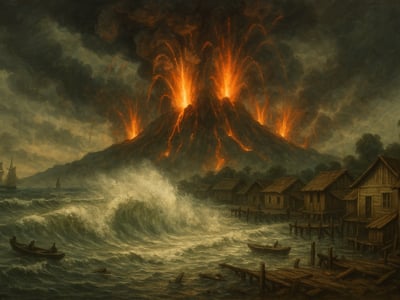
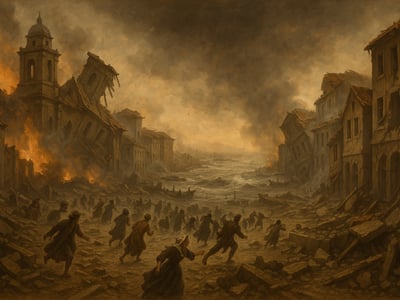
Lisbon after the earthquake of 1 November 1755, with tsunami and fires affecting the city.
On 1 November 1755, All Saints' Day, a major earthquake struck Lisbon, the capital of the Kingdom of Portugal. The timing mattered immediately. Many residents were attending religious services when the shaking began, and some of the city's churches, public buildings, and densely built streets were soon caught in a sequence of destruction that did not end with the first shock. After the earthquake came sea surges in the Tagus estuary and fires that burned through the damaged center for days. Casualty estimates vary, but they commonly reach into the tens of thousands.
A capital caught between shock, water, and fire
Mid-18th-century Lisbon was not only a royal capital but also an administrative and commercial center of a global empire. Goods, information, and people moved through its port. Government offices, churches, warehouses, and homes stood close together in districts such as the Baixa. That urban density, combined with masonry construction and narrow streets, made the city especially vulnerable once the earthquake damaged walls, roofs, and foundations.
The first challenge for those in Lisbon was simple and terrible: where to go. After severe shaking, buildings could collapse without warning, so many people fled outdoors. But open ground was limited in the crowded center. Others moved toward the waterfront, believing it to be safer than streets bordered by unstable structures. That decision exposed many of them to a second danger. Contemporary reports described the retreat and return of the water in the Tagus estuary, and the tsunami affected Lisbon's waterfront, including the Terreiro do Paço. In a matter of hours, the disaster spread from collapsing buildings to flooding and then to fire.
Fire was a particularly destructive force in the aftermath. Damaged buildings were harder to control, and a city already shaken apart offered little resistance once flames took hold. The blazes continued for several days in central Lisbon. This prolonged the emergency well beyond the earthquake itself. Rescue became more difficult, movement through the city was obstructed, and the surviving population faced not one catastrophe but several, layered one upon another.
Order, Carvalho e Melo, and a new street plan
The event also put the Portuguese state under immediate pressure. A capital city was not just a place where people lived; it was where government functioned. If public order failed, the consequences could spread far beyond Lisbon. King Joseph I survived the disaster, but the experience left a lasting mark. Sources commonly note that he afterward avoided living within masonry palace buildings, preferring other forms of accommodation rather than returning to the same kind of enclosed royal residence.
In the urgent work of response, Sebastião José de Carvalho e Melo emerged as the central official figure. He directed emergency measures in the aftermath and later oversaw reconstruction policy. His role became one of the defining political outcomes of the disaster. The immediate tasks were practical: restore order, address the dead and injured, organize food and shelter, and prevent further breakdown in the capital. In a city damaged by collapse, flood, and prolonged fire, administration itself had to be rebuilt before buildings could be.
The destruction of the Baixa and surrounding areas created a rare, grim opportunity to redesign part of a capital rather than simply repair it. Reconstruction in Lisbon became associated with a more regular urban plan, wider streets, and buildings intended to answer the lessons of the catastrophe. Later generations would connect this work especially with the rebuilt Baixa, often called the Pombaline downtown after Carvalho e Melo's later title, the Marquis of Pombal.
Seismic building and a European argument
The rebuilding effort is also linked to early attempts to think systematically about seismic risk in construction. Eighteenth-century builders did not possess modern seismology, but the disaster encouraged more deliberate attention to how structures might behave during future shocks. In historical accounts of Lisbon's reconstruction, this has made the city an important reference point in the longer story of earthquake-resistant design.
Beyond Portugal, the earthquake quickly became a European event in another sense: it entered argument, correspondence, and print. Because it struck a major Catholic capital on a major religious feast day, people debated what the event meant. Clergy, officials, and writers did not interpret it in the same way. Some framed it in religious terms, while others treated it as a problem of nature, governance, or both. The earthquake therefore became part of wider Enlightenment-era discussion about how states should respond to disaster and how people should understand suffering caused by natural hazards.
Those debates did not erase the more immediate reality of loss. Churches collapsed, homes disappeared, administrative spaces were ruined, and the port city that linked Portugal to the wider world was deeply disrupted. Even where exact numbers remain uncertain, the scale of death and displacement was enough to make the earthquake one of the defining European disasters of the eighteenth century.
Why it still matters
The Lisbon earthquake remains important because it joined several histories that are often studied separately. It was a natural disaster, but also a crisis of government, an urban planning challenge, and an intellectual event. The state's response showed how emergency administration could become a central task of rule when a capital was suddenly disabled. The rebuilding of Lisbon demonstrated that reconstruction could be organized at large scale rather than left to piecemeal repair.
It also matters because the rebuilt city became associated with early efforts to incorporate earthquake risk into construction practice. Modern engineers work with very different tools and knowledge, yet the Lisbon case still appears in discussions of how societies learn from catastrophe and translate that learning into building rules and city design.
Finally, the earthquake endured in European memory because it forced people to confront a difficult question: how should a society explain and govern disaster when the causes are natural but the consequences are shaped by human settlement, building choices, and public institutions? That question did not end in 1755, and Lisbon remains one of its clearest historical examples.
Timeline
- Earthquake, tsunami, and fires strike Lisbon
- Royal charter sets the rules for rebuilding
- Baixa street plan is approved
What you uncovered
Disaster and Reinvention
You didn't just…complete a puzzle about a destroyed city; you traced the moment when Lisbon's disaster forced officials and survivors to confront how a capital could function after earthquake, fire, and flood.
The Lisbon earthquake mattered not only because of its scale, but because it exposed how closely urban life depended on systems that could fail together. Recovery became a test of state capacity, from emergency control to rebuilding policy, while the catastrophe also fed wider debate about how natural events should be understood and governed. That combination helped make the disaster a lasting reference point far beyond Portugal.
After the disaster, Sebastião José de Carvalho e Melo directed emergency measures and the reconstruction of central Lisbon.
FAQ
What happened in Lisbon on 1 November 1755?
A major earthquake struck Lisbon, the capital of Portugal, on 1 November 1755. It was followed by a tsunami in the Tagus estuary and widespread fires in the damaged city center.
Where did the 1755 earthquake hit most severely?
The worst damage was in Lisbon, including the waterfront area around Terreiro do Paço and the Baixa district. Contemporary reports also described effects in the Tagus estuary.
Why did the Lisbon disaster include both a tsunami and fires?
The earthquake was followed by a tsunami in the Tagus estuary, and fires then burned through parts of Lisbon that had already been badly damaged. The fires continued for several days in the city center.
Who led the response after the 1755 Lisbon earthquake?
Sebastião José de Carvalho e Melo directed emergency response and reconstruction measures after the disaster. King Joseph I survived the event and later avoided living within masonry palace buildings.