
About this story
On 21 November 1783, Jean-François Pilâtre de Rozier and François Laurent d’Arlandes flew untethered from the Château de la Muette in a Montgolfier hot-air balloon. In about 25 minutes they covered roughly nine kilometres and landed near the Butte-aux-Cailles. It was the first documented free human balloon flight. Earlier that year the brothers had shown an uncrewed balloon at Annonay and an animal flight at Versailles.
The flight from Château de la Muette on 21 November 1783 lasted approximately 25 minutes.
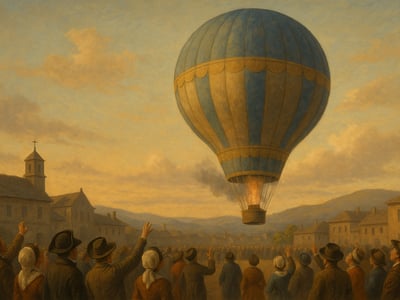
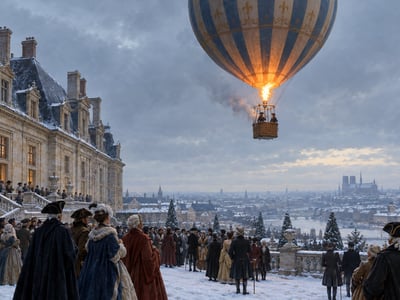
On 21 November 1783, Jean-François Pilâtre de Rozier and François Laurent d’Arlandes lifted off from the grounds of the Château de la Muette in Paris in a hot-air balloon. No tether connected their craft to the ground. Over approximately 25 minutes, they travelled an estimated nine kilometres before landing near the Butte-aux-Cailles. It was the first documented free, untethered human balloon flight.
Two men leave the tether behind
The balloon had been developed by Joseph-Michel and Jacques-Étienne Montgolfier. The brothers were its inventors, while Pilâtre de Rozier and d’Arlandes were the two occupants who took it into free flight. Their journey marked a particular threshold: people had already risen in balloons, but now they would leave the security of a tether and travel with the wind.
That departure followed a sequence of demonstrations during 1783. On 4 June, the Montgolfier brothers had publicly demonstrated a balloon at Annonay. On 19 September, another Montgolfier balloon carried a sheep, a duck and a rooster from the grounds of the Palace of Versailles. The animal flight provided a practical step between demonstrating that a balloon could rise and sending people into the air.
Annonay, Versailles, then a tethered ascent
Human ascents followed. On 15 October, Pilâtre de Rozier rose in a tethered Montgolfier balloon in Paris. A tether allowed a person to experience an ascent while the balloon remained physically connected to the ground. It also limited how far the craft could travel. Such a test could establish that the balloon would carry a person, but it could not reproduce an entire journey ending at a separate landing site.
The November flight removed that restraint. Once Pilâtre de Rozier and d’Arlandes departed from La Muette, their task was not simply to remain aboard a rising balloon. They had to keep it aloft and eventually return it to the ground in a place they could reach safely.
Fire under the envelope
The means of maintaining lift was an onboard fire. Heating the air inside the balloon made it less dense than the surrounding air, allowing the craft to rise. As the air cooled, its lifting effect diminished. The occupants therefore had an active role throughout the flight: they tended the heat source beneath the balloon rather than merely riding in a sealed vessel.
This arrangement placed two needs in tension. The fire was essential to flight, yet it burned beneath a combustible balloon envelope. Too little heat could bring an early descent; fire damage could threaten the structure that held them aloft. Managing the heat source was consequently both a means of sustaining flight and an immediate safety concern.
Lift without a way to steer
Their influence over the journey also had limits. They could affect lift through heating, but the balloon had no mechanism for steering an independent course across Paris. Its horizontal movement depended on the wind. Keeping a balloon in the air and directing it towards a chosen destination were separate technical problems, and this flight demonstrated the first without resolving the second.
After roughly 25 minutes, the journey ended near the Butte-aux-Cailles, in what is now Paris’s 13th arrondissement. The estimated distance was about nine kilometres. Those figures describe a short passage over the city, not a long-distance expedition. Its importance lay in completing the whole sequence: departure without a tether, sustained flight with people aboard, and a landing elsewhere.
Why it still matters
The events of 1783 show technological development proceeding through distinct tests. An uncrewed demonstration established one capability; an animal flight addressed another set of practical questions; tethered human ascents introduced people while retaining a physical restraint. Free flight then required the occupants to deal with a journey that could no longer be ended simply by keeping the balloon attached to its launch site.
That sequence should not be mistaken for a guarantee of safety. Each stage left questions that the next could only partly answer. Nevertheless, it makes the achievement easier to understand than a story centred on a single sudden invention. The November departure depended on a balloon that had been developed and tested, as well as on people prepared to operate it in flight.
The event also explains why historical aviation records use precise categories. A balloon ascent is not necessarily a human ascent, and a human ascent is not necessarily an untethered flight. Describing 21 November as the first documented free, untethered human balloon flight preserves its significance without overlooking the demonstrations that preceded it.
Pilâtre de Rozier and d’Arlandes did not establish a steerable air transport system during their brief journey. They demonstrated something more bounded: two people could leave the ground in a hot-air balloon, remain aloft without a tether and land at another location. The flight over Paris made that possibility a documented achievement, while leaving the problem of reliable navigation for further work.
Timeline
- Montgolfier demonstration at Annonay
- Animal flight at Versailles
- Tethered human ascent in Paris
- First free human balloon flight
- Hydrogen balloon flight in Paris
What you uncovered
The Limits of Control
You didn't just complete a puzzle; you revisited the practical challenges behind an early human journey through the air.
Managing heat gave the occupants influence over lift, but not the ability to choose a course independently of the wind. This distinction shows why getting an aircraft into the air and navigating it are separate engineering problems. A successful flight could demonstrate one capability without solving the other.
On 19 September 1783, a Montgolfier balloon carried a sheep, a duck, and a rooster from the grounds of the Palace of Versailles.
FAQ
What happened on 21 November 1783?
On 21 November 1783, Jean-François Pilâtre de Rozier and François Laurent d’Arlandes made the first documented free, untethered human balloon flight. They flew in a Montgolfier hot-air balloon over Paris.
Who built the balloon and who flew in it?
The balloon was developed by Joseph-Michel Montgolfier and Jacques-Étienne Montgolfier. The two occupants were Jean-François Pilâtre de Rozier and François Laurent d’Arlandes.
How did the Montgolfier balloon stay aloft?
During the flight, the occupants tended an onboard fire to heat the air, which provided lift. The balloon’s movement depended on the wind rather than a steering mechanism.
Where did the flight begin and end?
It departed from the Château de la Muette in Paris, France. The journey ended near the Butte-aux-Cailles after about 25 minutes and an estimated 9 kilometres.