
About this story
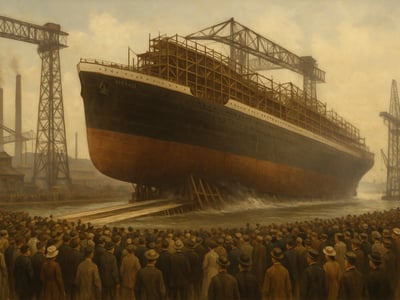
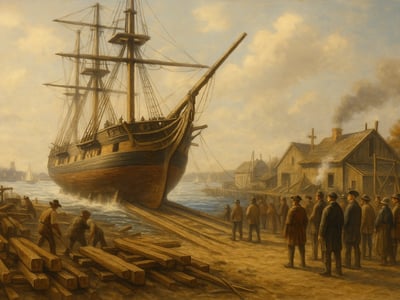
On 21 October 1797, the frigate USS Constitution entered the water at Edmund Hartt’s shipyard in Boston. Congress had authorized six frigates in the Naval Act of 27 March 1794, and George Washington signed their names on 1 March 1797. The launch showed the early republic could turn a naval law into a ship.
USS Constitution at its launch in Boston on 21 October 1797.
On October 21, 1797, the frigate USS *Constitution* was launched at Edmund Hartt's shipyard in Boston, Massachusetts. The moment marked more than the completion of a large wooden warship. It showed that the early United States, still shaping its institutions in the 1790s, was willing and able to carry out a federal plan for a permanent navy. In practical terms, the launch connected legislation passed in Congress, decisions made by President George Washington's administration, and the work of designers, shipwrights, and laborers on the Boston waterfront.
Six frigates, one federal decision
The ship belonged to a larger national project. On March 27, 1794, Congress passed the Naval Act of 1794, authorizing six frigates for the United States Navy. At the time, the United States had strong commercial interests at sea but only limited means to protect them. Debates over whether the country needed a standing navy had been serious and prolonged. A permanent naval force required money, administrative coordination, and political agreement in a republic that was still young and cautious about centralized power.
The frigates authorized by the act were intended to answer that need. Rather than producing a large battle fleet, the government committed itself to a small number of substantial warships. Their design is closely associated with Joshua Humphreys, who prepared the principal plans for the frigates authorized under the 1794 law. Humphreys favored vessels that would be strong, fast, and capable of carrying heavy armament for their class. The result was not just another shipbuilding program, but an attempt to create warships suited to the strategic realities of the Atlantic world.
Humphreys’ plan for a heavier frigate
Like any federal project in the 1790s, this one depended on more than a law and a drawing. It required timber, iron, skilled labor, contracts, supervision, and time. Constitution was built in Boston at Edmund Hartt's shipyard under the oversight of local master builders and naval authorities. Josiah Fox was also involved in the design process associated with the frigate program. The work unfolded within the limits of an administrative system that was still developing its routines and capacities. In that sense, launching the ship was also a test of the government's ability to turn policy into material results.
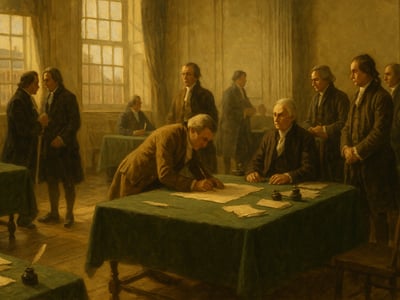
Naming mattered too. On March 1, 1797, George Washington signed the law that assigned names to the six frigates: *United States*, *Constitution*, *Constellation*, *Chesapeake*, *Congress*, and *President*. These names reflected the political vocabulary of the new republic. They linked the ships not to dynasties or provinces, but to national institutions and ideas. By the time Constitution reached the water in October of that year, it carried not only guns and timbers but also a clear federal identity.
Names for a republic, not a dynasty
The launch itself was a public and technical milestone. A vessel of Constitution's size required careful preparation to move safely from the ways into the water. The event in Boston Harbor signaled that one of the original six frigates had passed from shipyard construction into the next phase of its existence. Launching did not mean that all work was finished; fitting out a warship remained a substantial task. But a launch was still the clearest visible proof that years of authorization, planning, procurement, and labor had produced something real.
That mattered in the political setting of the late 1790s. The United States did not yet possess the long-established naval administration of European maritime powers. Every stage of the frigate program involved questions of cost, capability, and necessity. Had the effort failed, critics could have pointed to the program as evidence that the government had overreached. Instead, Constitution's launch demonstrated continuity from congressional authorization in 1794 to an operational shipbuilding result in 1797.
Boston sees the hull enter the water
The vessel would later become far better known because of its service, especially in the War of 1812. Yet the launch deserves attention on its own terms. Before any later fame, Constitution was part of a broader experiment in institution building. The federal government was testing whether it could support a durable maritime arm, and Boston's shipbuilding industry was one of the places where that test took physical form.
Why it still matters
The launch of USS *Constitution* still matters because it captures an early moment when federal legislation became permanent military infrastructure. Histories of the early United States often focus on constitutions, elections, and diplomatic disputes, but ships like Constitution reveal another side of state formation: the ability to fund, organize, and complete complex material projects.
The ship also ties together several fields of history that are often studied separately. It belongs to naval history, but also to the history of industry, labor, and design. Its construction at Edmund Hartt's shipyard shows how national policy depended on local expertise. The frigate program brought together lawmakers, naval planners, designers such as Joshua Humphreys, and skilled workers who translated plans into timber, hull form, and rigging.
Constitution's survival adds another reason for its continuing relevance. As an original U.S. Navy vessel that still exists, it serves as a rare link between the early republic and the present. Preservation of the ship has made it part of public history as well as naval heritage. Visitors can encounter not just an abstract story about government policy in the 1790s, but a surviving object that came out of that policy.
For that reason, the launch in Boston on October 21, 1797, remains significant beyond the narrow history of one warship. It marks a point at which a young republic showed that its laws, resources, and shipyards could be aligned to build an enduring institution at sea.
Timeline
- Naval Act authorizes six frigates
- Washington signs the frigate names
- USS Constitution launched in Boston
What you uncovered
Building a Navy on Paper and Wood
You didn't just…assemble a ship image; you traced a moment when federal plans, local labor, and naval ambition had to become something real in the water.
The launch of Constitution can be read as a practical test of state capacity in the early republic. Passing a law was one step, but turning legislation into a large, seaworthy warship required coordination across design, funding, materials, and skilled work. That makes the event less about a single vessel alone than about whether the new federal government could sustain permanent institutions beyond paper decisions.
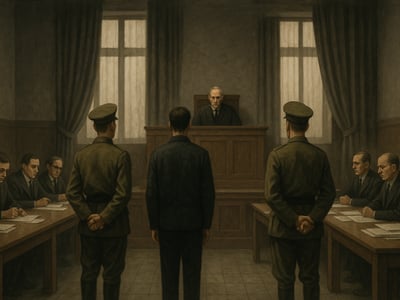
On 1 March 1797, George Washington signed the law assigning the names United States, Constitution, Constellation, Chesapeake, Congress, and President to the six authorized frigates.
FAQ
When was USS Constitution launched?
USS Constitution was launched on 21 October 1797. The launch took place in Boston, Massachusetts.
Where was USS Constitution built and launched?
It was built at Edmund Hartt's shipyard in Boston, Massachusetts. The ship was launched there into Boston Harbor.
Why was USS Constitution built?
USS Constitution was one of six frigates authorized for the early United States Navy under the Naval Act of 1794. The new federal government was building a permanent naval force and needed capable warships.
Who designed USS Constitution?
Joshua Humphreys prepared the principal design for the frigates authorized under the 1794 act, including Constitution.