

About this story
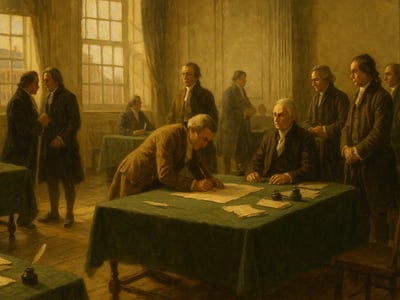
On 17 September 1787, 39 delegates in Philadelphia signed the proposed U.S. Constitution at the Pennsylvania State House, closing a summer of negotiation under George Washington. The Connecticut Compromise in July had balanced large and small states. Signing started ratification, not an instant government.
Philadelphia delegates signed the proposed U.S. Constitution on 17 September 1787.
On September 17, 1787, delegates at the Constitutional Convention in Philadelphia signed the proposed Constitution of the United States at the Pennsylvania State House. The signing did not create an operating government in a single stroke, nor did it end disagreement. Instead, it marked the close of a long summer of negotiation and the beginning of another political test: whether the states would accept a new framework to replace the Articles of Confederation.
A convention to replace the Articles
The convention had opened months earlier, on May 25, 1787, with George Washington chosen to preside. Delegates had come to Philadelphia because the existing national arrangement was widely seen as too weak. Under the Articles of Confederation, the central government had limited power and struggled to manage finance, interstate questions, and coordinated policy. But recognizing weakness was easier than agreeing on a remedy. The states differed in size, economy, and regional interest, and those differences shaped nearly every major debate.
From the start, the central question was whether the convention would merely revise the Articles or create something fundamentally new. That decision carried risk. A revised system might preserve familiar arrangements but fail to solve structural problems. A new constitution, however, could provoke resistance from states wary of losing influence. Delegates therefore had to design institutions strong enough to govern while still acceptable to a wide range of political interests.
Competing plans made those differences clear. Larger states tended to favor representation based on population, while smaller states feared domination by their neighbors. On June 15, William Paterson presented the New Jersey Plan, which offered an alternative to proposals that would have given more weight to populous states. The debate was not only technical. It concerned the basic question of how a union of unequal states could share power without coming apart.
Representation and hard compromises
A decisive step came on July 16, when delegates adopted what became known as the Connecticut Compromise. It combined proportional representation in one chamber of Congress with equal representation of states in the other. This did not settle every dispute, but it created a structure many delegates could live with. The compromise showed the convention's recurring pattern: positions were stated firmly, objections were real, and agreement emerged not from unanimity but from institutional balancing.
Other issues were harder still. The Constitution that emerged rested on major compromises, including those connected to slavery and representation. Those choices were central to the document's formation and cannot be separated from its history. The convention's work was therefore both a political achievement and a record of limits: a framework broad enough to win support, but shaped by exclusions and concessions that would have lasting consequences.
Thirty-nine signatures in Philadelphia
As summer turned toward autumn, delegates also defined the overall architecture of government. The proposed Constitution established separate legislative, executive, and judicial branches within a federal system. This structure was intended to distribute power rather than concentrate it in one place. The text associated with the convention's final draft was shaped in part by Gouverneur Morris, whose committee work helped give the document much of its final language, while figures such as James Madison, Roger Sherman, Benjamin Franklin, and others contributed through debate, drafting, and compromise.
When the final day arrived, the atmosphere was formal but not triumphant in any simple sense. Not every delegate approved. Some had already left the convention, and a few present refused to sign. In the end, 39 delegates signed the document on September 17. Franklin, one of the oldest participants, is often remembered for urging his colleagues to doubt their own infallibility and support the plan despite imperfections. That attitude captured the logic of the moment: the Constitution was presented not as a flawless design, but as a workable one.
From the hall to the states
The signing itself was only one stage in a larger constitutional process. On September 28, 1787, the Confederation Congress voted to transmit the proposed Constitution to the states for ratification conventions. That step mattered because the new frame of government would not take effect automatically. It required approval beyond the convention hall. Public arguments would now move into newspapers, pamphlets, and state debates, where supporters and opponents would test whether the compromises made in Philadelphia could survive outside it.
In that sense, the significance of September 17 lies partly in what it did not settle. The delegates had managed to produce a document where failure had been entirely possible. The convention could have broken apart over representation, executive power, or the balance between state and national authority. Instead, it produced a proposal. But whether that proposal would become the governing charter of the United States remained uncertain until ratification advanced in the months that followed.
Why it still matters
The signing of the Constitution remains important because it shows that founding documents are often the product of procedure as much as principle. The delegates did not simply announce a new political order. They worked through plans, counterplans, committees, and compromises, then submitted the result to a formal ratification process. Written constitutions, in this view, are mechanisms for channeling conflict into institutions rather than eliminating conflict altogether.
The structure outlined in 1787 has also had a long afterlife in legal and political thought. Its division of powers among legislative, executive, and judicial branches, and its distribution of authority between national and state governments, became enduring reference points in constitutional design and comparative study. Even where other countries adopted different solutions, the American example became part of a wider discussion about how governments can be limited, organized, and legitimated through a written charter.
Just as important, the events of 1787 show that constitution-making does not end with drafting. Ratification was essential. The proposed text had to move from a closed convention to public political approval at the state level. That sequence remains historically instructive: durable constitutional systems often depend not only on what is written, but also on the process by which people and institutions accept it.
The signatures in Philadelphia therefore marked neither a perfect consensus nor a final resolution of national conflict. They marked the moment when a negotiated text, shaped by both political creativity and serious moral compromise, was sent out into the uncertain world of ratification. That is why September 17, 1787, continues to be remembered: not merely as the day a document was signed, but as the point when a proposed system of government moved from debate among delegates to judgment by the states.
Timeline
- Constitutional Convention opens in Philadelphia
- Connecticut Compromise adopted
- 39 delegates sign the Constitution
- Confederation Congress sends it to the states
What you uncovered
Compromise in Written Form
You didn't just… complete a puzzle; you traced a moment when months of bargaining and procedural choices were condensed into a document sent forward for ratification.
The signing can look like a single founding scene, but it was really the visible end of a longer process of institutional trade-offs. What mattered was not only agreement on broad principles, but agreement on procedures, representation, and how conflict would be managed after the convention ended. That helps explain why constitutions are often less about perfect consensus than about creating rules durable enough for disagreement to continue within them.
On 28 September 1787, the Confederation Congress voted to send the proposed Constitution to the states for ratification conventions.
FAQ
What happened on 17 September 1787?
On 17 September 1787, 39 delegates signed the proposed Constitution of the United States at the Pennsylvania State House in Philadelphia. The document then went to the states for ratification.
Where was the U.S. Constitution signed?
It was signed at the Pennsylvania State House in Philadelphia, Pennsylvania. The Constitutional Convention had been meeting there that summer.
How many delegates signed the Constitution?
Thirty-nine delegates signed the Constitution on 17 September 1787. Not every delegate at the convention signed the document.
What happened after the Constitution was signed?
On 28 September 1787, the Confederation Congress voted to transmit the proposed Constitution to the states for ratification conventions. State approval was still needed before it could take effect.