
About this story
July 1918 protest in Handlová after wartime shortages led to a deadly crackdown.
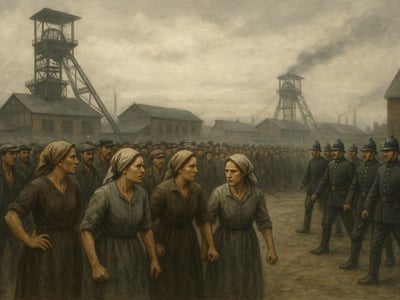
On 24 July 1918, in the mining town of Handlová, then in the Kingdom of Hungary within Austria-Hungary, a protest driven by wartime shortages ended in deadly gunfire. After several days of unrest over the lack of food and other basic necessities, gendarmes opened fire on demonstrators. Two women were killed and seven more were wounded.
The violence in Handlová came during the final year of the First World War, when shortages were affecting daily life across Austria-Hungary. By 1918, the strain of war had reached deep into industrial towns as well as large cities. Food distribution was failing, prices were rising, and families who depended on wages from heavy labor still struggled to secure bread and other essentials. In a mining community, where work was physically demanding and household survival depended on regular supply, those pressures could become immediate and visible.
Handlová was one of the places where that pressure turned into open protest. The immediate cause was not a dispute over abstract politics or distant military events, but the practical question of how families were supposed to live when food and basic goods were scarce. In such circumstances, protest emerged from household need as much as from workplace grievance. The people most directly managing that daily crisis were often women, especially miners' wives and other women tied to mining households.
In July 1918, women associated with local miners took a step that pushed the unrest beyond complaint. They damaged mining equipment in order to stop work from continuing. That act mattered because it connected domestic desperation to the operation of the mine itself. If the town's families were being forced to endure shortages without relief, then the smooth running of industrial production could also be interrupted. What began as a protest over provisioning became direct action at the workplace.
Miners then joined the protest, widening its character. The unrest was no longer only a gathering of women demanding relief but a broader confrontation involving the labor force of the town. In a mining settlement, that shift carried weight. Mines depended on order, routine, and the authority of management and the state. Once workers and their families acted together to halt or disrupt operations, the issue became both social and political in the eyes of the authorities.
The confrontation did not end at once. It continued for several days, suggesting both the seriousness of the shortages and the determination of those involved. The authorities were facing unrest at an operating mining site in wartime, a situation they were unlikely to view as tolerable. Late Habsburg rule increasingly relied on policing to contain disorder, especially when shortages, labor conflict, and public anger began to overlap.
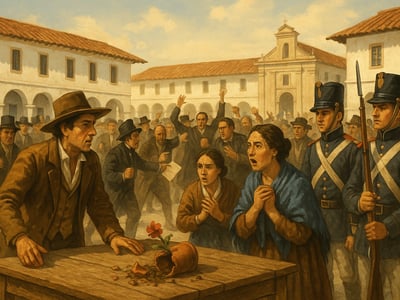
By 24 July, the protest met armed state force directly. Gendarmes fired on the crowd in Handlová. The known outcome is stark: two women were killed, and seven women were wounded. Even in a period marked by war and widespread hardship, that fact stands out. The dead and wounded were not soldiers on a battlefield but civilians involved in a protest tied to survival and work.
The available facts establish the sequence clearly: shortages led to unrest, women damaged equipment to stop work, miners joined them, the protest continued for days, and gendarmes eventually used gunfire. What is harder to recover in full is the texture of the moment for those in the crowd—the fear, anger, and calculation that came with confronting armed authority. Yet the event is still legible in its essentials. It was a local crisis created by larger wartime breakdowns, and it showed how quickly the boundary between social protest and violent repression could collapse.
The setting also matters. In July 1918, Austria-Hungary was nearing its end, though the empire had not yet collapsed. Across its territories, state institutions were under severe strain. Supply failures, labor unrest, and weakened legitimacy were not isolated problems but connected signs of a system under pressure. Handlová was a small place within that much larger story, but its experience reflected the broader instability of the final wartime months.
Why it still matters
The Handlová protest remains important because it shows how shortages can transform private hardship into public confrontation. Hunger and the lack of basic supplies did not stay inside the home. They spilled outward into streets, workplaces, and clashes with authority. In that sense, the event helps explain how wartime economies could produce unrest that was at once social, industrial, and political.
It also matters because women were central to what happened. In many accounts of labor history, women appear at the edge of industrial conflict, supporting families while men occupy the visible space of the strike or protest. Handlová shows a different pattern. Women did not simply endure shortages; they acted directly, intervening at the mine itself and shaping the course of the unrest.
Finally, the shooting in Handlová offers a local example of how late Austro-Hungarian authorities responded when civilian protest threatened order during the empire's final year. The deaths of two women and the wounding of seven others reveal the human cost of that response. The event belongs not only to local or mining history, but also to the wider history of how war strained society from within long before formal political collapse was complete.
Remembered at the local level, the protest in Handlová stands as a concise record of a larger truth about 1918: the end of empires was experienced not only in parliaments and battle reports, but also in working towns where families faced scarcity, workers resisted, and the state answered with force.
Timeline
- Wartime food shortages in Austria-Hungary
- Labor unrest in mining communities
- Women in provisioning protests
- Gendarmerie response to civilian protest in late Habsburg territories
- Social conditions in Upper Hungary
- Handlová protest and gendarme shooting
What you uncovered
When Hunger Reached the Mine
You didn't just… complete a puzzle; you traced how a crisis of food and daily survival spilled into the workplace and ended in deadly repression.
What makes the Handlová protest striking is how quickly the line between home and industry disappeared. When food shortages made household survival precarious, women did not remain outside the story of labor unrest; they acted at the mine itself, where wages, production, and family subsistence were tied together. That helps explain why a protest over provisions could become a confrontation over industrial control and public order. In the final year of Austria-Hungary, local scarcity was no longer only a private hardship but a pressure point in the wider wartime system.
On 24 July 1918, gendarmes fired on protesters in Handlová, killing two women and wounding seven others.
FAQ
What happened in Handlová on 24 July 1918?
On 24 July 1918, gendarmes opened fire on protesters in Handlová after several days of unrest. The protest had begun in response to wartime shortages of food and basic necessities.
Why did the Handlová protest break out in July 1918?
It was driven by wartime shortages of food and other basic supplies in the mining town. The unrest continued for several days before the shooting on 24 July 1918.
What role did women play in the Handlová protest?
Women associated with local miners damaged mining equipment to stop work from continuing. Their action was part of the protest over shortages and was later joined by miners.
Who was killed when gendarmes fired on protesters in Handlová?
Two women were killed and seven women were wounded. The shooting happened on 24 July 1918 during the suppression of the protest.